AI Desk Card
A secondary e-ink desk display designed for AI Agents like Claude Code and Codex, utilizing the M5Paper V1.1 hardware. The project features a Python-based daemon for server-side rendering and an ESP32 firmware that supports Wi-Fi, BLE, and USB communication.
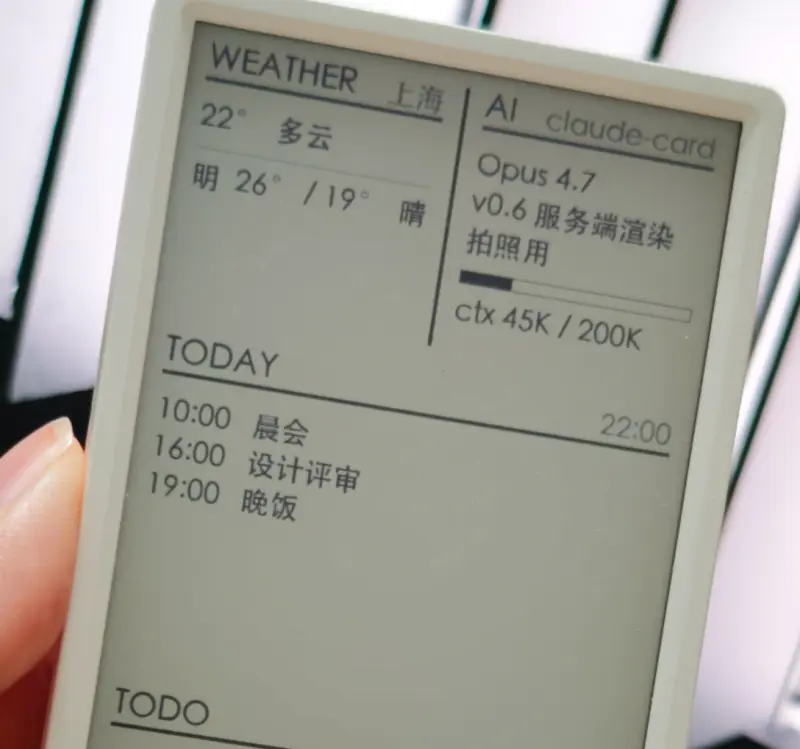
The AI Desk Card is an innovative project that bridges the gap between digital AI agents and physical ambient displays. Designed specifically for the M5Paper V1.1—a 4.7-inch e-ink device—it serves as a dedicated “Skill” for agents like Claude Code, Codex, and Cursor. Instead of forcing users to manage firmware updates or manual configuration, the project leverages the power of AI agents to handle the entire lifecycle, from compiling code via PlatformIO to configuring Wi-Fi credentials.
Architecture and Rendering
At its core, the system uses a server-side rendering architecture. A Python-based daemon runs on the host machine, utilizing the Pillow library to render pixel-perfect frames for various widgets. This approach keeps the ESP32 firmware lightweight, as it only needs to receive and display image data via HTTP, USB, or BLE. This decoupling allows for rapid development of new widgets—such as weather, calendars, PR queues, and system monitors—without needing to modify the C++ firmware.
The firmware itself is built on the Arduino framework for ESP32, utilizing FreeRTOS for task management. It relies on the LittleFS filesystem to store essential assets, including CJK fonts for proper international character rendering. Communication is handled through a local LAN connection (LWIP) or a specialized BLE standby mode.
Advanced Power Management
One of the standout features is its sophisticated power management, categorized into three distinct modes:
- Mode A (Always-on): USB-C powered with continuous Wi-Fi connectivity for ultra-low latency updates (0.2s).
- Mode B (USB Only): Standard wired data transmission, useful for initial setup before Wi-Fi is configured.
- Mode C (Battery + BLE Standby): The most efficient mode, where the Wi-Fi is powered down and the device waits for a BLE wake-up signal from the daemon. This leverages the inherent strengths of e-ink technology, providing up to six months of battery life while maintaining a persistent ambient presence on the desk.
AI Agent Integration
The integration with AI agents is seamless. By adding the repository as a skill, users can interact with their desk card using natural language. Commands like “Show the weather in Beijing” or “Put my schedule on the card” trigger automated workflows that handle data fetching, rendering, and transmission. The project includes 16 built-in widgets, covering everything from Git status and PR queues to focus timers and “now playing” information.
The display uses a flexible 2-1-1 layout, allowing for multiple slots (top-left, top-right, middle, and bottom) to be populated with different data sources. This turns a piece of hardware into a dynamic extension of the developer’s workspace, providing glanceable information without the distraction of a traditional backlit monitor.
Related Projects
ESP32 AI Mini Screen
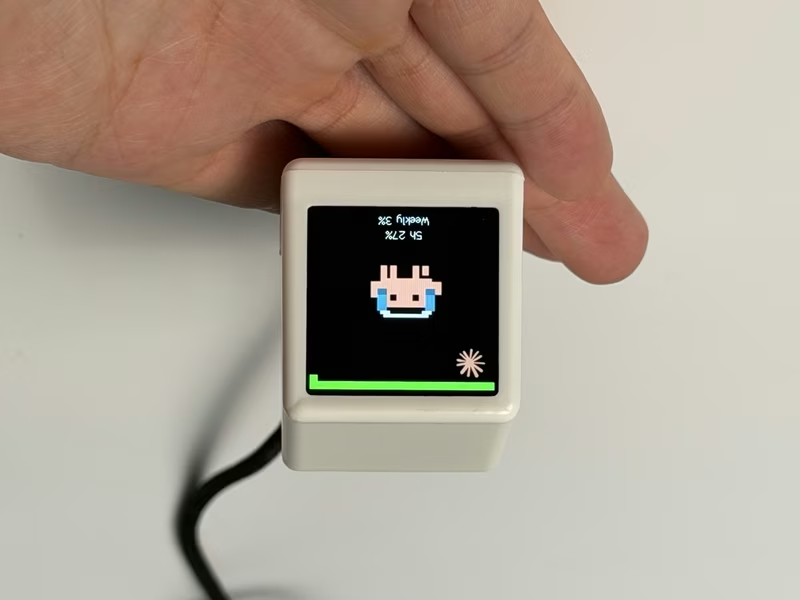
A retro-styled desktop companion for ESP32-C3 and ESP8266 that monitors AI coding assistant usage, stock markets, and system telemetry. It leverages the Arduino framework with TFT_eSPI and AnimatedGIF libraries to display real-time data provided by a local bridge application.
Clawdmeter Plus
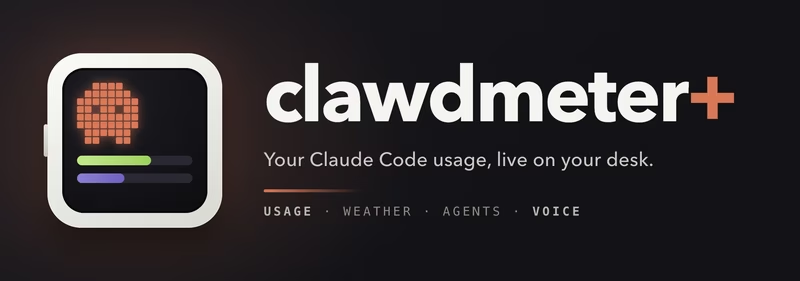
An embedded desk display project using the Waveshare ESP32-S3-Touch-AMOLED-2.16 to track live Claude Code usage, local weather, and background agent health. The system leverages the LVGL graphics library for its UI and connects to a host computer via Bluetooth LE using the NimBLE stack.
Clawdmeter
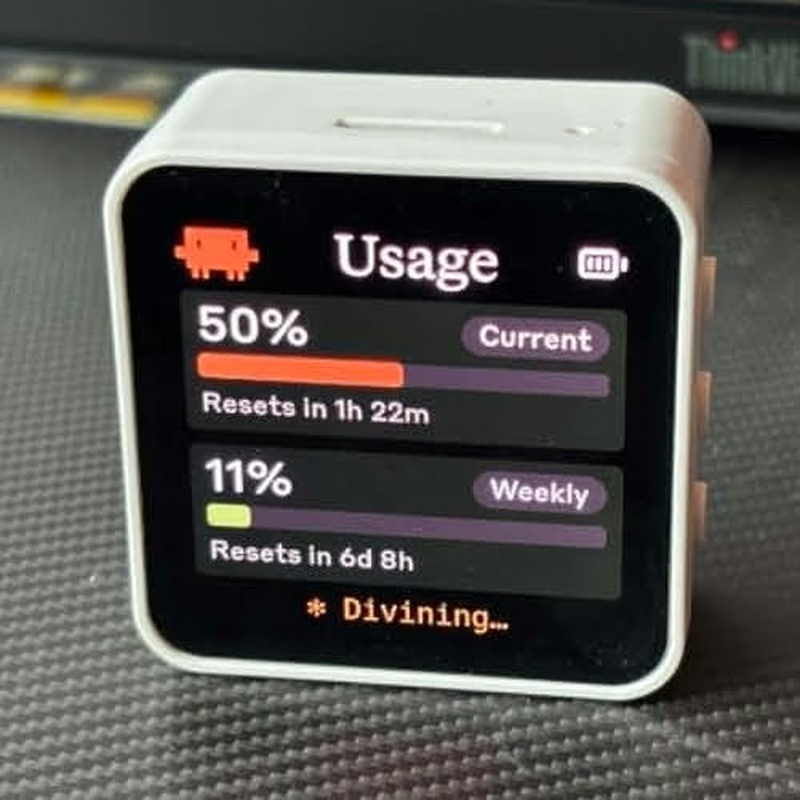
Clawdmeter is an ESP32-S3-powered desk dashboard that monitors Claude Code token usage and displays it on a 2.16" AMOLED screen. It uses the LVGL library for its high-resolution UI and the NimBLE stack to communicate with a host daemon via BLE, while also functioning as a HID keyboard for shortcuts. The project features dynamic pixel-art animations that react to real-time API utilization rates.
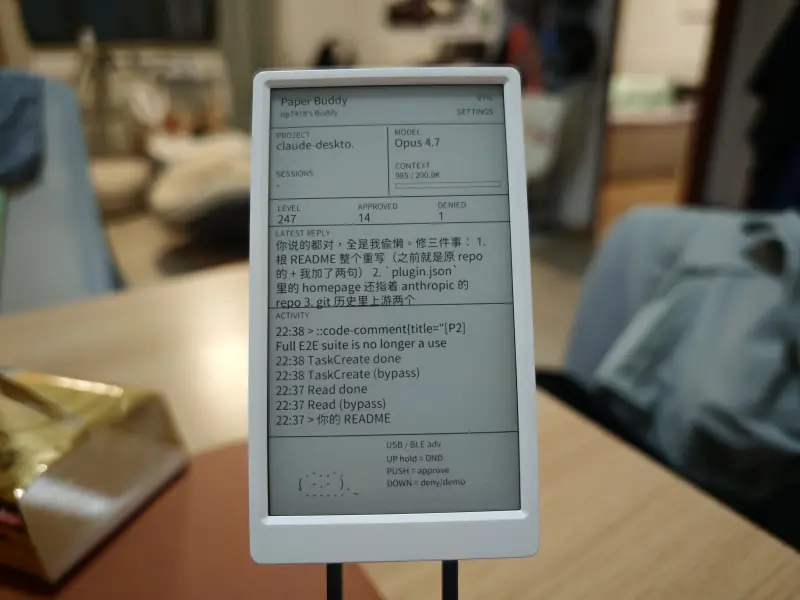
M5Paper Buddy
A physical companion device for the Claude Code AI assistant, utilizing the M5Paper V1.1 e-ink display. It features real-time session mirroring, hardware-based tool approval, and touch-screen interactions powered by ESP32 and a Python-based daemon.
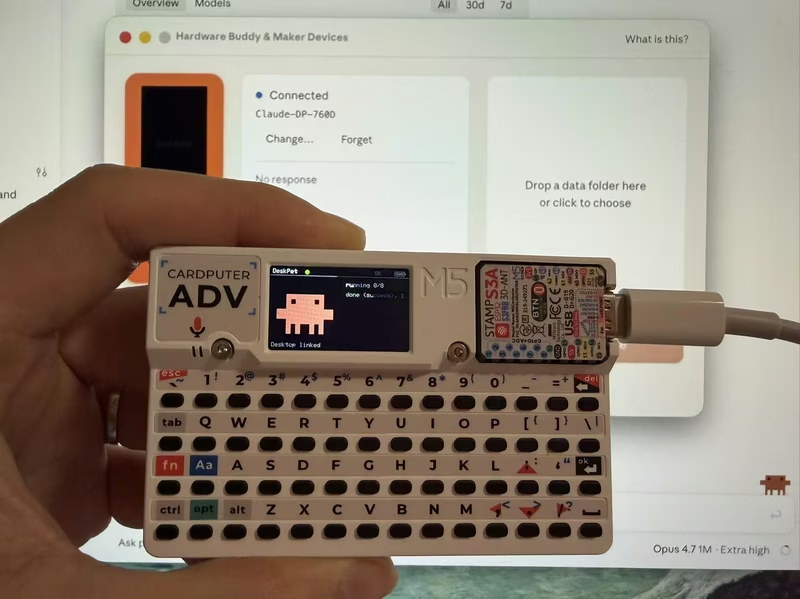
DeskPet for M5Stack Cardputer
DeskPet is a pixel-art companion for the M5Stack Cardputer that synchronizes with Claude Code sessions via Bluetooth Low Energy (BLE). Built on the ESP32-S3 using the NimBLE stack and ArduinoJson, it provides real-time visual feedback and hardware-based command approval for AI agent workflows.
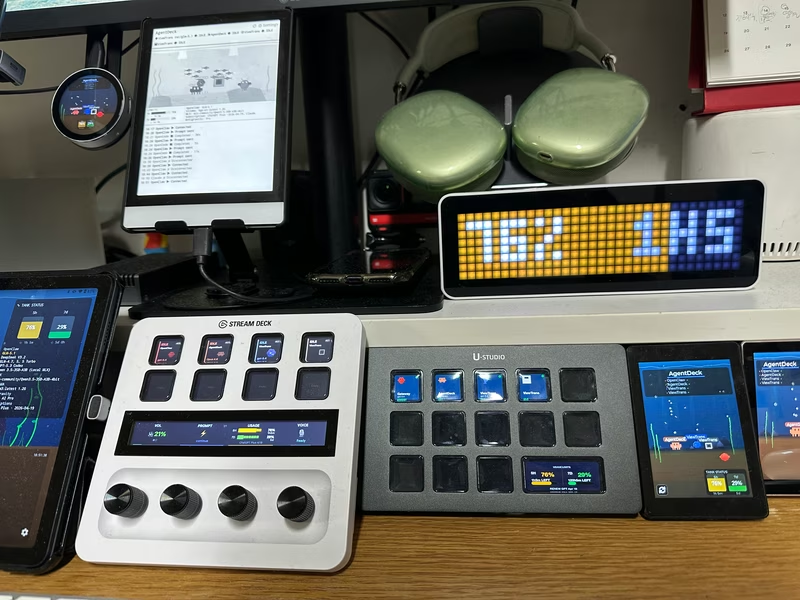
AgentDeck
AgentDeck is a multi-surface physical control interface for AI coding agents, enabling real-time steering of agents like Claude Code and Codex via hardware. It supports 13 different display surfaces simultaneously, utilizing a Node.js or Swift-based bridge to coordinate between terminal-based agents and devices like the Stream Deck+, Android tablets, and ESP32 displays. The system includes a sophisticated performance evaluation framework (APME) that uses local SQLite storage to track and optimize agent efficiency.