littlefs
v2.11.3Features
-
Power-loss resilience with strong copy-on-write guarantees for all file operations.
-
Dynamic wear leveling across flash blocks to extend storage lifespan.
-
Bad block detection and automatic workaround capabilities for NAND/NOR flash.
-
Strictly bounded RAM and ROM usage that remains constant regardless of filesystem size.
-
Elimination of unbounded recursion to prevent stack overflow in constrained environments.
-
Configurable, potentially static buffers to avoid dynamic memory allocation.
-
Full POSIX-like API for file and directory management.
-
Atomic POSIX operations including file removal and renaming.
-
Metadata stored in small logs called metadata pairs for efficient, low-latency updates.
-
File data stored in copy-on-write structures to prevent wear amplification.
-
C99 compliant source code for maximum portability across embedded compilers.
-
Support for multiple simultaneous filesystem instances via user-allocated state structures.
-
Data integrity verification through read-back checks during write operations.
-
Customizable block device interface for read, program, erase, and sync operations.
-
Support for custom error codes returned from underlying block device drivers.
-
Integrated test suite for PC/Linux environments using emulated block devices.
Architecture
littlefs is architected as a block-based filesystem utilizing a “two-layered cake” design to balance performance and reliability. The first layer consists of metadata pairs, which are small logs used to store directory information and file metadata. These logs allow for fast, frequent updates to metadata anywhere on the storage medium without requiring large-scale erases. The second layer uses larger copy-on-write (COW) structures to store actual file data, ensuring that data is stored compactly and that updates do not cause unnecessary wear amplification.
At the core of the system is a common block allocator that services both metadata and data structures. This allocator implements dynamic wear leveling by tracking and limiting the number of erases allowed on a block per allocation cycle. The system is designed to be entirely reentrant and supports multiple instances by requiring the user to provide the state storage (lfs_t) and configuration (lfs_config). This design ensures that RAM usage is strictly bounded and predictable, as the filesystem does not use recursion or unbounded dynamic memory allocation.
Use Cases
This library is ideal for:
- IoT Edge Devices: Systems requiring high reliability during unpredictable power cycles or battery failures.
- Data Logging: Applications that need to write data frequently to flash while maximizing the lifespan of the hardware through wear leveling.
- Embedded Firmware Storage: Storing system configurations and firmware images where corruption could lead to device bricking.
- Resource-Constrained MCUs: Microcontrollers with very limited RAM (e.g., <10KB) where a traditional filesystem would be too heavy.
- NAND/NOR Flash Management: Devices using raw flash chips that require manual bad block management and wear leveling.
Getting Started
To integrate littlefs, developers must first define a lfs_config structure that specifies the block device dimensions (read size, program size, block size, and count) and provides function pointers for the hardware-specific read, prog, erase, and sync operations. Once the configuration is defined, the filesystem can be initialized using lfs_mount. If the mount fails (common on first boot), lfs_format can be called to create a fresh filesystem.
Detailed API documentation is located within the lfs.h header file. For developers looking to port the library, the DESIGN.md and SPEC.md files in the repository provide deep dives into the on-disk format and architectural tradeoffs. Testing can be performed on a development PC using the provided emulated block device and the Python-based test runner found in the scripts directory.
Related Projects (176)
View All 176 Projects →SW32 - 4 Channel E-Stim
The SW32 is a modern 4-channel E-Stim box powered by a dual-processor architecture featuring an RP2040 and an ESP32. It provides isolated outputs, a color display, and versatile control via USB, Bluetooth, or Wi-Fi, utilizing FreeRTOS through the ESP-IDF framework alongside the SPIFFS and littlefs filesystems.
M5Paper Buddy
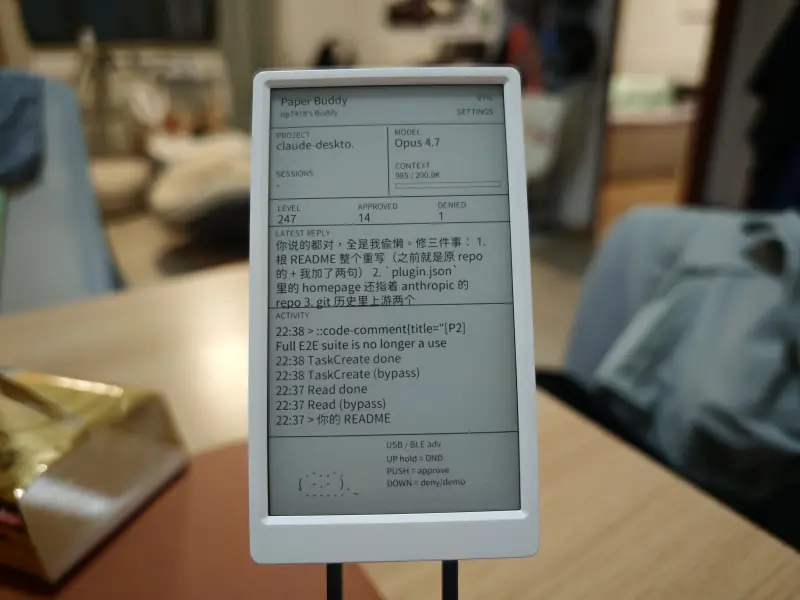
A physical companion device for the Claude Code AI assistant, utilizing the M5Paper V1.1 e-ink display. It features real-time session mirroring, hardware-based tool approval, and touch-screen interactions powered by ESP32 and a Python-based daemon.
Beremiz4uC
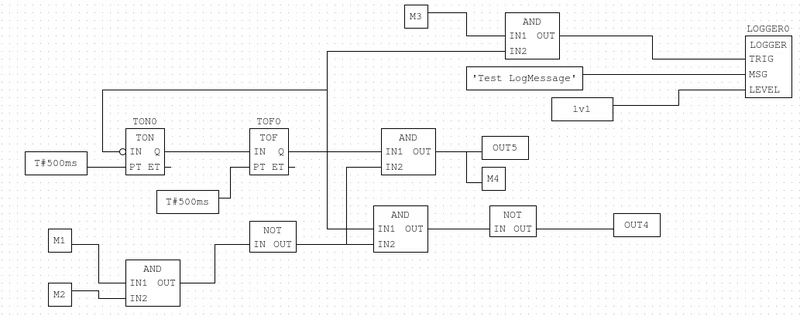
Beremiz4uC is a real-time runtime environment that executes Beremiz IDE PLC programs on STM32F4 microcontrollers using Zephyr RTOS. It features dynamic code loading via udynlink, eRPC-based communication, and flexible I/O management for industrial control applications.
Cydintosh
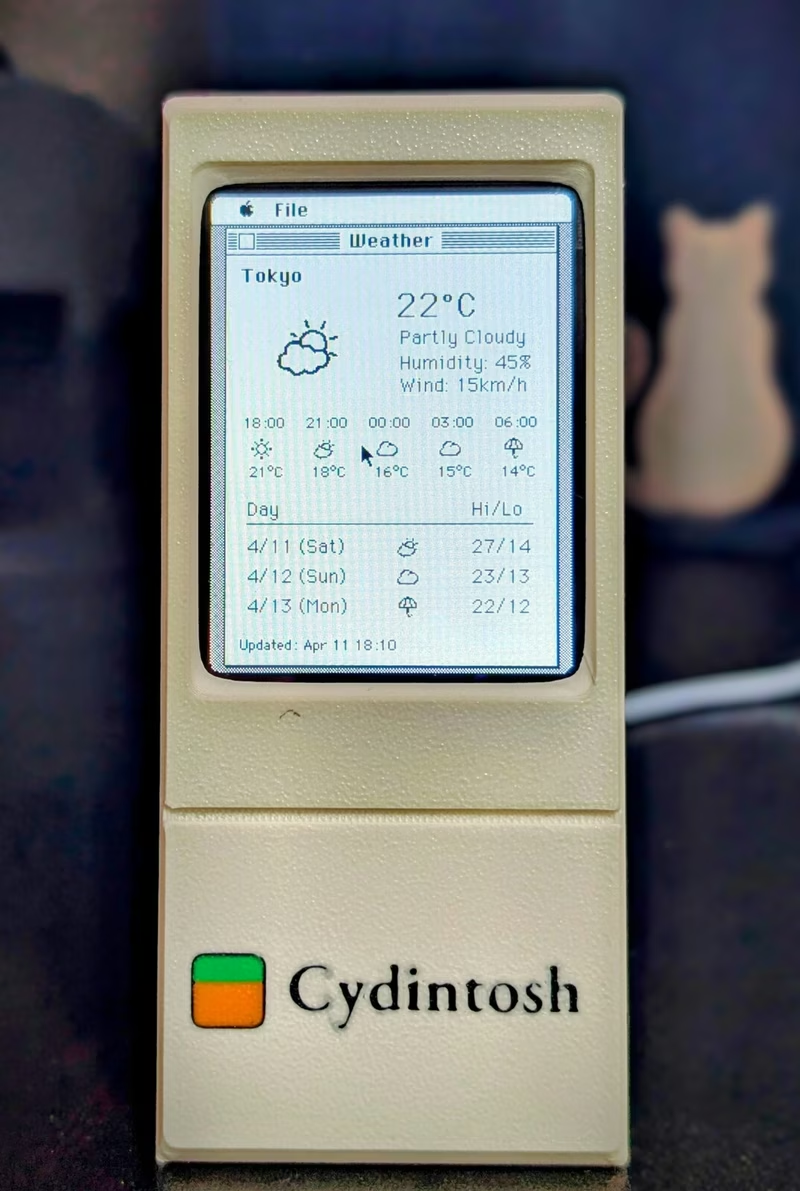
Cydintosh is a Macintosh Plus emulator designed for the ESP32-based Cheap-Yellow-Display (CYD). It utilizes the Musashi 68k emulator core and umac to run classic Macintosh software alongside modern ESP32 features like WiFi, MQTT, and Home Assistant integration.

Zephyr RTOS AI Harness
A specialized harness designed for AI-assisted embedded firmware development using the Zephyr RTOS. It provides a comprehensive set of 'Agent Skills' covering core Zephyr subsystems like BLE, device drivers, and kernel primitives to help AI agents generate, understand, and manage firmware code efficiently.
BackgroundAudio
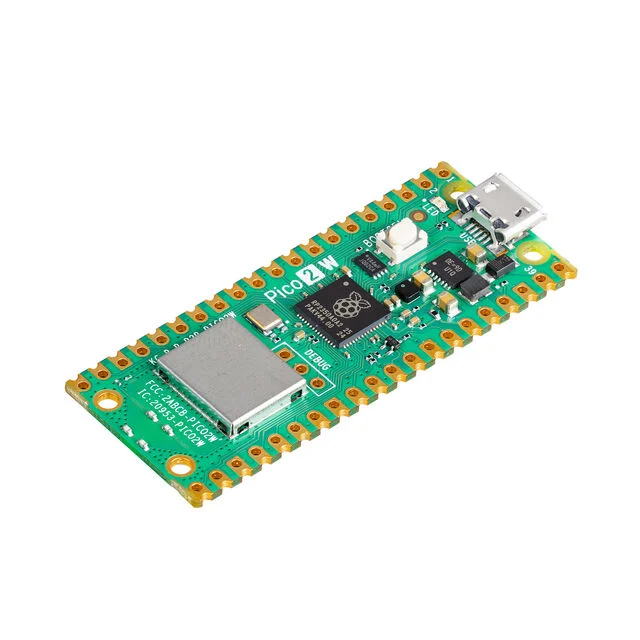
An optimized Arduino library for background audio playback and speech synthesis on Raspberry Pi Pico (RP2040/RP2350) and ESP32. It uses an interrupt-driven architecture to support MP3, AAC, WAV, and text-to-speech while keeping the main application loop responsive and dropout-free.
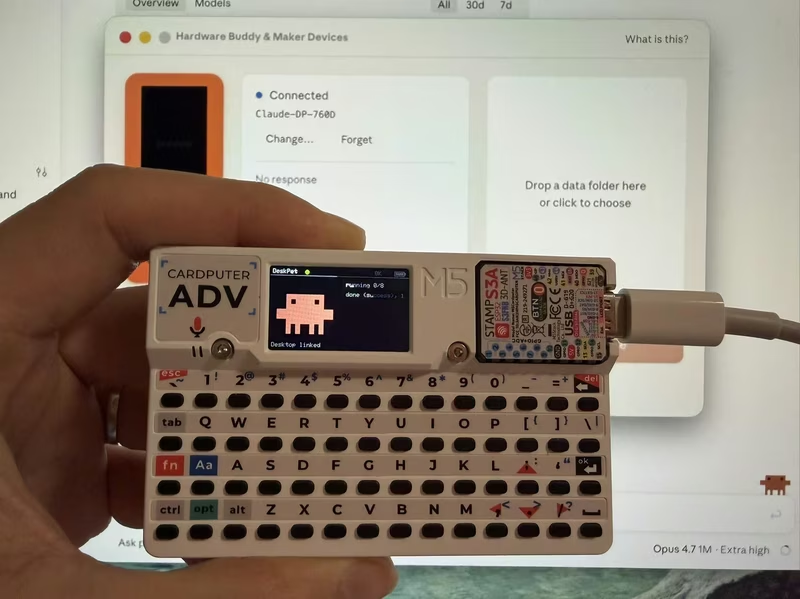
DeskPet for M5Stack Cardputer
DeskPet is a pixel-art companion for the M5Stack Cardputer that synchronizes with Claude Code sessions via Bluetooth Low Energy (BLE). Built on the ESP32-S3 using the NimBLE stack and ArduinoJson, it provides real-time visual feedback and hardware-based command approval for AI agent workflows.
ESP32 A2DP Sink with LDAC, aptX HD, and AAC Support
A premium Bluetooth audio receiver firmware for ESP32-WROVER modules that enables high-resolution streaming via LDAC and aptX codecs. It features a custom DSP pipeline for 3D audio enhancement, real-time LED matrix visualization, and a secure OTA recovery system built on FreeRTOS.