FreeRTOS
202411.00Features
-
Preemptive or co-operative multitasking with priority-based scheduling for deterministic performance.
-
Symmetric Multiprocessing (SMP) support for multi-core microcontroller architectures.
-
Native TCP/IP stack (FreeRTOS+TCP) with comprehensive support for both IPv4 and IPv6.
-
Integrated TLS v1.3 support via MbedTLS and WolfSSL for secure encrypted communications.
-
AWS IoT integration for Over-the-air (OTA) updates, Device Shadow, and Jobs management.
-
Support for ARMv8-M TrustZone and ARMv8.1-M PACBTI security extensions for firmware protection.
-
Lightweight IoT messaging via coreMQTT and coreMQTT Agent for shared network connections.
-
Cryptographic identity and key management through the corePKCS11 library.
-
Formal verification of software correctness for core libraries using CBMC proofs.
-
Memory Protection Unit (MPU) support for task isolation and enhanced system reliability.
-
Cellular interface library for seamless mobile network integration.
-
SNTP client for accurate network-based time synchronization across devices.
-
Support for 40+ architectures and 15+ toolchains including latest RISC-V and ARMv8-M.
-
Low power modes and tickless idle functionality for energy-efficient battery operation.
-
Trace and profiling support via Percepio View for real-time application analysis.
Architecture
FreeRTOS utilizes a microkernel design focused on providing a minimal but robust set of primitives for real-time applications. The core kernel is responsible for task management, scheduling, and inter-process communication (IPC) through queues, semaphores, and mutexes. It is designed to be highly portable, with a clear separation between the hardware-independent core and the hardware-dependent port layer. This architecture allows it to maintain a tiny memory footprint, typically around 6K to 12K bytes of ROM, depending on the architecture and configuration.
The system is highly modular, following a “kernel + libraries” approach. While the core kernel handles execution, additional functionality such as the TCP/IP stack (FreeRTOS+TCP), MQTT, and security protocols are provided as optional, loosely coupled libraries under the FreeRTOS-Plus umbrella. This design pattern ensures that developers only include the code necessary for their specific application, optimizing resource usage for constrained embedded devices.
Core Components
- Task Scheduler: Supports preemptive, co-operative, and round-robin scheduling with priority levels.
- IPC Primitives: Includes thread-safe queues, binary semaphores, counting semaphores, and recursive mutexes.
- Software Timers: Allows for the execution of functions at specific times or periodic intervals.
- Event Groups: Enables tasks to wait for combinations of events to occur.
- Stream/Message Buffers: Optimized for task-to-task and interrupt-to-task data transfer.
Use Cases
This RTOS is ideal for:
- Industrial Automation: Managing real-time sensor data and motor control loops with deterministic timing requirements.
- Consumer Electronics: Powering smart home devices, wearables, and appliances that require low power consumption and small footprints.
- Medical Devices: Providing a reliable and formally verified foundation for life-critical monitoring and diagnostic equipment.
- IoT Gateways: Handling complex networking stacks, TLS encryption, and cloud connectivity for edge-to-cloud data routing.
- Automotive Systems: Implementing non-safety critical telematics and infotainment systems using ARM Cortex-R or Cortex-A processors.
- Smart Energy: Managing smart meters and grid infrastructure components that require long-term stability and remote OTA updates.
Getting Started
To begin developing with FreeRTOS, it is recommended to clone the main repository using the --recurse-submodules flag, as the kernel and supplementary libraries are maintained in separate Git submodules. Developers should start by exploring the FreeRTOS/Demo directory, which contains pre-configured projects for hundreds of hardware platforms and various compilers (GCC, IAR, Keil). These demos provide a functional baseline that includes the necessary port files and configuration headers (FreeRTOSConfig.h).
Extensive documentation is available on the official FreeRTOS website, including a Kernel Quick Start Guide and a comprehensive API Reference. For community support, developers can access the FreeRTOS Support Forums to interact with the primary developers and the broader ecosystem.
Related Projects
View All Projects →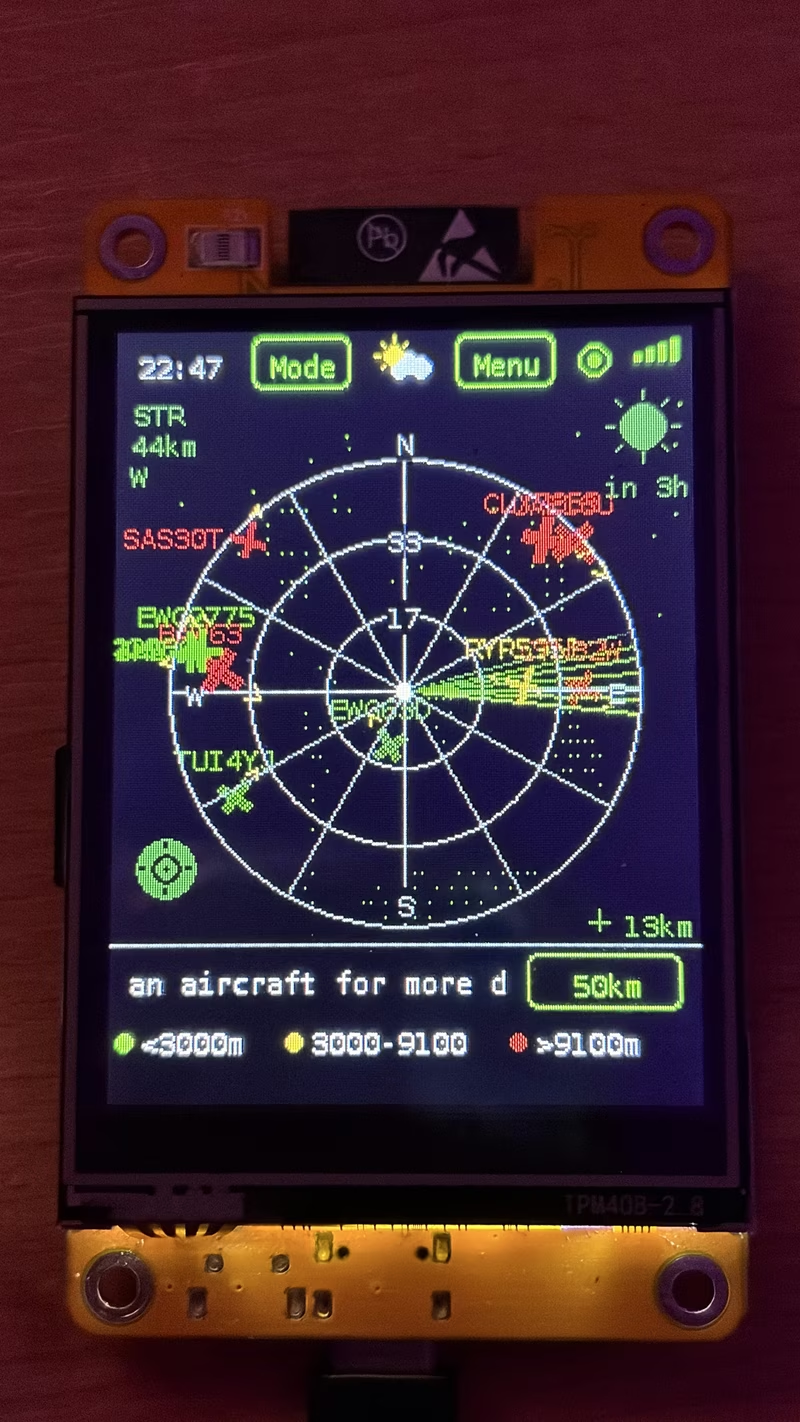
Eiswolfs Flightradar (CYD)
A live ADS-B flight radar firmware for the ESP32-based 'Cheap Yellow Display' (CYD). It tracks nearby aircraft in real-time, featuring a rotating radar screen, detailed flight information, and integration with MQTT and Home Assistant.
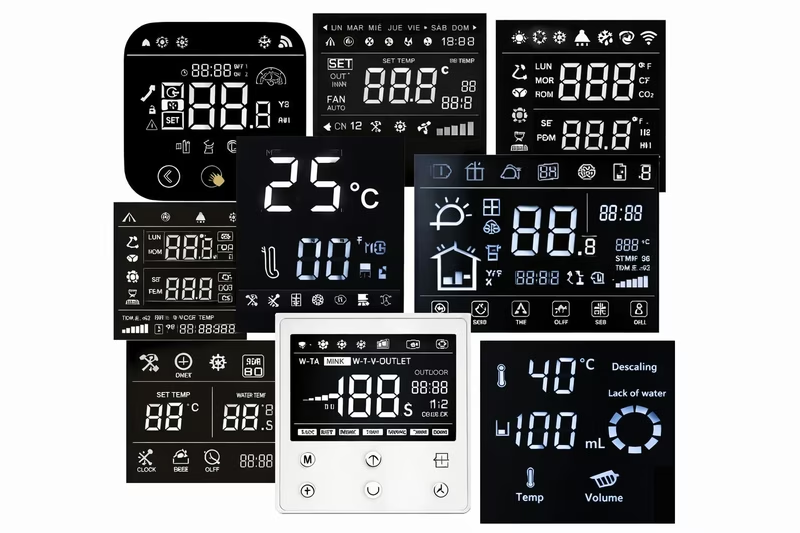
ESP32 Display Reader
An ESP32-based firmware for optical character recognition of 7-segment displays and status symbols using camera modules. It processes visual data locally and transmits recognized values to Home Assistant via MQTT, featuring a comprehensive web interface for ROI configuration and system management.
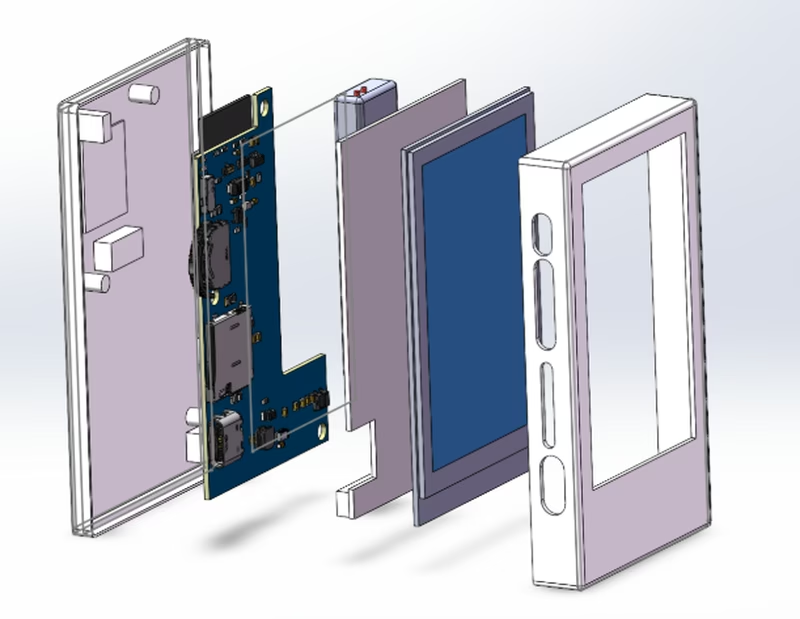
ESP32-S3 Ebook
An advanced ESP32-S3-based e-book reader featuring a 2.7-inch E-ink display and a custom-built UI framework. It integrates Wi-Fi/BLE connectivity, audio playback via the ES8311 codec, and a diverse application ecosystem including a reader, notepad, and file manager.
SignalRF
SignalRF is a multi-tool RF analysis firmware for the M5Stack Cardputer, enabling WiFi and BLE sniffing, signal mapping, and ultrasonic detection. Built on the ESP32-S3 platform and FreeRTOS, it provides a portable toolkit for field RF analysis and tracker discovery.

AWTRIX NG
AWTRIX NG is a comprehensive firmware rewrite for ESP32 and ESP32-S3 microcontrollers designed to transform LED matrix displays into networked smart screens. It features a dual-operational model supporting external control via HTTP/MQTT and native on-device scripting using the Berry language. The project integrates with Home Assistant and supports a wide range of visual elements, including scrolling text, icons, and real-time sensor data.
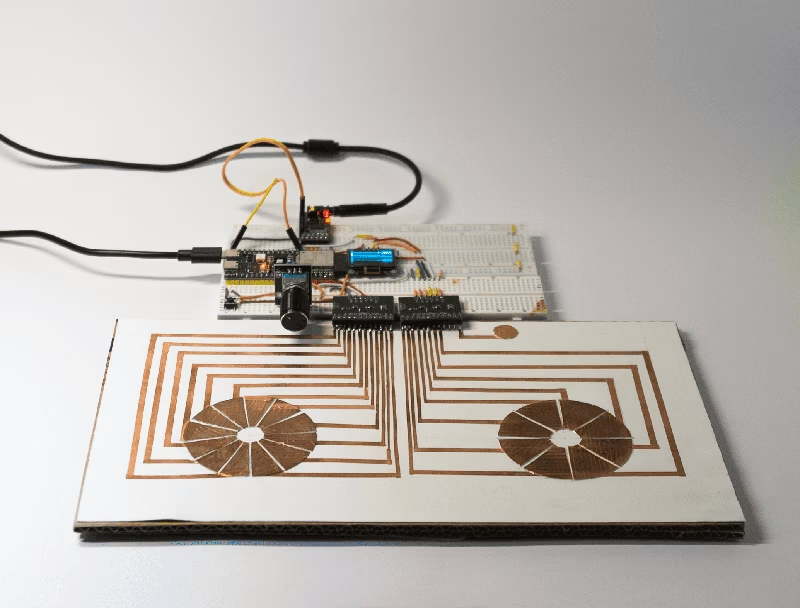
TYPE-2 Autonomous Polyphonic Synthesizer
The TYPE-2 is an ESP32-S3-based polyphonic synthesizer featuring a custom hybrid dual-rate DSP engine and analog-modeled filters. It utilizes FreeRTOS for task management, I2S for high-fidelity audio, and capacitive touch for a responsive user interface.
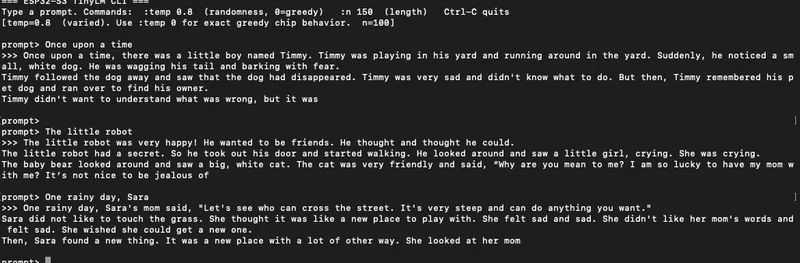
esp32-tinyLLM
A high-performance Rust implementation of a 28.9M-parameter Large Language Model optimized for the ESP32-S3 microcontroller. It utilizes 4-bit quantization and Per-Layer Embedding techniques to achieve 10.5 tokens per second, significantly outperforming the original C implementation.
Zigbee Gateway (ESP32-C6)
A professional-grade Zigbee gateway for the ESP32-C6 based on ESP-IDF, featuring a stable layered architecture and host-side testability. It integrates an MQTT bridge with Home Assistant discovery, a Matter bridge runtime, and a secure OTA firmware update system with signed manifests.