Task notifications in FreeRTOS
How a task notification signals a task directly, without a semaphore, how the count tells the task how many signals it got, and what Zephyr offers instead.
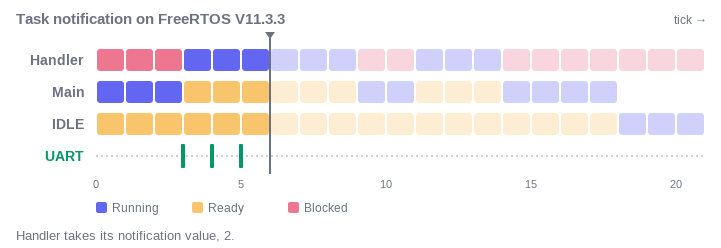
Simulated kernel: FreeRTOS V11.3.3. This scenario and every other one are in the scheduler playground. The simulator and its data files are not covered by the site's CC BY-SA license; see their license notices.
Most signals in a program go to one task that is known in advance: the UART interrupt always wakes
the UART handler. A semaphore does that job, but it is an object of its own,
with a queue structure, a list of waiters and a call through xQueueGenericSend(). FreeRTOS has a
lighter way: every task has a notification value of its
own, and anyone who has the task’s handle can signal the task directly.
xTaskNotifyGive( xHandler )adds one toHandler’s notification value, and wakesHandlerif it is waiting for a notification. From an interrupt:vTaskNotifyGiveFromISR().ulTaskNotifyTake( xClearCountOnExit, xTicksToWait )waits until the value is not zero, and returns it. WithpdTRUEthe value goes back to 0, so one take collects every notification that came; withpdFALSEit goes down by one, which makes it a counting semaphore.
There is no object to create, and no list of waiters: only the task itself can wait for its notifications. That is the limit: a notification has one receiver, and it cannot be shared by two waiting tasks the way a semaphore can.
The scenario
Handler(urgency 3) loops for ever: it takes its notifications withpdTRUEand works three ticks on them.Main(urgency 2) computes for five ticks, notifiesHandler, and computes for four more.- The
UARTinterrupt notifiesHandlerat ticks 3, 4 and 5.
What happens
- Tick 0:
HandlercallsulTaskNotifyTake(). Its value is 0, so it waits: its notify state becomestaskWAITING_NOTIFICATIONand, with no timeout, it goes intoxSuspendedTaskList. It is in no object’s waiting list, because there is no object. Its task card showsulNotifiedValue 0. - Tick 3: the interrupt notifies it.
vTaskNotifyGiveFromISR()adds one to the value, sees thatHandlerwas waiting, moves it to its ready list and setsxHigherPriorityTaskWoken.portYIELD_FROM_ISR()switches to it as the interrupt returns.Handlertakes the value, 1, and clears it. - Ticks 4 and 5: two more interrupts.
Handleris busy, not waiting, so each one only adds one: the value is 2. Nobody is woken, and nothing is lost. - Tick 6:
Handlerloops and callsulTaskNotifyTake()again. The value is 2, so it does not wait: it returns 2 and clears the value. One pass ofHandlerlearns that two interrupts happened. - Tick 9:
Handlerwaits again, andMainruns. At tick 11MainnotifiesHandlerwithxTaskNotifyGive();Handleris more urgent and preempts it straight away.
Compare the deferred interrupt lesson with Yield from ISR off, where a
binary semaphore given twice before the handler took it simply stayed given: the second interrupt
was lost. A notification taken with pdTRUE behaves like a binary semaphore that still says how
many gives it missed.
With pdFALSE it is a counting semaphore: Handler would wake once per notification, and take
them one at a time.
Why it is lighter
The kernel code is short. xTaskGenericNotify() sets the target’s state to
taskNOTIFICATION_RECEIVED, adds one to its value, and, if the target was waiting, moves it from
its delayed or suspended list to its ready list:
BaseType_t xTaskGenericNotify( TaskHandle_t xTaskToNotify,
                               UBaseType_t uxIndexToNotify,
                               uint32_t ulValue,
                               eNotifyAction eAction,
                               uint32_t * pulPreviousNotificationValue )
{
    TCB_t * pxTCB;
    BaseType_t xReturn = pdPASS;
    uint8_t ucOriginalNotifyState;

    traceENTER_xTaskGenericNotify( xTaskToNotify, uxIndexToNotify, ulValue, eAction, pulPreviousNotificationValue );

    configASSERT( uxIndexToNotify < configTASK_NOTIFICATION_ARRAY_ENTRIES );
    configASSERT( xTaskToNotify );
    pxTCB = xTaskToNotify;

    taskENTER_CRITICAL();
    {
        if( pulPreviousNotificationValue != NULL )
        {
            *pulPreviousNotificationValue = pxTCB->ulNotifiedValue[ uxIndexToNotify ];
        }

        ucOriginalNotifyState = pxTCB->ucNotifyState[ uxIndexToNotify ];

        pxTCB->ucNotifyState[ uxIndexToNotify ] = taskNOTIFICATION_RECEIVED;

        switch( eAction )
        {
            case eSetBits:
                pxTCB->ulNotifiedValue[ uxIndexToNotify ] |= ulValue;
                break;

            case eIncrement:
                ( pxTCB->ulNotifiedValue[ uxIndexToNotify ] )++;
                break;

            case eSetValueWithOverwrite:
                pxTCB->ulNotifiedValue[ uxIndexToNotify ] = ulValue;
                break;

            case eSetValueWithoutOverwrite:

                if( ucOriginalNotifyState != taskNOTIFICATION_RECEIVED )
                {
                    pxTCB->ulNotifiedValue[ uxIndexToNotify ] = ulValue;
                }
                else
                {
                    /* The value could not be written to the task. */
                    xReturn = pdFAIL;
                }

                break;

            case eNoAction:

                /* The task is being notified without its notify value being
                 * updated. */
                break;

            default:

                /* Should not get here if all enums are handled.
                 * Artificially force an assert by testing a value the
                 * compiler can't assume is const. */
                configASSERT( xTickCount == ( TickType_t ) 0 );

                break;
        }

        traceTASK_NOTIFY( uxIndexToNotify );

        /* If the task is in the blocked state specifically to wait for a
         * notification then unblock it now. */
        if( ucOriginalNotifyState == taskWAITING_NOTIFICATION )
        {
            listREMOVE_ITEM( &( pxTCB->xStateListItem ) );
            prvAddTaskToReadyList( pxTCB );

            /* The task should not have been on an event list. */
            configASSERT( listLIST_ITEM_CONTAINER( &( pxTCB->xEventListItem ) ) == NULL );

            #if ( configUSE_TICKLESS_IDLE != 0 )
            {
                /* If a task is blocked waiting for a notification then
                 * xNextTaskUnblockTime might be set to the blocked task's time
                 * out time.  If the task is unblocked for a reason other than
                 * a timeout xNextTaskUnblockTime is normally left unchanged,
                 * because it will automatically get reset to a new value when
                 * the tick count equals xNextTaskUnblockTime.  However if
                 * tickless idling is used it might be more important to enter
                 * sleep mode at the earliest possible time - so reset
                 * xNextTaskUnblockTime here to ensure it is updated at the
                 * earliest possible time. */
                prvResetNextTaskUnblockTime();
            }
            #endif

            /* Check if the notified task has a priority above the currently
             * executing task. */
            taskYIELD_ANY_CORE_IF_USING_PREEMPTION( pxTCB );
        }
        else
        {
            mtCOVERAGE_TEST_MARKER();
        }
    }
    taskEXIT_CRITICAL();

    traceRETURN_xTaskGenericNotify( xReturn );

    return xReturn;
}tasks.c, lines 8013–8126 · FreeRTOS V11.3.3 · MIT license
The wait is just as short. There is no object to lock and no waiting list to join: the task marks
itself as waiting and goes into a delayed list, or with no timeout into xSuspendedTaskList.
uint32_t ulTaskGenericNotifyTake( UBaseType_t uxIndexToWaitOn,
                                  BaseType_t xClearCountOnExit,
                                  TickType_t xTicksToWait )
{
    uint32_t ulReturn;
    BaseType_t xAlreadyYielded, xShouldBlock = pdFALSE;

    traceENTER_ulTaskGenericNotifyTake( uxIndexToWaitOn, xClearCountOnExit, xTicksToWait );

    configASSERT( uxIndexToWaitOn < configTASK_NOTIFICATION_ARRAY_ENTRIES );

    /* If the notification count is zero, and if we are willing to wait for a
     * notification, then block the task and wait. */
    if( ( pxCurrentTCB->ulNotifiedValue[ uxIndexToWaitOn ] == 0U ) && ( xTicksToWait > ( TickType_t ) 0 ) )
    {
        /* We suspend the scheduler here as prvAddCurrentTaskToDelayedList is a
         * non-deterministic operation. */
        vTaskSuspendAll();
        {
            /* We MUST enter a critical section to atomically check if a notification
             * has occurred and set the flag to indicate that we are waiting for
             * a notification. If we do not do so, a notification sent from an ISR
             * will get lost. */
            taskENTER_CRITICAL();
            {
                /* Only block if the notification count is not already non-zero. */
                if( pxCurrentTCB->ulNotifiedValue[ uxIndexToWaitOn ] == 0U )
                {
                    /* Mark this task as waiting for a notification. */
                    pxCurrentTCB->ucNotifyState[ uxIndexToWaitOn ] = taskWAITING_NOTIFICATION;

                    /* Arrange to wait for a notification. */
                    xShouldBlock = pdTRUE;
                }
                else
                {
                    mtCOVERAGE_TEST_MARKER();
                }
            }
            taskEXIT_CRITICAL();

            /* We are now out of the critical section but the scheduler is still
             * suspended, so we are safe to do non-deterministic operations such
             * as prvAddCurrentTaskToDelayedList. */
            if( xShouldBlock == pdTRUE )
            {
                traceTASK_NOTIFY_TAKE_BLOCK( uxIndexToWaitOn );
                prvAddCurrentTaskToDelayedList( xTicksToWait, pdTRUE );
            }
            else
            {
                mtCOVERAGE_TEST_MARKER();
            }
        }
        xAlreadyYielded = xTaskResumeAll();

        /* Force a reschedule if xTaskResumeAll has not already done so. */
        if( ( xShouldBlock == pdTRUE ) && ( xAlreadyYielded == pdFALSE ) )
        {
            taskYIELD_WITHIN_API();
        }
        else
        {
            mtCOVERAGE_TEST_MARKER();
        }
    }

    taskENTER_CRITICAL();
    {
        traceTASK_NOTIFY_TAKE( uxIndexToWaitOn );
        ulReturn = pxCurrentTCB->ulNotifiedValue[ uxIndexToWaitOn ];

        if( ulReturn != 0U )
        {
            if( xClearCountOnExit != pdFALSE )
            {
                pxCurrentTCB->ulNotifiedValue[ uxIndexToWaitOn ] = ( uint32_t ) 0U;
            }
            else
            {
                pxCurrentTCB->ulNotifiedValue[ uxIndexToWaitOn ] = ulReturn - ( uint32_t ) 1;
            }
        }
        else
        {
            mtCOVERAGE_TEST_MARKER();
        }

        pxCurrentTCB->ucNotifyState[ uxIndexToWaitOn ] = taskNOT_WAITING_NOTIFICATION;
    }
    taskEXIT_CRITICAL();

    traceRETURN_ulTaskGenericNotifyTake( ulReturn );

    return ulReturn;
}tasks.c, lines 7797–7892 · FreeRTOS V11.3.3 · MIT license
Step through a take and a give at the Line level and count the steps, then do the same in the semaphores lesson. The FreeRTOS documentation quotes notifications as considerably faster and smaller than a binary semaphore, and the source shows why. The price is generality: one receiver, which must be known by handle, and no priority inheritance (a notification is not a mutex).
The same value can also carry data instead of a count: xTaskNotify() with eSetBits makes it a
small event group, and with eSetValueWithOverwrite a mailbox of one 32-bit value. The simulator
models the give-and-take form only.
Suspending a waiting task
The notify state has to be kept right when a waiting task is suspended. vTaskSuspend() sets it
back to taskNOT_WAITING_NOTIFICATION: the task was waiting, but now it is suspended, so a
notification must not wake it. And vTaskResume() must not resume a task that only looks
suspended because it waits for a notification without a timeout (it is in xSuspendedTaskList
too): prvTaskIsTaskSuspended() checks the notify state before it says yes.
What Zephyr offers instead
Zephyr has no per-thread notification. The usual replacements:
- A
k_semthat only one thread takes, defined next to that thread. It costs a small object, and gives the same counting behaviour (k_sem_take()takes one;k_sem_reset()clears the count). - A
k_event, when the signal should carry a few bits rather than a count. k_poll()with ak_poll_signal, when one thread waits for several sources.
None of them is attached to the thread: the sender needs the object, not the thread’s handle.
What to try
- Untick Yield from ISR: at tick 3
Handleris woken but not switched to. It runs only at tick 4, when the tick finds the switch pending; by then the tick-4 interrupt has notified it again, and its first take returns 2. - Lower Handler urgency to 1:
Mainruns first and keeps the CPU until it ends at tick 9.Handlerhas not even started to wait, but nothing is lost: its first take returns 4, the three interrupts andMain’s notification. A notification sent before the receiver waits is kept, like a semaphore given before anyone takes it.