Semaphores as signals
How one task waits for another with a binary semaphore, why the waiter runs the moment it is signalled, and how a semaphore differs from a mutex.
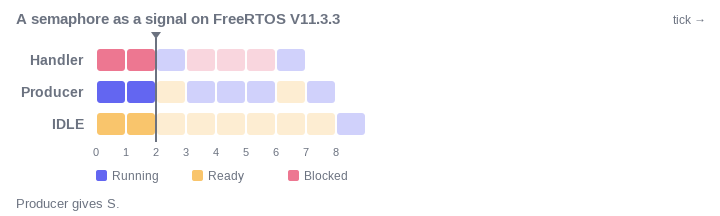
Simulated kernel: FreeRTOS V11.3.3 and Zephyr v4.5.0. This scenario and every other one are in the scheduler playground. The simulator and its data files are not covered by the site's CC BY-SA license; see their license notices.
Tasks often have to wait for each other. A task that handles data has nothing to do until another task (or, later, an interrupt) has produced some. It could check a flag in a loop, but that burns the CPU that the producer needs. The kernel offers a better way: the waiting task blocks on a semaphore, and the producer gives the semaphore when there is work.
A binary semaphore is a counter that is either 0 or 1. Taking it when it is 1 sets it to 0 and returns at once. Taking it when it is 0 blocks the caller until somebody gives it. Giving it sets it to 1, or, if a task is waiting, wakes that task.
The two tasks
Handleris the more urgent task. It takesSand does one tick of work, twice.Producerworks for two ticks, givesS, works three more, givesSagain and works one last tick.
S starts empty: xSemaphoreCreateBinary() creates it that way in FreeRTOS, and the Zephyr
program defines it with K_SEM_DEFINE(S, 0, 1), a count of 0 and a limit of 1.
What happens
- Tick 0:
Handlerruns first, because it is more urgent. It takesS, which is empty, so it blocks. Its card shows it as blocked onS, andProducergets the CPU. Producerworks during ticks 0 and 1. Nothing in the kernel looks atHandlermeanwhile: a task that waits for a semaphore costs no CPU time at all.- Tick 2:
ProducergivesS.Handleris taken off the semaphore’s waiting list and made ready. It is more urgent thanProducer, so the kernel switches to it inside the give call.Produceris preempted in the middle of its own code. Handlerdoes its tick of work and, at tick 3, takesSagain.Sis empty again, so it blocks again, andProducercontinues.- Tick 6: the second give, and the same thing happens.
Handlerruns during tick 6 and ends. Producerfinishes its last tick, 7, and ends.
The timing of Handler is now decided by the event it waits for, not by polling: it reacts in the
same tick the signal is given. That is the pattern behind most RTOS programs, with the giver often
being an interrupt handler (the lesson on interrupts comes later).
Who takes the count: FreeRTOS and Zephyr differ
Step through tick 2 on each kernel with Event steps and watch the semaphore in the kernel structures panel.
- FreeRTOS builds a semaphore on its queue.
xSemaphoreGive()puts one (empty) item in the queue, souxMessagesWaitingbecomes 1, and wakesHandler. WhenHandlerruns again, it is still insidexSemaphoreTake(), which goes round its loop, finds the item and removes it. The take happens after the context switch. - Zephyr’s
k_sem_give()checks the wait queue first. If a thread waits, the kernel wakes it with the semaphore already taken on its behalf; the count is never raised. The take happens before the context switch, inside the give.
void z_impl_k_sem_give(struct k_sem *sem)
{
	struct k_spinlock *lock = sem_spinlock_get(sem);
	k_spinlock_key_t key = k_spin_lock(lock);
	bool resched;

	SYS_PORT_TRACING_OBJ_FUNC_ENTER(k_sem, give, sem);

	if (z_sched_wake(&sem->wait_q, 0, NULL)) {
		resched = true;
	} else {
		sem->count += (sem->count != sem->limit) ? 1U : 0U;
		resched = sem_handle_poll_events(sem);
	}

	if (unlikely(resched)) {
		z_reschedule(lock, key);
	} else {
		k_spin_unlock(lock, key);
	}

	SYS_PORT_TRACING_OBJ_FUNC_EXIT(k_sem, give, sem);
}kernel/sem.c, lines 116–138 · Zephyr v4.5.0 · Apache-2.0 license
The if at the top is the whole difference: z_sched_wake() hands the semaphore to the first
waiter, and only when nobody waits does count go up. As with
mutex handoff, the result here is the same on both kernels, but on FreeRTOS
a third task could take S between the give and the moment Handler runs.
A semaphore is not a mutex
Both are taken and given, and FreeRTOS even creates both with xSemaphoreCreate...(), so they are
easy to confuse. They answer different questions.
| Binary semaphore | Mutex | |
|---|---|---|
| Used for | signalling: “something happened” | mutual exclusion: “I am using this” |
| Starts | empty (nothing has happened yet) | free |
| Who gives it | any task, often a different one from the taker | only the task that took it |
| Owner | none | the task that holds it |
| Priority inheritance | no: there is no owner to raise | yes |
| From an interrupt | can be given (with the ISR form of the call) | must not be used |
A semaphore can be used as a lock, by starting it full. The priority inversion lesson does exactly that and shows the price: the kernel does not know who holds it, so it cannot help the waiter. Use a mutex to protect data, and a semaphore to say that something has happened.
A binary semaphore remembers one signal
The count of a binary semaphore stops at 1. If the producer gives twice before the handler takes
once, the second give is lost: FreeRTOS’s xSemaphoreGive() returns pdFALSE, and Zephyr’s
k_sem_give() leaves the count at its limit. The handler then sees one event where there were two.
When events can arrive faster than they are handled, or when a semaphore stands for a number of free resources, a counting semaphore is needed. It works the same way with a larger limit. And when each signal comes with data, a queue carries both.
What to try
- Swap the urgencies: set Handler urgency to 1 and Producer urgency to 2. Now
Handlerdoes not run untilProducerhas finished.Producergives twice while nobody waits; the second give is lost,HandlertakesSonce, runs, and then waits for a signal that never comes. The run stops at its tick limit withHandlerstill blocked. - Set Handler starts at tick to 3. The first give finds nobody waiting and leaves the count at
1, so when
Handlerarrives it takesSwithout blocking. Only its second take waits.