Events in Zephyr
How k_event_wait records what a thread waits for in the thread itself, how k_event_post walks the wait queue and hands each waiter the events that satisfied it, and what the _safe variants clear.
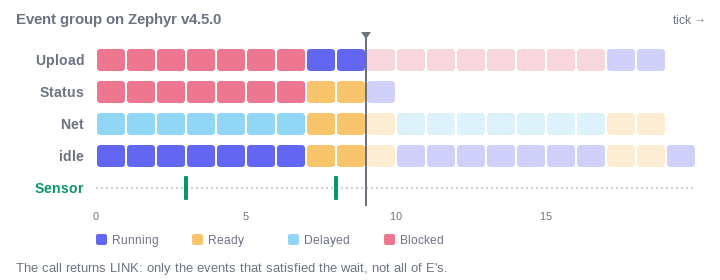
Simulated kernel: Zephyr v4.5.0. This scenario and every other one are in the scheduler playground. The simulator and its data files are not covered by the site's CC BY-SA license; see their license notices.
This walkthrough follows the event groups lesson through Zephyr’s
kernel/events.c. Zephyr’s event object, k_event, is its event group. Set the step level to
Line to follow it.
What an event object is
K_EVENT_DEFINE(E) defines a struct k_event:
events: 32 bits, all of them the application’s.wait_q: the threads waiting, sorted by priority like every Zephyr wait queue.
There are four ways to wait: k_event_wait() for any of a set of events, k_event_wait_all() for
all of them, and the _safe variants of each, which consume the events they get (clear them as
the wait ends). Each one calls k_event_wait_internal() with its options.
Waiting
At tick 0 Upload calls k_event_wait_all_safe(&E, BIT_DATA | BIT_LINK, false, K_FOREVER).
static uint32_t k_event_wait_internal(struct k_event *event, uint32_t events,
				      unsigned int options, k_timeout_t timeout)
{
	uint32_t  rv = 0;

	__ASSERT(((arch_is_in_isr() == false) ||
		  K_TIMEOUT_EQ(timeout, K_NO_WAIT)), "");

	SYS_PORT_TRACING_OBJ_FUNC_ENTER(k_event, wait, event, events,
					options, timeout);

	if ((events == 0U) && !(options & K_EVENT_OPTION_RESET)) {
		SYS_PORT_TRACING_OBJ_FUNC_EXIT(k_event, wait, event, events, 0);
		return 0;
	}

	k_spinlock_key_t  key = k_spin_lock(&event->lock);

	if (options & K_EVENT_OPTION_RESET) {
		event->events = 0;
	}

	if (events == 0) {
		k_spin_unlock(&event->lock, key);
		SYS_PORT_TRACING_OBJ_FUNC_EXIT(k_event, wait, event, events, 0);
		return 0;
	}

	unsigned int wait_condition = options & K_EVENT_WAIT_MASK;
	struct k_thread *thread = k_sched_current_thread_query();

	/* Test if the wait conditions have already been met. */
	rv = are_wait_conditions_met(events, event->events, wait_condition);
	if (rv != 0) {
		/* clear the events that are matched */
		if (options & K_EVENT_OPTION_CLEAR) {
			event->events &= ~rv;
		}

		k_spin_unlock(&event->lock, key);
		goto out;
	}

	if (K_TIMEOUT_EQ(timeout, K_NO_WAIT)) {
		k_spin_unlock(&event->lock, key);
		goto out;
	}

	/*
	 * The caller must pend to wait for the match. Save the desired
	 * set of events in the k_thread structure.
	 */

	thread->events = events;
	thread->event_options = options;

	SYS_PORT_TRACING_OBJ_FUNC_BLOCKING(k_event, wait, event, events,
					   options, timeout);

	if (z_pend_curr(&event->lock, key, &event->wait_q, timeout) == 0) {
		/* Retrieve the set of events that woke the thread */
		rv = thread->events;
	}

out:
	SYS_PORT_TRACING_OBJ_FUNC_EXIT(k_event, wait, event, events, rv);

	return rv;
}kernel/events.c, lines 282–350 · Zephyr v4.5.0 · Apache-2.0 license
are_wait_conditions_met()matches the events against the ones the thread wants. It returns the events that satisfy the wait, or 0: for “all”, 0 unless every one of them is there.- Nothing is set, so the thread must wait. It writes what it waits for into its own thread
object (
thread->eventsandthread->event_options), not into the event object. z_pend_curr()puts it inE.wait_qand switches away, as for any wait.
Status waits with k_event_wait(&E, BIT_LINK | BIT_ERR, false, K_FOREVER). It is less urgent, so
it queues behind Upload.
Posting
At tick 3 the Sensor interrupt calls k_event_post(&E, BIT_DATA), right in the
handler. k_event_post() and k_event_clear() both go through one function:
static uint32_t k_event_post_internal(struct k_event *event, uint32_t events,
				  uint32_t events_mask)
{
	k_spinlock_key_t  key;
	struct event_walk_data data;
	uint32_t previous_events;

	key = k_spin_lock(&event->lock);

	SYS_PORT_TRACING_OBJ_FUNC_ENTER(k_event, post, event, events,
					events_mask);

	previous_events = event->events & events_mask;
	events = (event->events & ~events_mask) |
		 (events & events_mask);

	/*
	 * Posting an event has the potential to wake multiple pended threads.
	 * It is desirable to wake all affected threads simultaneously. When
	 * z_sched_waitq_walk() allows removal of nodes from the wait queue,
	 * we wake (unpend and ready) each thread as part of the callback.
	 * Otherwise, proceed in two steps:
	 *
	 * 1. Walk the waitq and create a linked list of threads to wake.
	 * 2. Walk the resulting linked list and wake each of the threads.
	 */

#ifdef CONFIG_WAITQ_SCALABLE
	data.head = NULL;
#endif /* CONFIG_WAITQ_SCALABLE */
	data.events = events;
	data.clear_events = 0;
	z_sched_waitq_walk(&event->wait_q, event_walk_op, EVENT_POST_WALK_OP_FN, &data);

	/* stash any events not consumed */
	event->events = data.events & ~data.clear_events;

	z_reschedule(&event->lock, key);

	SYS_PORT_TRACING_OBJ_FUNC_EXIT(k_event, post, event, events,
				       events_mask);

	return previous_events;
}kernel/events.c, lines 179–222 · Zephyr v4.5.0 · Apache-2.0 license
The new events are worked out under a mask: a post sets the bits it names, a clear posts nothing
under the mask of the bits it clears. Then z_sched_waitq_walk() calls event_walk_op() for
every waiting thread:
static int event_walk_op(struct k_thread *thread, void *data)
{
	uint32_t match;
	unsigned int wait_condition;
	struct event_walk_data *event_data = data;

	wait_condition = thread->event_options & K_EVENT_WAIT_MASK;

	match = are_wait_conditions_met(thread->events, event_data->events,
					wait_condition);
	if (match != 0) {
		/*
		 * The wait conditions have been satisfied. Set the
		 * received events then wake thread now if allowed,
		 * else add it to the list of threads to unpend.
		 *
		 * NOTE: thread event options can consume an event
		 */
		thread->events = match;
		if (thread->event_options & K_EVENT_OPTION_CLEAR) {
			event_data->clear_events |= match;
		}
		(void)z_try_abort_thread_timeout(thread);

#ifndef CONFIG_WAITQ_SCALABLE
		/*
		 * Note: z_sched_wake_thread_locked() is safe
		 * to call here because this walk_op callback
		 * is invoked with the scheduler spinlock held.
		 */
		arch_thread_return_value_set(thread, 0);
		z_sched_wake_thread_locked(thread);
#else /* !CONFIG_WAITQ_SCALABLE */
		thread->next_wake_link = event_data->head;
		event_data->head = thread;
#endif /* !CONFIG_WAITQ_SCALABLE */
	}

	return 0;
}kernel/events.c, lines 138–177 · Zephyr v4.5.0 · Apache-2.0 license
At tick 3 DATA alone satisfies nobody. At tick 7 Net posts LINK, and both threads match:
UploadgetsDATA | LINK;Status, which wanted any ofLINKandERR, gets onlyLINK.thread->eventsis overwritten with the events that matched: that is what the thread’s call will return.Uploadconsumes its events, so they are added toclear_events, to be cleared after the walk;Statusstill sees them.- Each matched thread’s timeout is taken out of the timeout list, its return value is set to 0, and
z_sched_wake_thread_locked()takes it out of the wait queue and makes it ready.
After the walk the consumed events are cleared, and z_reschedule() switches to Upload, the
most urgent thread now ready. In an interrupt handler, z_reschedule() does not switch; the
interrupt’s exit does.
Waking up
Upload returns from z_pend_curr() with 0, reads thread->events, and returns DATA | LINK.
Status returns LINK, only what satisfied its wait. FreeRTOS returns the
whole group instead, as it was when the task was woken; with Zephyr’s form, the caller does not
have to mask the result.
A wait that times out returns 0: z_pend_curr() returns -EAGAIN, and the events are not looked
at again. If the events arrive a moment later, they stay set for the next wait (FreeRTOS looks once
more after a timeout and takes them).
Who clears what
k_event_wait() without _safe leaves the events set: Status could wait for LINK again and
return at once. The reset argument (false here) is different again: it clears all events
before the wait starts, so only events posted from then on count. In FreeRTOS terms, _safe is
xClearOnExit, and reset has no counterpart.