The tick and k_sleep in Zephyr
How k_sleep puts a thread on Zephyr's timeout list, why it wakes one tick later than asked, and how the tick announcement wakes it, in the real kernel source.
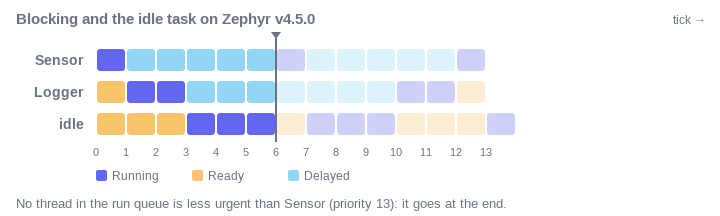
Simulated kernel: Zephyr v4.5.0. This scenario and every other one are in the scheduler playground. The simulator and its data files are not covered by the site's CC BY-SA license; see their license notices.
This page follows a sleep through the Zephyr source, as it is in v4.5.0: what k_sleep() does
when a thread asks to sleep, and what the tick does to wake it. The
scheduling lesson explains the idea. In the simulator above, set the step
level to Line and open the Kernel tab of the code panel.
The scenario has two threads. Sensor (priority 13) works for one tick and calls
k_sleep(K_TICKS(4)), twice. Logger (priority 14) works for two ticks, sleeps for six and works
for two more. In Zephyr a lower number is a more urgent priority.
One list for every kind of waiting
FreeRTOS has delayed lists for tasks. Zephyr has something more
general: a single timeout list of struct _timeout entries, each with a function to call when it
expires. A sleeping thread is one entry (its function is z_thread_timeout()). A thread waiting for
a mutex with a time limit is another. The time slice timer is
another, and so are k_timer objects. The simulator’s kernel structures panel shows this list as
timeout_list, with the slice timer as slice_timeout.
k_sleep
k_sleep() is an inline function that calls the system call k_sleep_ticks(), which ends up here:
k_ticks_t z_impl_k_sleep_ticks(k_timeout_t timeout)
{
	uint32_t expected_wakeup_ticks;

	__ASSERT(!arch_is_in_isr(), "");

	SYS_PORT_TRACING_FUNC_ENTER(k_thread, sleep_ticks, timeout);

	/* K_NO_WAIT is treated as a 'yield' */
	if (K_TIMEOUT_EQ(timeout, K_NO_WAIT)) {
		k_yield();
		SYS_PORT_TRACING_FUNC_EXIT(k_thread, sleep_ticks, timeout, 0);
		return 0;
	}

	k_spinlock_key_t key = z_sched_spinlock_lock();

#if defined(CONFIG_TIMESLICING) && defined(CONFIG_SWAP_NONATOMIC)
	pending_current = _current;
#endif /* CONFIG_TIMESLICING && CONFIG_SWAP_NONATOMIC */
	z_sched_unready_locked(_current);
	expected_wakeup_ticks = (uint32_t)z_add_thread_timeout(_current, timeout);
	z_mark_thread_as_sleeping(_current);

	(void)z_swap_locked(key);

	/* There is no meaningful remainder to report for K_FOREVER: reaching
	 * this point at all means a k_wakeup() cut the sleep short.
	 */
	if (K_TIMEOUT_EQ(timeout, K_FOREVER)) {
		SYS_PORT_TRACING_FUNC_EXIT(k_thread, sleep_ticks, timeout, K_TICKS_FOREVER);
		return K_TICKS_FOREVER;
	}

	/* We require a 32 bit unsigned subtraction to handle a wraparound.
	 * A normal timeout-driven wakeup leaves zero (or a slightly negative)
	 * remainder; only an early k_wakeup() yields a positive value.
	 */
	uint32_t left_ticks = expected_wakeup_ticks - sys_clock_tick_get_32();

	/* Use signed comparison so past-due wakeups (negative remainder) return 0.
	 * k_ticks_t may be uint32_t (!CONFIG_TIMEOUT_64BIT), so comparing ticks > 0
	 * directly would be an unsigned comparison and would misinterpret a negative
	 * remainder as a large positive value.
	 */
	int32_t signed_left = (int32_t)left_ticks;

	if (signed_left < 0) {
		signed_left = 0;
	}

	SYS_PORT_TRACING_FUNC_EXIT(k_thread, sleep_ticks, timeout, signed_left);
	return (k_ticks_t)signed_left;
}kernel/sleep.c, lines 50–103 · Zephyr v4.5.0 · Apache-2.0 license
At tick 1, Sensor calls it. Reading from the top, past the K_NO_WAIT case
(which is a yield):
z_sched_unready_locked(_current)takesSensorout of the run queue. Taking the running thread out is a reschedule point, so the scheduler also picks the next thread here:Logger. It is recorded as the next to run in_kernel.ready_q.cache; the switch itself comes at the end. Because a different thread will run,Loggergets a fresh time slice, which means the slice timer is removed from the timeout list and added again.z_add_thread_timeout()addsSensor’s own entry to the timeout list.z_mark_thread_as_sleeping()sets a state flag. A sleeping thread is in no list at all except the timeout list; you can see the flag inthread_stateon its task card.z_swap_locked()switches toLogger. ForSensorthe call returns when it runs again, and the function works out how many ticks were left (zero unless something woke it early withk_wakeup()).
The extra tick
Every relative timeout goes through z_add_timeout():
k_ticks_t z_add_timeout(struct _timeout *to, _timeout_func_t fn, k_timeout_t timeout)
{
	k_ticks_t ticks = 0;

	if (K_TIMEOUT_EQ(timeout, K_FOREVER)) {
		return 0;
	}

#ifdef CONFIG_KERNEL_COHERENCE
	__ASSERT_NO_MSG(sys_cache_is_mem_coherent(to));
#endif /* CONFIG_KERNEL_COHERENCE */

	__ASSERT(z_is_inactive_timeout(to), "");
	to->fn = fn;

	K_SPINLOCK(&timeout_lock) {
		uint32_t ticks_elapsed = 0;
		bool has_elapsed = false;
		k_ticks_t dticks;

		if (Z_IS_TIMEOUT_RELATIVE(timeout)) {
			ticks_elapsed = elapsed();
			has_elapsed = true;
			/*
			 * In the general case, "now" may be anywhere within
			 * the current tick. Rounding up by one tick guarantees
			 * "at least N ticks" semantics -- otherwise a request
			 * made partway through a tick would fire on the next
			 * tick edge, yielding less than N full ticks.
			 *
			 * The one moment we know *this* CPU is at a tick edge
			 * is while it is processing timeouts inside its own
			 * sys_clock_announce_locked() loop. Periodic timers
			 * rely on this when rescheduling themselves from the
			 * timer ISR: the round-up would otherwise accumulate
			 * and make every period one tick late. The check is
			 * per-CPU: a thread on another CPU running while we
			 * announce is *not* at a tick edge and still needs
			 * the round-up.
			 */
			dticks = timeout.ticks + ticks_elapsed +
				 (this_cpu_announcing() ? 0 : 1);
			ticks = curr_tick + dticks;
		} else {
			dticks = Z_TICK_ABS(timeout.ticks) - curr_tick;
			dticks = max(1, dticks);
			ticks = timeout.ticks;
		}

		if (z_timeout_q_insert(to, dticks) && !any_cpu_announcing()) {
			if (!has_elapsed) {
				/* In case of absolute timeout that is first to expire
				 * elapsed need to be read from the system clock.
				 */
				ticks_elapsed = elapsed();
			}
			sys_clock_set_timeout(next_timeout(ticks_elapsed), false);
		}
	}

	return ticks;
}kernel/timeout.c, lines 176–237 · Zephyr v4.5.0 · Apache-2.0 license
The line that matters is the one that computes dticks:
dticks = timeout.ticks + ticks_elapsed + (this_cpu_announcing() ? 0 : 1);A thread calls k_sleep() at some moment inside a tick. If the kernel counted from the next tick
edge, a sleep of 4 could last only a little more than 3 tick periods. Zephyr promises at least the
time asked for, so it adds one tick. Sensor asked for 4 at tick 1 and will wake at 1 + 4 + 1 = 6.
FreeRTOS does not add the tick, so the same program wakes at tick 5 there; see
the FreeRTOS version of this page. In the simulator each call is
made right after a tick, so on Zephyr the sleep lasts exactly five periods.
The exception is a timeout added while the tick is being processed. Then “now” is exactly on a
tick edge and nothing is added. You will see both cases in the simulator’s notes on the
round-up line: Sensor’s slice, set up while the tick wakes it at 6, gets no extra tick; a slice
set up from a thread gets one. A slice that z_time_slice() starts again after the timeouts have
run gets the extra tick too, but slice_reset() asks for one tick less to cancel it, so it also
lasts exactly one tick.
The timeout list stores differences
static inline bool z_timeout_q_insert(struct _timeout *to, k_ticks_t dticks)
{
	struct _timeout *t;

	to->dticks = dticks;
	for (t = z_timeout_q_first(); t != NULL; t = z_timeout_q_next(t)) {
		if (t->dticks > to->dticks) {
			t->dticks -= to->dticks;
			sys_dlist_insert(&t->node, &to->node);
			return z_timeout_q_first() == to;
		}
		to->dticks -= t->dticks;
	}

	sys_dlist_append(&timeout_list, &to->node);
	return z_timeout_q_first() == to;
}kernel/timeout/list.h, lines 44–60 · Zephyr v4.5.0 · Apache-2.0 license
The list is sorted by expiry, but no entry stores its expiry tick. Each stores dticks, the number
of ticks after the entry before it. Insertion walks the list subtracting each entry’s dticks
from the new one until it finds a later entry, inserts there, and takes its own remainder off that
entry.
At tick 3, Logger goes to sleep for 6 ticks, until tick 10. The list then
holds Sensor (expires at 6, dticks 3) and Logger (expires at 10, dticks 4): 3 + 4 = 7 ticks
from tick 3. The simulator shows the expiry tick for reading and the stored dticks next to it.
The point of storing differences is the tick: only the first entry has to change.
The tick announcement
On native_sim the system timer interrupt is delivered through posix_irq_handler(). The timer
driver’s handler takes the timeout lock and tells the kernel how many ticks have passed (always one
here, because the simulated kernel is not tickless):
void sys_clock_announce_locked(uint32_t ticks, k_spinlock_key_t key)
{
	/* We release the lock around the callbacks below, so on SMP
	 * systems someone might be already running the loop.  Don't
	 * race (which will cause parallel execution of "sequential"
	 * timeouts and confuse apps), just increment the tick count
	 * and return.
	 */
	if (IS_ENABLED(CONFIG_SMP) && any_cpu_announcing()) {
		announce_remaining += ticks;
		k_spin_unlock(&timeout_lock, key);
		return;
	}

	announce_remaining = ticks;
	announcing_cpu = CPU_ID;

#ifdef _TIMEOUT_BACKEND_OWNS_ANNOUNCE
	/* The backend (timer wheel) runs the firing loop itself: its per-tick
	 * advance is a bitmap jump over empty ticks and its sift is a
	 * time-driven event with no single timeout to drive a generic loop.
	 * It advances curr_tick / announce_remaining and fires handlers via
	 * the same inflight_timeout dance as below.
	 */
	key = z_timeout_q_announce(key);
#else
	while (announce_remaining > 0) {
		struct _timeout *t;
		int32_t dt = z_timeout_q_next_gap();

		if ((uint32_t)dt > announce_remaining) {
			/* Next event is past this announce window: advance the
			 * backend by the residual ticks without firing anything.
			 */
			dt = (int32_t)announce_remaining;
		}

		/* Advance curr_tick and decrement announce_remaining together
		 * under the lock so non-announcing CPUs observe a consistent
		 * (curr_tick + announce_remaining + sys_clock_elapsed()) ==
		 * T_real even while we drop the lock around handlers. The "we
		 * are announcing" state is carried by announcing_cpu, so
		 * announce_remaining reaching 0 mid-loop is harmless: same-tick
		 * handlers' z_add_timeout() still anchors via
		 * this_cpu_announcing(), and another CPU's announce still folds
		 * into ours via any_cpu_announcing() in the SMP early-return.
		 */
		z_timeout_q_advance(dt);
		curr_tick += dt;
		announce_remaining -= dt;

		/* Drain everything due at the new curr_tick. */
		while ((t = z_timeout_q_pop_due()) != NULL) {
			_timeout_func_t handler = t->fn;

			inflight_timeout = t;

			k_spin_unlock(&timeout_lock, key);
			handler(t);
			key = k_spin_lock(&timeout_lock);
			inflight_timeout = NULL;
		}
	}
#endif /* _TIMEOUT_BACKEND_OWNS_ANNOUNCE */

	announcing_cpu = -1;

	reprogram_next(0);

	k_spin_unlock(&timeout_lock, key);

#ifdef CONFIG_TIMESLICING
	z_time_slice();
#endif /* CONFIG_TIMESLICING */
}kernel/timeout.c, lines 343–417 · Zephyr v4.5.0 · Apache-2.0 license
The loop advances time towards the next event. z_timeout_q_advance() takes the elapsed ticks off
the first entry’s dticks, and curr_tick grows. Then every entry whose dticks is now 0 is
removed and its function is called, with the timeout lock released so that the function may add
new timeouts. After the loop, z_time_slice() checks whether the running thread’s time slice has
run out.
At tick 4 nothing is due: Sensor’s entry goes from dticks 3 to dticks 2 and that
is all. Zephyr’s tick count, curr_tick, is 64 bits wide here (CONFIG_TIMEOUT_64BIT), so unlike
FreeRTOS it needs no second list for the wrap; see the
tick overflow walkthrough.
Waking up
At tick 6, Sensor’s entry reaches 0. Its function runs:
void z_thread_timeout(struct _timeout *timeout)
{
	struct k_thread *thread = CONTAINER_OF(timeout,
					       struct k_thread, base.timeout);

	Z_SCHED_SPINLOCK {
		/* A concurrent waker (e.g. a sem give on another CPU) may
		 * have unpended and readied the thread, after which the
		 * thread could run and re-pend elsewhere -- possibly with no
		 * timeout. Such a waker aborts this timeout, flagging it
		 * superseded; bail so we don't wake the thread from its new
		 * wait.
		 */
		if (!z_timeout_inflight_superseded(timeout)) {
			z_sched_wake_thread_locked(thread);
		}
	}
}kernel/sched.c, lines 502–519 · Zephyr v4.5.0 · Apache-2.0 license
void z_sched_wake_thread_locked(struct k_thread *thread)
{
	/* No K_SPINLOCK: caller must hold the scheduler's spinlock when calling */
	bool killed = (thread->base.thread_state &
			(_THREAD_DEAD | _THREAD_ABORTING));

	if (!killed) {
		/* The thread is not being killed */
		if (thread->base.pended_on != NULL) {
			unpend_thread_no_timeout(thread);
		}
		z_mark_thread_as_not_sleeping(thread);
		ready_thread(thread);
	}
}kernel/sched.c, lines 484–498 · Zephyr v4.5.0 · Apache-2.0 license
z_sched_wake_thread_locked() is shared by every kind of timeout on a thread. If the thread was
waiting for an object, it is first taken off that object’s wait queue
(it gave up waiting). Then it is no longer sleeping, and ready_thread() puts it into the
run queue and updates the cache. Sensor is more urgent than the idle
thread, so it becomes the next to run; it also gets a new time slice, added from inside the tick and
so due one tick later, at 7.
The interrupt handler does the switch on its way out: it compares _kernel.ready_q.cache with
_current and calls z_swap_irqlock(). See the context switch in Zephyr.
The time slice timer
Between the sleeps you can watch the other kind of entry. At tick 3, before Logger
sleeps, its slice timer is due. slice_timeout() only sets the flag slice_expired; z_time_slice()
then finds no other thread of priority 14 to give the CPU to and starts a new slice. The
Zephyr scheduler walkthrough follows a slice that does move
a thread.
What to try
- Set the step level to Tick and step from tick 3 to tick 6: the first entry’s
dtickscounts down, the second never changes. - Compare the wake-up ticks with the FreeRTOS page: each wake-up here is one tick later, and so everything after it shifts.