Semaphores in FreeRTOS
How FreeRTOS builds a counting semaphore on its queue, how xQueueSemaphoreTake waits when the count is 0, and why a woken task takes the count itself when it runs.
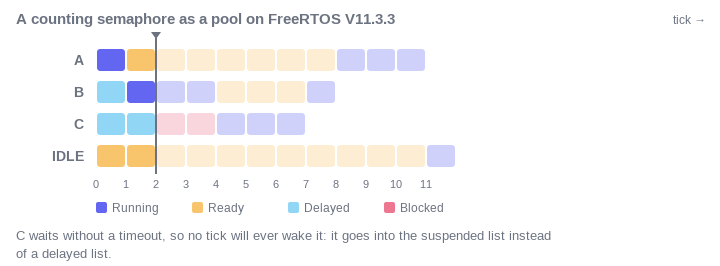
Simulated kernel: FreeRTOS V11.3.3. This scenario and every other one are in the scheduler playground. The simulator and its data files are not covered by the site's CC BY-SA license; see their license notices.
This walkthrough follows the counting semaphore lesson through
FreeRTOS’s queue.c. Pool counts two free buffers. A (priority 1), B (2) and C (3) each
take one, work, and give it back; B starts at tick 1 and C at tick 2. Set the step level to
Line and open the Kernel tab.
A queue that holds nothing
main() creates the semaphore with xSemaphoreCreateCounting( 2, 2 ), a macro for:
QueueHandle_t xQueueCreateCountingSemaphore( const UBaseType_t uxMaxCount,
                                             const UBaseType_t uxInitialCount )
{
    QueueHandle_t xHandle = NULL;

    traceENTER_xQueueCreateCountingSemaphore( uxMaxCount, uxInitialCount );

    if( ( uxMaxCount != 0U ) &&
        ( uxInitialCount <= uxMaxCount ) )
    {
        xHandle = xQueueGenericCreate( uxMaxCount, queueSEMAPHORE_QUEUE_ITEM_LENGTH, queueQUEUE_TYPE_COUNTING_SEMAPHORE );

        if( xHandle != NULL )
        {
            ( ( Queue_t * ) xHandle )->uxMessagesWaiting = uxInitialCount;

            traceCREATE_COUNTING_SEMAPHORE();
        }
        else
        {
            traceCREATE_COUNTING_SEMAPHORE_FAILED();
        }
    }
    else
    {
        configASSERT( xHandle );
        mtCOVERAGE_TEST_MARKER();
    }

    traceRETURN_xQueueCreateCountingSemaphore( xHandle );

    return xHandle;
}queue.c, lines 912–944 · FreeRTOS V11.3.3 · MIT license
It is an ordinary queue, made by xQueueGenericCreate(), with an item size of
queueSEMAPHORE_QUEUE_ITEM_LENGTH, which is 0. The queue walkthrough
describes the fields; for a semaphore they mean:
uxLength: the largest count, here 2.uxMessagesWaiting: the count itself.xQueueCreateCountingSemaphore()writes the start value straight into it: 2, both buffers free.uxItemSize: 0. The queue has no storage, soxQueueGenericCreate()allocates only theQueue_theader, andpcWriteToandpcReadFromare never used.xTasksWaitingToReceive: the tasks waiting for the count to rise above 0.
A binary semaphore is the same queue with a length of 1 that starts at 0
(xSemaphoreCreateBinary()). A mutex is one too, which also records its holder in
xMutexHolder; see priority inheritance.
Taking: xQueueSemaphoreTake
xSemaphoreTake() is a macro for xQueueSemaphoreTake(). Unlike xQueueReceive(), it copies
nothing out.
BaseType_t xQueueSemaphoreTake( QueueHandle_t xQueue,
                                TickType_t xTicksToWait )
{
    BaseType_t xEntryTimeSet = pdFALSE;
    TimeOut_t xTimeOut;
    Queue_t * const pxQueue = xQueue;

    #if ( configUSE_MUTEXES == 1 )
        BaseType_t xInheritanceOccurred = pdFALSE;
    #endif

    traceENTER_xQueueSemaphoreTake( xQueue, xTicksToWait );

    /* Check the queue pointer is not NULL. */
    configASSERT( ( pxQueue ) );

    /* Check this really is a semaphore, in which case the item size will be
     * 0. */
    configASSERT( pxQueue->uxItemSize == 0 );

    /* Cannot block if the scheduler is suspended. */
    #if ( ( INCLUDE_xTaskGetSchedulerState == 1 ) || ( configUSE_TIMERS == 1 ) )
    {
        configASSERT( !( ( xTaskGetSchedulerState() == taskSCHEDULER_SUSPENDED ) && ( xTicksToWait != 0 ) ) );
    }
    #endif

    for( ; ; )
    {
        taskENTER_CRITICAL();
        {
            /* Semaphores are queues with an item size of 0, and where the
             * number of messages in the queue is the semaphore's count value. */
            const UBaseType_t uxSemaphoreCount = pxQueue->uxMessagesWaiting;

            /* Is there data in the queue now?  To be running the calling task
             * must be the highest priority task wanting to access the queue. */
            if( uxSemaphoreCount > ( UBaseType_t ) 0 )
            {
                traceQUEUE_RECEIVE( pxQueue );

                /* Semaphores are queues with a data size of zero and where the
                 * messages waiting is the semaphore's count.  Reduce the count. */
                pxQueue->uxMessagesWaiting = ( UBaseType_t ) ( uxSemaphoreCount - ( UBaseType_t ) 1 );

                #if ( configUSE_MUTEXES == 1 )
                {
                    if( pxQueue->uxQueueType == queueQUEUE_IS_MUTEX )
                    {
                        /* Record the information required to implement
                         * priority inheritance should it become necessary. */
                        pxQueue->u.xSemaphore.xMutexHolder = pvTaskIncrementMutexHeldCount();
                    }
                    else
                    {
                        mtCOVERAGE_TEST_MARKER();
                    }
                }
                #endif /* configUSE_MUTEXES */

                /* Check to see if other tasks are blocked waiting to give the
                 * semaphore, and if so, unblock the highest priority such task. */
                if( listLIST_IS_EMPTY( &( pxQueue->xTasksWaitingToSend ) ) == pdFALSE )
                {
                    if( xTaskRemoveFromEventList( &( pxQueue->xTasksWaitingToSend ) ) != pdFALSE )
                    {
                        queueYIELD_IF_USING_PREEMPTION();
                    }
                    else
                    {
                        mtCOVERAGE_TEST_MARKER();
                    }
                }
                else
                {
                    mtCOVERAGE_TEST_MARKER();
                }

                taskEXIT_CRITICAL();

                traceRETURN_xQueueSemaphoreTake( pdPASS );

                return pdPASS;
            }
            else
            {
                if( xTicksToWait == ( TickType_t ) 0 )
                {
                    /* The semaphore count was 0 and no block time is specified
                     * (or the block time has expired) so exit now. */
                    taskEXIT_CRITICAL();

                    traceQUEUE_RECEIVE_FAILED( pxQueue );
                    traceRETURN_xQueueSemaphoreTake( errQUEUE_EMPTY );

                    return errQUEUE_EMPTY;
                }
                else if( xEntryTimeSet == pdFALSE )
                {
                    /* The semaphore count was 0 and a block time was specified
                     * so configure the timeout structure ready to block. */
                    vTaskInternalSetTimeOutState( &xTimeOut );
                    xEntryTimeSet = pdTRUE;
                }
                else
                {
                    /* Entry time was already set. */
                    mtCOVERAGE_TEST_MARKER();
                }
            }
        }
        taskEXIT_CRITICAL();

        /* Interrupts and other tasks can give to and take from the semaphore
         * now the critical section has been exited. */

        vTaskSuspendAll();
        prvLockQueue( pxQueue );

        /* Update the timeout state to see if it has expired yet. */
        if( xTaskCheckForTimeOut( &xTimeOut, &xTicksToWait ) == pdFALSE )
        {
            /* A block time is specified and not expired.  If the semaphore
             * count is 0 then enter the Blocked state to wait for a semaphore to
             * become available.  As semaphores are implemented with queues the
             * queue being empty is equivalent to the semaphore count being 0. */
            if( prvIsQueueEmpty( pxQueue ) != pdFALSE )
            {
                traceBLOCKING_ON_QUEUE_RECEIVE( pxQueue );

                #if ( configUSE_MUTEXES == 1 )
                {
                    if( pxQueue->uxQueueType == queueQUEUE_IS_MUTEX )
                    {
                        taskENTER_CRITICAL();
                        {
                            xInheritanceOccurred = xTaskPriorityInherit( pxQueue->u.xSemaphore.xMutexHolder );
                        }
                        taskEXIT_CRITICAL();
                    }
                    else
                    {
                        mtCOVERAGE_TEST_MARKER();
                    }
                }
                #endif /* if ( configUSE_MUTEXES == 1 ) */

                vTaskPlaceOnEventList( &( pxQueue->xTasksWaitingToReceive ), xTicksToWait );
                prvUnlockQueue( pxQueue );

                if( xTaskResumeAll() == pdFALSE )
                {
                    taskYIELD_WITHIN_API();
                }
                else
                {
                    mtCOVERAGE_TEST_MARKER();
                }
            }
            else
            {
                /* There was no timeout and the semaphore count was not 0, so
                 * attempt to take the semaphore again. */
                prvUnlockQueue( pxQueue );
                ( void ) xTaskResumeAll();
            }
        }
        else
        {
            /* Timed out. */
            prvUnlockQueue( pxQueue );
            ( void ) xTaskResumeAll();

            /* If the semaphore count is 0 exit now as the timeout has
             * expired.  Otherwise return to attempt to take the semaphore that is
             * known to be available.  As semaphores are implemented by queues the
             * queue being empty is equivalent to the semaphore count being 0. */
            if( prvIsQueueEmpty( pxQueue ) != pdFALSE )
            {
                #if ( configUSE_MUTEXES == 1 )
                {
                    /* xInheritanceOccurred could only have be set if
                     * pxQueue->uxQueueType == queueQUEUE_IS_MUTEX so no need to
                     * test the mutex type again to check it is actually a mutex. */
                    if( xInheritanceOccurred != pdFALSE )
                    {
                        taskENTER_CRITICAL();
                        {
                            UBaseType_t uxHighestWaitingPriority;

                            /* This task blocking on the mutex caused another
                             * task to inherit this task's priority.  Now this task
                             * has timed out the priority should be disinherited
                             * again, but only as low as the next highest priority
                             * task that is waiting for the same mutex. */
                            uxHighestWaitingPriority = prvGetHighestPriorityOfWaitToReceiveList( pxQueue );

                            /* vTaskPriorityDisinheritAfterTimeout uses the uxHighestWaitingPriority
                             * parameter to index pxReadyTasksLists when adding the task holding
                             * mutex to the ready list for its new priority. Coverity thinks that
                             * it can result in out-of-bounds access which is not true because
                             * uxHighestWaitingPriority, as returned by prvGetHighestPriorityOfWaitToReceiveList,
                             * is capped at ( configMAX_PRIORITIES - 1 ). */
                            /* coverity[overrun] */
                            vTaskPriorityDisinheritAfterTimeout( pxQueue->u.xSemaphore.xMutexHolder, uxHighestWaitingPriority );
                        }
                        taskEXIT_CRITICAL();
                    }
                }
                #endif /* configUSE_MUTEXES */

                traceQUEUE_RECEIVE_FAILED( pxQueue );
                traceRETURN_xQueueSemaphoreTake( errQUEUE_EMPTY );

                return errQUEUE_EMPTY;
            }
            else
            {
                mtCOVERAGE_TEST_MARKER();
            }
        }
    }
}queue.c, lines 1659–1881 · FreeRTOS V11.3.3 · MIT license
The function is a loop, like the queue functions. Each pass first looks at the count inside a critical section.
At tick 0 A takes Pool. The count is 2, so the fast path runs: the count
drops to 1, and the function returns pdPASS. The xTasksWaitingToSend check is for a task that waits to
give; nobody does here, because xSemaphoreGive() never waits. At tick 1 B takes the last
buffer the same way, and the count is 0.
At tick 2 C wakes and calls xSemaphoreTake( Pool, portMAX_DELAY ). The
count is 0 and C is willing to wait:
vTaskInternalSetTimeOutState()notes when the wait began.- The function leaves the critical section, suspends the scheduler and locks the queue with
prvLockQueue(). An interrupt may still give or take now; it only counts what it did in the queue’s locks. xTaskCheckForTimeOut()confirms the wait has not run out (it never does withportMAX_DELAY), andprvIsQueueEmpty()confirms that the count is still 0.- The mutex branch is skipped:
Poolis not a mutex, so nobody’s priority is raised. vTaskPlaceOnEventList()putsCintoxTasksWaitingToReceive, sorted by priority, and, because it waits without a timeout, intoxSuspendedTaskList.prvUnlockQueue()andxTaskResumeAll()undo step 2, andtaskYIELD_WITHIN_API()switches toB.
When C runs again, it will be at the bottom of this loop.
Giving: xQueueGenericSend
xSemaphoreGive() is xQueueGenericSend( xSemaphore, NULL, 0, queueSEND_TO_BACK ): a send with no
item and a block time of 0.
BaseType_t xQueueGenericSend( QueueHandle_t xQueue,
                              const void * const pvItemToQueue,
                              TickType_t xTicksToWait,
                              const BaseType_t xCopyPosition )
{
    BaseType_t xEntryTimeSet = pdFALSE, xYieldRequired;
    TimeOut_t xTimeOut;
    Queue_t * const pxQueue = xQueue;

    traceENTER_xQueueGenericSend( xQueue, pvItemToQueue, xTicksToWait, xCopyPosition );

    configASSERT( pxQueue );
    configASSERT( !( ( pvItemToQueue == NULL ) && ( pxQueue->uxItemSize != ( UBaseType_t ) 0U ) ) );
    configASSERT( !( ( xCopyPosition == queueOVERWRITE ) && ( pxQueue->uxLength != 1 ) ) );
    #if ( ( INCLUDE_xTaskGetSchedulerState == 1 ) || ( configUSE_TIMERS == 1 ) )
    {
        configASSERT( !( ( xTaskGetSchedulerState() == taskSCHEDULER_SUSPENDED ) && ( xTicksToWait != 0 ) ) );
    }
    #endif

    for( ; ; )
    {
        taskENTER_CRITICAL();
        {
            /* Is there room on the queue now?  The running task must be the
             * highest priority task wanting to access the queue.  If the head item
             * in the queue is to be overwritten then it does not matter if the
             * queue is full. */
            if( ( pxQueue->uxMessagesWaiting < pxQueue->uxLength ) || ( xCopyPosition == queueOVERWRITE ) )
            {
                traceQUEUE_SEND( pxQueue );

                #if ( configUSE_QUEUE_SETS == 1 )
                {
                    const UBaseType_t uxPreviousMessagesWaiting = pxQueue->uxMessagesWaiting;

                    xYieldRequired = prvCopyDataToQueue( pxQueue, pvItemToQueue, xCopyPosition );

                    if( pxQueue->pxQueueSetContainer != NULL )
                    {
                        if( ( xCopyPosition == queueOVERWRITE ) && ( uxPreviousMessagesWaiting != ( UBaseType_t ) 0 ) )
                        {
                            /* Do not notify the queue set as an existing item
                             * was overwritten in the queue so the number of items
                             * in the queue has not changed. */
                            mtCOVERAGE_TEST_MARKER();
                        }
                        else if( prvNotifyQueueSetContainer( pxQueue ) != pdFALSE )
                        {
                            /* The queue is a member of a queue set, and posting
                             * to the queue set caused a higher priority task to
                             * unblock. A context switch is required. */
                            queueYIELD_IF_USING_PREEMPTION();
                        }
                        else
                        {
                            mtCOVERAGE_TEST_MARKER();
                        }
                    }
                    else
                    {
                        /* If there was a task waiting for data to arrive on the
                         * queue then unblock it now. */
                        if( listLIST_IS_EMPTY( &( pxQueue->xTasksWaitingToReceive ) ) == pdFALSE )
                        {
                            if( xTaskRemoveFromEventList( &( pxQueue->xTasksWaitingToReceive ) ) != pdFALSE )
                            {
                                /* The unblocked task has a priority higher than
                                 * our own so yield immediately.  Yes it is ok to
                                 * do this from within the critical section - the
                                 * kernel takes care of that. */
                                queueYIELD_IF_USING_PREEMPTION();
                            }
                            else
                            {
                                mtCOVERAGE_TEST_MARKER();
                            }
                        }
                        else if( xYieldRequired != pdFALSE )
                        {
                            /* This path is a special case that will only get
                             * executed if the task was holding multiple mutexes
                             * and the mutexes were given back in an order that is
                             * different to that in which they were taken. */
                            queueYIELD_IF_USING_PREEMPTION();
                        }
                        else
                        {
                            mtCOVERAGE_TEST_MARKER();
                        }
                    }
                }
                #else /* configUSE_QUEUE_SETS */
                {
                    xYieldRequired = prvCopyDataToQueue( pxQueue, pvItemToQueue, xCopyPosition );

                    /* If there was a task waiting for data to arrive on the
                     * queue then unblock it now. */
                    if( listLIST_IS_EMPTY( &( pxQueue->xTasksWaitingToReceive ) ) == pdFALSE )
                    {
                        if( xTaskRemoveFromEventList( &( pxQueue->xTasksWaitingToReceive ) ) != pdFALSE )
                        {
                            /* The unblocked task has a priority higher than
                             * our own so yield immediately.  Yes it is ok to do
                             * this from within the critical section - the kernel
                             * takes care of that. */
                            queueYIELD_IF_USING_PREEMPTION();
                        }
                        else
                        {
                            mtCOVERAGE_TEST_MARKER();
                        }
                    }
                    else if( xYieldRequired != pdFALSE )
                    {
                        /* This path is a special case that will only get
                         * executed if the task was holding multiple mutexes and
                         * the mutexes were given back in an order that is
                         * different to that in which they were taken. */
                        queueYIELD_IF_USING_PREEMPTION();
                    }
                    else
                    {
                        mtCOVERAGE_TEST_MARKER();
                    }
                }
                #endif /* configUSE_QUEUE_SETS */

                taskEXIT_CRITICAL();

                traceRETURN_xQueueGenericSend( pdPASS );

                return pdPASS;
            }
            else
            {
                if( xTicksToWait == ( TickType_t ) 0 )
                {
                    /* The queue was full and no block time is specified (or
                     * the block time has expired) so leave now. */
                    taskEXIT_CRITICAL();

                    /* Return to the original privilege level before exiting
                     * the function. */
                    traceQUEUE_SEND_FAILED( pxQueue );
                    traceRETURN_xQueueGenericSend( errQUEUE_FULL );

                    return errQUEUE_FULL;
                }
                else if( xEntryTimeSet == pdFALSE )
                {
                    /* The queue was full and a block time was specified so
                     * configure the timeout structure. */
                    vTaskInternalSetTimeOutState( &xTimeOut );
                    xEntryTimeSet = pdTRUE;
                }
                else
                {
                    /* Entry time was already set. */
                    mtCOVERAGE_TEST_MARKER();
                }
            }
        }
        taskEXIT_CRITICAL();

        /* Interrupts and other tasks can send to and receive from the queue
         * now the critical section has been exited. */

        vTaskSuspendAll();
        prvLockQueue( pxQueue );

        /* Update the timeout state to see if it has expired yet. */
        if( xTaskCheckForTimeOut( &xTimeOut, &xTicksToWait ) == pdFALSE )
        {
            if( prvIsQueueFull( pxQueue ) != pdFALSE )
            {
                traceBLOCKING_ON_QUEUE_SEND( pxQueue );
                vTaskPlaceOnEventList( &( pxQueue->xTasksWaitingToSend ), xTicksToWait );

                /* Unlocking the queue means queue events can effect the
                 * event list. It is possible that interrupts occurring now
                 * remove this task from the event list again - but as the
                 * scheduler is suspended the task will go onto the pending
                 * ready list instead of the actual ready list. */
                prvUnlockQueue( pxQueue );

                /* Resuming the scheduler will move tasks from the pending
                 * ready list into the ready list - so it is feasible that this
                 * task is already in the ready list before it yields - in which
                 * case the yield will not cause a context switch unless there
                 * is also a higher priority task in the pending ready list. */
                if( xTaskResumeAll() == pdFALSE )
                {
                    taskYIELD_WITHIN_API();
                }
            }
            else
            {
                /* Try again. */
                prvUnlockQueue( pxQueue );
                ( void ) xTaskResumeAll();
            }
        }
        else
        {
            /* The timeout has expired. */
            prvUnlockQueue( pxQueue );
            ( void ) xTaskResumeAll();

            traceQUEUE_SEND_FAILED( pxQueue );
            traceRETURN_xQueueGenericSend( errQUEUE_FULL );

            return errQUEUE_FULL;
        }
    }
}queue.c, lines 949–1164 · FreeRTOS V11.3.3 · MIT license
At tick 4 B gives its buffer back:
- The count (0) is below
uxLength(2), so there is room. prvCopyDataToQueue()copies nothing, because the item size is 0, but it still adds one touxMessagesWaiting: the count is 1. For a mutex this is also where the holder’s priority is restored.
static BaseType_t prvCopyDataToQueue( Queue_t * const pxQueue,
                                      const void * pvItemToQueue,
                                      const BaseType_t xPosition )
{
    BaseType_t xReturn = pdFALSE;
    UBaseType_t uxMessagesWaiting;

    /* This function is called from a critical section. */

    uxMessagesWaiting = pxQueue->uxMessagesWaiting;

    if( pxQueue->uxItemSize == ( UBaseType_t ) 0 )
    {
        #if ( configUSE_MUTEXES == 1 )
        {
            if( pxQueue->uxQueueType == queueQUEUE_IS_MUTEX )
            {
                /* The mutex is no longer being held. */
                xReturn = xTaskPriorityDisinherit( pxQueue->u.xSemaphore.xMutexHolder );
                pxQueue->u.xSemaphore.xMutexHolder = NULL;
            }
            else
            {
                mtCOVERAGE_TEST_MARKER();
            }
        }
        #endif /* configUSE_MUTEXES */
    }
    else if( xPosition == queueSEND_TO_BACK )
    {
        ( void ) memcpy( ( void * ) pxQueue->pcWriteTo, pvItemToQueue, ( size_t ) pxQueue->uxItemSize );
        pxQueue->pcWriteTo += pxQueue->uxItemSize;

        if( pxQueue->pcWriteTo >= pxQueue->u.xQueue.pcTail )
        {
            pxQueue->pcWriteTo = pxQueue->pcHead;
        }
        else
        {
            mtCOVERAGE_TEST_MARKER();
        }
    }
    else
    {
        ( void ) memcpy( ( void * ) pxQueue->u.xQueue.pcReadFrom, pvItemToQueue, ( size_t ) pxQueue->uxItemSize );
        pxQueue->u.xQueue.pcReadFrom -= pxQueue->uxItemSize;

        if( pxQueue->u.xQueue.pcReadFrom < pxQueue->pcHead )
        {
            pxQueue->u.xQueue.pcReadFrom = ( pxQueue->u.xQueue.pcTail - pxQueue->uxItemSize );
        }
        else
        {
            mtCOVERAGE_TEST_MARKER();
        }

        if( xPosition == queueOVERWRITE )
        {
            if( uxMessagesWaiting > ( UBaseType_t ) 0 )
            {
                /* An item is not being added but overwritten, so subtract
                 * one from the recorded number of items in the queue so when
                 * one is added again below the number of recorded items remains
                 * correct. */
                --uxMessagesWaiting;
            }
            else
            {
                mtCOVERAGE_TEST_MARKER();
            }
        }
        else
        {
            mtCOVERAGE_TEST_MARKER();
        }
    }

    pxQueue->uxMessagesWaiting = ( UBaseType_t ) ( uxMessagesWaiting + ( UBaseType_t ) 1 );

    return xReturn;
}queue.c, lines 2395–2475 · FreeRTOS V11.3.3 · MIT license
xTasksWaitingToReceiveis not empty, soxTaskRemoveFromEventList()takesCoff it and puts it back in its ready list.C(3) is more urgent thanB(2), so the function returnspdTRUE.queueYIELD_IF_USING_PREEMPTION()asks for a switch, andCruns beforeBeven returns from its call.
If the count were already at uxLength, there would be no room. The block time is 0, so the give
would return errQUEUE_FULL at once instead of waiting.
The woken task takes the count itself
Note what the give did not do: it did not take the count for C. The count is 1 when C runs.
C resumes inside xQueueSemaphoreTake(), goes round the loop, finds the count at 1 and takes it
(the take at tick 4, in C’s own context). Only then is the count 0 again.
Between the give and that take, the count is 1 and anyone could take it. Here nobody can, because
C runs at once. If C were not more urgent than the giver, the switch would wait, and another
task could take the buffer first; C would find the count at 0 and wait again. Zephyr does it the
other way round: see
who takes the count.
What to try
- Set Pool counts up to 3.
Cfinds the count at 1 at tick 2 and takes it on the fast path;xTasksWaitingToReceivestays empty for the whole run. - Give
Can urgency of 2, the same asB. At tick 4B’s give still raises the count and makesCready, butxTaskRemoveFromEventList()returnspdFALSE:Cis not more urgent.Bkeeps the CPU with the count at 1 until the tick-5 time slice, and only then doesCtake it.