Queues in FreeRTOS
How xQueueSend and xQueueReceive copy items through a ring of slots, how a task waits for room or for an item, and why the queue is locked while it does.
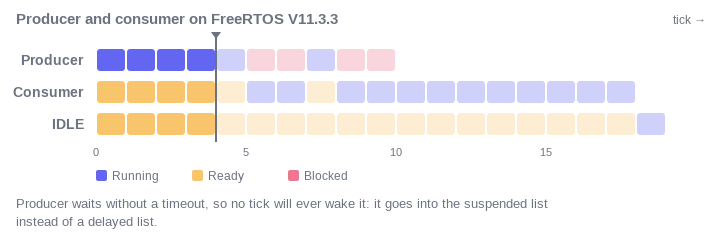
Simulated kernel: FreeRTOS V11.3.3. This scenario and every other one are in the scheduler playground. The simulator and its data files are not covered by the site's CC BY-SA license; see their license notices.
This walkthrough follows the producer and consumer through FreeRTOS’s
queue.c. Set the step level to Line and go to tick 4: the queue Q is full,
Producer is about to send its fourth item and Consumer has not run yet.
What a queue is
xQueueCreate( 3, sizeof( uint32_t ) ) allocates one block: the Queue_t header followed by the
storage for 3 items of 4 bytes. The fields that matter here are shown in the kernel panel:
uxLengthanduxItemSize: 3 slots of 4 bytes.uxMessagesWaiting: how many slots hold an item.pcWriteTo: the slot the next item is copied into.pcReadFrom: the slot the last item was read from. The next read moves it on by one first.xTasksWaitingToSendandxTasksWaitingToReceive: the tasks blocked on a full and on an empty queue, each list ordered by priority.
Both pointers wrap round at the end of the storage, so the slots form a ring. The panel draws the
slots in memory order, with the oldest item marked “out” and the slot pcWriteTo points at marked
“in”. Mutexes and semaphores are the same structure with uxItemSize 0: nothing is copied, and
only uxMessagesWaiting counts.
Sending: xQueueGenericSend
xQueueSend() is a macro for xQueueGenericSend(), which also implements xQueueSendToFront(),
xQueueOverwrite() and, with no item, xSemaphoreGive().
BaseType_t xQueueGenericSend( QueueHandle_t xQueue,
                              const void * const pvItemToQueue,
                              TickType_t xTicksToWait,
                              const BaseType_t xCopyPosition )
{
    BaseType_t xEntryTimeSet = pdFALSE, xYieldRequired;
    TimeOut_t xTimeOut;
    Queue_t * const pxQueue = xQueue;

    traceENTER_xQueueGenericSend( xQueue, pvItemToQueue, xTicksToWait, xCopyPosition );

    configASSERT( pxQueue );
    configASSERT( !( ( pvItemToQueue == NULL ) && ( pxQueue->uxItemSize != ( UBaseType_t ) 0U ) ) );
    configASSERT( !( ( xCopyPosition == queueOVERWRITE ) && ( pxQueue->uxLength != 1 ) ) );
    #if ( ( INCLUDE_xTaskGetSchedulerState == 1 ) || ( configUSE_TIMERS == 1 ) )
    {
        configASSERT( !( ( xTaskGetSchedulerState() == taskSCHEDULER_SUSPENDED ) && ( xTicksToWait != 0 ) ) );
    }
    #endif

    for( ; ; )
    {
        taskENTER_CRITICAL();
        {
            /* Is there room on the queue now?  The running task must be the
             * highest priority task wanting to access the queue.  If the head item
             * in the queue is to be overwritten then it does not matter if the
             * queue is full. */
            if( ( pxQueue->uxMessagesWaiting < pxQueue->uxLength ) || ( xCopyPosition == queueOVERWRITE ) )
            {
                traceQUEUE_SEND( pxQueue );

                #if ( configUSE_QUEUE_SETS == 1 )
                {
                    const UBaseType_t uxPreviousMessagesWaiting = pxQueue->uxMessagesWaiting;

                    xYieldRequired = prvCopyDataToQueue( pxQueue, pvItemToQueue, xCopyPosition );

                    if( pxQueue->pxQueueSetContainer != NULL )
                    {
                        if( ( xCopyPosition == queueOVERWRITE ) && ( uxPreviousMessagesWaiting != ( UBaseType_t ) 0 ) )
                        {
                            /* Do not notify the queue set as an existing item
                             * was overwritten in the queue so the number of items
                             * in the queue has not changed. */
                            mtCOVERAGE_TEST_MARKER();
                        }
                        else if( prvNotifyQueueSetContainer( pxQueue ) != pdFALSE )
                        {
                            /* The queue is a member of a queue set, and posting
                             * to the queue set caused a higher priority task to
                             * unblock. A context switch is required. */
                            queueYIELD_IF_USING_PREEMPTION();
                        }
                        else
                        {
                            mtCOVERAGE_TEST_MARKER();
                        }
                    }
                    else
                    {
                        /* If there was a task waiting for data to arrive on the
                         * queue then unblock it now. */
                        if( listLIST_IS_EMPTY( &( pxQueue->xTasksWaitingToReceive ) ) == pdFALSE )
                        {
                            if( xTaskRemoveFromEventList( &( pxQueue->xTasksWaitingToReceive ) ) != pdFALSE )
                            {
                                /* The unblocked task has a priority higher than
                                 * our own so yield immediately.  Yes it is ok to
                                 * do this from within the critical section - the
                                 * kernel takes care of that. */
                                queueYIELD_IF_USING_PREEMPTION();
                            }
                            else
                            {
                                mtCOVERAGE_TEST_MARKER();
                            }
                        }
                        else if( xYieldRequired != pdFALSE )
                        {
                            /* This path is a special case that will only get
                             * executed if the task was holding multiple mutexes
                             * and the mutexes were given back in an order that is
                             * different to that in which they were taken. */
                            queueYIELD_IF_USING_PREEMPTION();
                        }
                        else
                        {
                            mtCOVERAGE_TEST_MARKER();
                        }
                    }
                }
                #else /* configUSE_QUEUE_SETS */
                {
                    xYieldRequired = prvCopyDataToQueue( pxQueue, pvItemToQueue, xCopyPosition );

                    /* If there was a task waiting for data to arrive on the
                     * queue then unblock it now. */
                    if( listLIST_IS_EMPTY( &( pxQueue->xTasksWaitingToReceive ) ) == pdFALSE )
                    {
                        if( xTaskRemoveFromEventList( &( pxQueue->xTasksWaitingToReceive ) ) != pdFALSE )
                        {
                            /* The unblocked task has a priority higher than
                             * our own so yield immediately.  Yes it is ok to do
                             * this from within the critical section - the kernel
                             * takes care of that. */
                            queueYIELD_IF_USING_PREEMPTION();
                        }
                        else
                        {
                            mtCOVERAGE_TEST_MARKER();
                        }
                    }
                    else if( xYieldRequired != pdFALSE )
                    {
                        /* This path is a special case that will only get
                         * executed if the task was holding multiple mutexes and
                         * the mutexes were given back in an order that is
                         * different to that in which they were taken. */
                        queueYIELD_IF_USING_PREEMPTION();
                    }
                    else
                    {
                        mtCOVERAGE_TEST_MARKER();
                    }
                }
                #endif /* configUSE_QUEUE_SETS */

                taskEXIT_CRITICAL();

                traceRETURN_xQueueGenericSend( pdPASS );

                return pdPASS;
            }
            else
            {
                if( xTicksToWait == ( TickType_t ) 0 )
                {
                    /* The queue was full and no block time is specified (or
                     * the block time has expired) so leave now. */
                    taskEXIT_CRITICAL();

                    /* Return to the original privilege level before exiting
                     * the function. */
                    traceQUEUE_SEND_FAILED( pxQueue );
                    traceRETURN_xQueueGenericSend( errQUEUE_FULL );

                    return errQUEUE_FULL;
                }
                else if( xEntryTimeSet == pdFALSE )
                {
                    /* The queue was full and a block time was specified so
                     * configure the timeout structure. */
                    vTaskInternalSetTimeOutState( &xTimeOut );
                    xEntryTimeSet = pdTRUE;
                }
                else
                {
                    /* Entry time was already set. */
                    mtCOVERAGE_TEST_MARKER();
                }
            }
        }
        taskEXIT_CRITICAL();

        /* Interrupts and other tasks can send to and receive from the queue
         * now the critical section has been exited. */

        vTaskSuspendAll();
        prvLockQueue( pxQueue );

        /* Update the timeout state to see if it has expired yet. */
        if( xTaskCheckForTimeOut( &xTimeOut, &xTicksToWait ) == pdFALSE )
        {
            if( prvIsQueueFull( pxQueue ) != pdFALSE )
            {
                traceBLOCKING_ON_QUEUE_SEND( pxQueue );
                vTaskPlaceOnEventList( &( pxQueue->xTasksWaitingToSend ), xTicksToWait );

                /* Unlocking the queue means queue events can effect the
                 * event list. It is possible that interrupts occurring now
                 * remove this task from the event list again - but as the
                 * scheduler is suspended the task will go onto the pending
                 * ready list instead of the actual ready list. */
                prvUnlockQueue( pxQueue );

                /* Resuming the scheduler will move tasks from the pending
                 * ready list into the ready list - so it is feasible that this
                 * task is already in the ready list before it yields - in which
                 * case the yield will not cause a context switch unless there
                 * is also a higher priority task in the pending ready list. */
                if( xTaskResumeAll() == pdFALSE )
                {
                    taskYIELD_WITHIN_API();
                }
            }
            else
            {
                /* Try again. */
                prvUnlockQueue( pxQueue );
                ( void ) xTaskResumeAll();
            }
        }
        else
        {
            /* The timeout has expired. */
            prvUnlockQueue( pxQueue );
            ( void ) xTaskResumeAll();

            traceQUEUE_SEND_FAILED( pxQueue );
            traceRETURN_xQueueGenericSend( errQUEUE_FULL );

            return errQUEUE_FULL;
        }
    }
}queue.c, lines 949–1164 · FreeRTOS V11.3.3 · MIT license
The function is a loop. Each pass first looks for room inside a critical section:
- At ticks 1 to 3 there is room.
prvCopyDataToQueue()copies the item and raisesuxMessagesWaiting; nobody is waiting to receive, so the call returnspdPASS. - At tick 4
uxMessagesWaitingequalsuxLength.ProducerpassedportMAX_DELAY, so it is willing to wait:vTaskInternalSetTimeOutState()notes when the wait began.
Then it leaves the critical section and prepares to block, which takes longer:
vTaskSuspendAll()stops the scheduler, so no other task runs while the lists are changed. Interrupts still can.prvLockQueue()setscRxLockandcTxLock. An interrupt that sends to or receives from the queue now still moves items, but leaves the waiting lists alone and only counts what it did in the lock. This is how FreeRTOS keeps its critical sections short: the slow work is done with interrupts on.xTaskCheckForTimeOut()confirms the wait has not run out (it never does withportMAX_DELAY), andprvIsQueueFull()confirms that the queue is still full.vTaskPlaceOnEventList()putsProducerintoxTasksWaitingToSend, and, because it waits without a timeout, intoxSuspendedTaskListrather than a delayed list.prvUnlockQueue()replays anything an interrupt counted in the locks (here nothing), andxTaskResumeAll()restarts the scheduler.Produceris no longer ready, sotaskYIELD_WITHIN_API()switches toConsumer.
When Producer runs again it will be at the bottom of the loop, and go round to try again.
Receiving: xQueueReceive
Consumer now calls xQueueReceive(), which has the same shape:
BaseType_t xQueueReceive( QueueHandle_t xQueue,
                          void * const pvBuffer,
                          TickType_t xTicksToWait )
{
    BaseType_t xEntryTimeSet = pdFALSE;
    TimeOut_t xTimeOut;
    Queue_t * const pxQueue = xQueue;

    traceENTER_xQueueReceive( xQueue, pvBuffer, xTicksToWait );

    /* Check the pointer is not NULL. */
    configASSERT( ( pxQueue ) );

    /* The buffer into which data is received can only be NULL if the data size
     * is zero (so no data is copied into the buffer). */
    configASSERT( !( ( ( pvBuffer ) == NULL ) && ( ( pxQueue )->uxItemSize != ( UBaseType_t ) 0U ) ) );

    /* Cannot block if the scheduler is suspended. */
    #if ( ( INCLUDE_xTaskGetSchedulerState == 1 ) || ( configUSE_TIMERS == 1 ) )
    {
        configASSERT( !( ( xTaskGetSchedulerState() == taskSCHEDULER_SUSPENDED ) && ( xTicksToWait != 0 ) ) );
    }
    #endif

    for( ; ; )
    {
        taskENTER_CRITICAL();
        {
            const UBaseType_t uxMessagesWaiting = pxQueue->uxMessagesWaiting;

            /* Is there data in the queue now?  To be running the calling task
             * must be the highest priority task wanting to access the queue. */
            if( uxMessagesWaiting > ( UBaseType_t ) 0 )
            {
                /* Data available, remove one item. */
                prvCopyDataFromQueue( pxQueue, pvBuffer );
                traceQUEUE_RECEIVE( pxQueue );
                pxQueue->uxMessagesWaiting = ( UBaseType_t ) ( uxMessagesWaiting - ( UBaseType_t ) 1 );

                /* There is now space in the queue, were any tasks waiting to
                 * post to the queue?  If so, unblock the highest priority waiting
                 * task. */
                if( listLIST_IS_EMPTY( &( pxQueue->xTasksWaitingToSend ) ) == pdFALSE )
                {
                    if( xTaskRemoveFromEventList( &( pxQueue->xTasksWaitingToSend ) ) != pdFALSE )
                    {
                        queueYIELD_IF_USING_PREEMPTION();
                    }
                    else
                    {
                        mtCOVERAGE_TEST_MARKER();
                    }
                }
                else
                {
                    mtCOVERAGE_TEST_MARKER();
                }

                taskEXIT_CRITICAL();

                traceRETURN_xQueueReceive( pdPASS );

                return pdPASS;
            }
            else
            {
                if( xTicksToWait == ( TickType_t ) 0 )
                {
                    /* The queue was empty and no block time is specified (or
                     * the block time has expired) so leave now. */
                    taskEXIT_CRITICAL();

                    traceQUEUE_RECEIVE_FAILED( pxQueue );
                    traceRETURN_xQueueReceive( errQUEUE_EMPTY );

                    return errQUEUE_EMPTY;
                }
                else if( xEntryTimeSet == pdFALSE )
                {
                    /* The queue was empty and a block time was specified so
                     * configure the timeout structure. */
                    vTaskInternalSetTimeOutState( &xTimeOut );
                    xEntryTimeSet = pdTRUE;
                }
                else
                {
                    /* Entry time was already set. */
                    mtCOVERAGE_TEST_MARKER();
                }
            }
        }
        taskEXIT_CRITICAL();

        /* Interrupts and other tasks can send to and receive from the queue
         * now the critical section has been exited. */

        vTaskSuspendAll();
        prvLockQueue( pxQueue );

        /* Update the timeout state to see if it has expired yet. */
        if( xTaskCheckForTimeOut( &xTimeOut, &xTicksToWait ) == pdFALSE )
        {
            /* The timeout has not expired.  If the queue is still empty place
             * the task on the list of tasks waiting to receive from the queue. */
            if( prvIsQueueEmpty( pxQueue ) != pdFALSE )
            {
                traceBLOCKING_ON_QUEUE_RECEIVE( pxQueue );
                vTaskPlaceOnEventList( &( pxQueue->xTasksWaitingToReceive ), xTicksToWait );
                prvUnlockQueue( pxQueue );

                if( xTaskResumeAll() == pdFALSE )
                {
                    taskYIELD_WITHIN_API();
                }
                else
                {
                    mtCOVERAGE_TEST_MARKER();
                }
            }
            else
            {
                /* The queue contains data again.  Loop back to try and read the
                 * data. */
                prvUnlockQueue( pxQueue );
                ( void ) xTaskResumeAll();
            }
        }
        else
        {
            /* Timed out.  If there is no data in the queue exit, otherwise loop
             * back and attempt to read the data. */
            prvUnlockQueue( pxQueue );
            ( void ) xTaskResumeAll();

            if( prvIsQueueEmpty( pxQueue ) != pdFALSE )
            {
                traceQUEUE_RECEIVE_FAILED( pxQueue );
                traceRETURN_xQueueReceive( errQUEUE_EMPTY );

                return errQUEUE_EMPTY;
            }
            else
            {
                mtCOVERAGE_TEST_MARKER();
            }
        }
    }
}queue.c, lines 1509–1656 · FreeRTOS V11.3.3 · MIT license
uxMessagesWaiting is 3, so it takes the fast path. prvCopyDataFromQueue() moves pcReadFrom
on by one slot (from slot 2 it wraps round to slot 0) and copies Producer#1 out:
static void prvCopyDataFromQueue( Queue_t * const pxQueue,
                                  void * const pvBuffer )
{
    if( pxQueue->uxItemSize != ( UBaseType_t ) 0 )
    {
        pxQueue->u.xQueue.pcReadFrom += pxQueue->uxItemSize;

        if( pxQueue->u.xQueue.pcReadFrom >= pxQueue->u.xQueue.pcTail )
        {
            pxQueue->u.xQueue.pcReadFrom = pxQueue->pcHead;
        }
        else
        {
            mtCOVERAGE_TEST_MARKER();
        }

        ( void ) memcpy( ( void * ) pvBuffer, ( void * ) pxQueue->u.xQueue.pcReadFrom, ( size_t ) pxQueue->uxItemSize );
    }
}queue.c, lines 2478–2496 · FreeRTOS V11.3.3 · MIT license
The count drops to 2. Then xQueueReceive() looks at xTasksWaitingToSend. A slot has just been
freed and Producer waits for one, so xTaskRemoveFromEventList() takes it off the list and puts
it back in its ready list. Producer is more urgent than Consumer, so
queueYIELD_IF_USING_PREEMPTION() asks for a switch, and PendSV switches to Producer before
Consumer even returns from its call.
Back in the send loop
Producer resumes in xQueueGenericSend() and goes round its loop. Now there is room, and
prvCopyDataToQueue() copies Producer#4:
static BaseType_t prvCopyDataToQueue( Queue_t * const pxQueue,
                                      const void * pvItemToQueue,
                                      const BaseType_t xPosition )
{
    BaseType_t xReturn = pdFALSE;
    UBaseType_t uxMessagesWaiting;

    /* This function is called from a critical section. */

    uxMessagesWaiting = pxQueue->uxMessagesWaiting;

    if( pxQueue->uxItemSize == ( UBaseType_t ) 0 )
    {
        #if ( configUSE_MUTEXES == 1 )
        {
            if( pxQueue->uxQueueType == queueQUEUE_IS_MUTEX )
            {
                /* The mutex is no longer being held. */
                xReturn = xTaskPriorityDisinherit( pxQueue->u.xSemaphore.xMutexHolder );
                pxQueue->u.xSemaphore.xMutexHolder = NULL;
            }
            else
            {
                mtCOVERAGE_TEST_MARKER();
            }
        }
        #endif /* configUSE_MUTEXES */
    }
    else if( xPosition == queueSEND_TO_BACK )
    {
        ( void ) memcpy( ( void * ) pxQueue->pcWriteTo, pvItemToQueue, ( size_t ) pxQueue->uxItemSize );
        pxQueue->pcWriteTo += pxQueue->uxItemSize;

        if( pxQueue->pcWriteTo >= pxQueue->u.xQueue.pcTail )
        {
            pxQueue->pcWriteTo = pxQueue->pcHead;
        }
        else
        {
            mtCOVERAGE_TEST_MARKER();
        }
    }
    else
    {
        ( void ) memcpy( ( void * ) pxQueue->u.xQueue.pcReadFrom, pvItemToQueue, ( size_t ) pxQueue->uxItemSize );
        pxQueue->u.xQueue.pcReadFrom -= pxQueue->uxItemSize;

        if( pxQueue->u.xQueue.pcReadFrom < pxQueue->pcHead )
        {
            pxQueue->u.xQueue.pcReadFrom = ( pxQueue->u.xQueue.pcTail - pxQueue->uxItemSize );
        }
        else
        {
            mtCOVERAGE_TEST_MARKER();
        }

        if( xPosition == queueOVERWRITE )
        {
            if( uxMessagesWaiting > ( UBaseType_t ) 0 )
            {
                /* An item is not being added but overwritten, so subtract
                 * one from the recorded number of items in the queue so when
                 * one is added again below the number of recorded items remains
                 * correct. */
                --uxMessagesWaiting;
            }
            else
            {
                mtCOVERAGE_TEST_MARKER();
            }
        }
        else
        {
            mtCOVERAGE_TEST_MARKER();
        }
    }

    pxQueue->uxMessagesWaiting = ( UBaseType_t ) ( uxMessagesWaiting + ( UBaseType_t ) 1 );

    return xReturn;
}queue.c, lines 2395–2475 · FreeRTOS V11.3.3 · MIT license
pcWriteTo wrapped to slot 0 after the third item, so Producer#4 lands in slot 0, the slot
Producer#1 was just read from. Look at the panel: the items read Producer#4, Producer#2,
Producer#3 in memory order, with “out” on slot 1. The order in which they will be received is
still #2, #3, #4.
Note what the receive did not do: it did not send Producer#4 on the producer’s behalf. It only
woke the producer, which sent the item itself when it ran. If a third task had filled the slot
first, Producer would have found the queue full again and blocked again. Zephyr does it the
other way round, as its walkthrough shows; the
queue handoff lesson shows the same choice on the receiving side.
A timeout that runs out
With a timeout, xTaskCheckForTimeOut() may say the wait is over. A send then unlocks the queue,
resumes the scheduler and returns errQUEUE_FULL without looking again, even if a slot was freed
in the meantime. A receive is more forgiving: it looks once more with prvIsQueueEmpty(), and goes
round the loop if an item arrived after all.