Counting semaphores
A semaphore that counts higher than 1, used as a pool of identical resources or to count events, and why a task waiting for one inherits nothing.
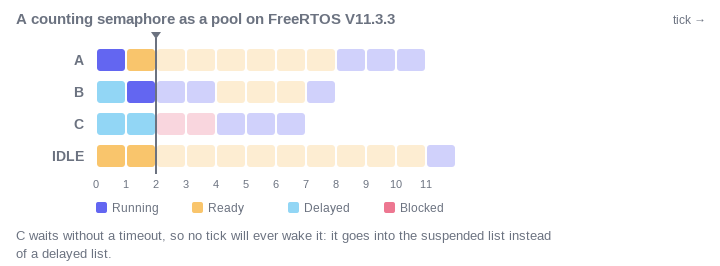
Simulated kernel: FreeRTOS V11.3.3 and Zephyr v4.5.0. This scenario and every other one are in the scheduler playground. The simulator and its data files are not covered by the site's CC BY-SA license; see their license notices.
A binary semaphore counts to 1: something has happened, or it has not. Many problems need a larger number. A driver has four DMA buffers, and any four tasks may use one at a time. An interrupt fires three times before the task that handles it gets to run, and all three must be handled. A counting semaphore is the same kernel object with a higher limit: taking it decrements the count, giving it increments the count up to its maximum, and a task that takes it at 0 waits.
The count can mean two things, and the semaphore starts accordingly:
- Free resources (a pool). The count starts at the maximum: every buffer is free. A task takes before it uses a buffer and gives when it is done, like a lock that several tasks can hold at once.
- Events not yet handled. The count starts at 0. The producer (often an interrupt handler) gives once per event, and the handler takes once per event it handles.
This lesson shows the first; the second is in the interrupts lesson.
The scenario
Pool counts two free buffers: xSemaphoreCreateCounting( 2, 2 ) in FreeRTOS, and
K_SEM_DEFINE(Pool, 2, 2) in Zephyr (an initial count of 2 and a limit of 2). Three tasks each need
a buffer for a while.
A, the least urgent, takesPoolat once, works for three ticks with it, gives it back and works one tick more.Bdoes the same, starting at tick 1.C, the most urgent, starts at tick 2, needs a buffer for two ticks, gives it back and works one more tick.
There are three takers and two buffers, so one of them has to wait.
What happens
The ticks are those of FreeRTOS. On Zephyr each start delay is one tick longer (k_sleep() sleeps
at least the full ticks it is given), so most steps come one tick later; the order is the same.
- Tick 0:
CandBsleep until their start, andAtakesPool. The count goes from 2 to 1. The semaphore panel shows one of its two tokens left. - Tick 1:
Bwakes, preemptsAand takes the last buffer. The count is 0. - Tick 2:
Cwakes, preemptsBand tries to takePool. The count is 0, soCblocks in the semaphore’s waiting list, andBruns on. - Tick 4:
Bgives its buffer back.Cis waiting, so the give wakes it.Cis more urgent thanBand runs at once, with the buffer. Cgives at tick 6, works one more tick and ends;Band thenAfinish their work.Agives the last buffer back at tick 10, on both kernels.
Look at the cards while C waits. A and B hold the buffers, yet their priorities do not
change, and the “Who waits for whom” panel says Pool has no owner. A mutex records the task that
holds it, and the kernel can raise that task’s priority when a more urgent one waits
(priority inheritance). A counting semaphore only has a number.
The kernel cannot tell which of the takers will give next, so it cannot help them along. If A and
B were preempted by a medium-priority task, C would wait for as long as that task ran: the same
priority inversion as with a binary semaphore used as a lock.
In the kernels
FreeRTOS makes a counting semaphore out of a queue whose items have no size, as it does a binary semaphore. The maximum is the queue’s length, and the start value is written straight into the count:
QueueHandle_t xQueueCreateCountingSemaphore( const UBaseType_t uxMaxCount,
                                             const UBaseType_t uxInitialCount )
{
    QueueHandle_t xHandle = NULL;

    traceENTER_xQueueCreateCountingSemaphore( uxMaxCount, uxInitialCount );

    if( ( uxMaxCount != 0U ) &&
        ( uxInitialCount <= uxMaxCount ) )
    {
        xHandle = xQueueGenericCreate( uxMaxCount, queueSEMAPHORE_QUEUE_ITEM_LENGTH, queueQUEUE_TYPE_COUNTING_SEMAPHORE );

        if( xHandle != NULL )
        {
            ( ( Queue_t * ) xHandle )->uxMessagesWaiting = uxInitialCount;

            traceCREATE_COUNTING_SEMAPHORE();
        }
        else
        {
            traceCREATE_COUNTING_SEMAPHORE_FAILED();
        }
    }
    else
    {
        configASSERT( xHandle );
        mtCOVERAGE_TEST_MARKER();
    }

    traceRETURN_xQueueCreateCountingSemaphore( xHandle );

    return xHandle;
}queue.c, lines 912–944 · FreeRTOS V11.3.3 · MIT license
Taking and giving are the same xQueueSemaphoreTake() and xQueueGenericSend() that a binary
semaphore uses; only uxLength differs. A give checks uxMessagesWaiting < pxQueue->uxLength, so
a give to a full pool fails and returns pdFALSE.
Zephyr’s struct k_sem keeps a count and a limit. A binary semaphore is just one with a limit
of 1:
int z_impl_k_sem_take(struct k_sem *sem, k_timeout_t timeout)
{
	struct k_spinlock *lock = sem_spinlock_get(sem);
	int ret;

	__ASSERT(((arch_is_in_isr() == false) ||
		  K_TIMEOUT_EQ(timeout, K_NO_WAIT)), "");

	k_spinlock_key_t key = k_spin_lock(lock);

	SYS_PORT_TRACING_OBJ_FUNC_ENTER(k_sem, take, sem, timeout);

	if (likely(sem->count > 0U)) {
		sem->count--;
		k_spin_unlock(lock, key);
		ret = 0;
		goto out;
	}

	if (K_TIMEOUT_EQ(timeout, K_NO_WAIT)) {
		k_spin_unlock(lock, key);
		ret = -EBUSY;
		goto out;
	}

	SYS_PORT_TRACING_OBJ_FUNC_BLOCKING(k_sem, take, sem, timeout);

	ret = z_pend_curr(lock, key, &sem->wait_q, timeout);

out:
	SYS_PORT_TRACING_OBJ_FUNC_EXIT(k_sem, take, sem, timeout, ret);

	return ret;
}kernel/sem.c, lines 149–182 · Zephyr v4.5.0 · Apache-2.0 license
Step through B’s give on each kernel with Event steps (tick 4 on
FreeRTOS, 5 on Zephyr). As with a binary semaphore, Zephyr’s
k_sem_give() hands the give straight to C, so C has taken Pool before it even runs. FreeRTOS
raises the count to 1 and wakes C, which takes it a moment later, after the context switch.
When to use which
| You need | Use |
|---|---|
| One task at a time inside a piece of code or on a device | a mutex: it has an owner and priority inheritance |
| Up to N tasks at a time on N identical resources | a counting semaphore, starting at N |
| To know that something happened, once | a binary semaphore, starting at 0 |
| To count events that may come faster than they are handled | a counting semaphore, starting at 0 |
| To pass data with each event | a queue |
A pool semaphore only says how many buffers are free, not which ones. The code still has to find a free buffer, usually under a mutex or with interrupts masked for a moment.
What to try
- Set Pool counts up to 3. Now there is a buffer for every task,
Ctakes one at tick 2 without waiting, and the three tasks only compete for the CPU. - Set C starts at tick 5.
Bhas given its buffer back at tick 4, soCfinds the count at 1 and does not wait either. Whether a pool is big enough depends on timing, not only on the number of tasks.