ESP32 Flight Tracker
A real-time aircraft tracking system built for the ESP32-S3 that visualizes live flight data from the OpenSky Network API. It utilizes a dual-core FreeRTOS architecture to handle concurrent networking and high-speed rendering across a dual-display setup, featuring a hybrid map system optimized for hardware with limited PSRAM.
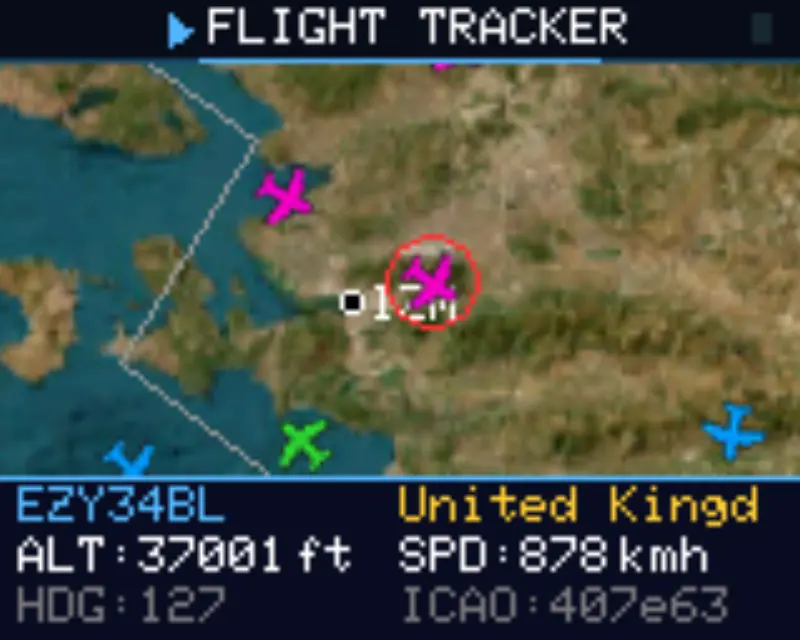
Real-Time Flight Tracking on the ESP32-S3
The ESP32 Flight Tracker is a sophisticated embedded project designed to bring live aviation data to a compact, dual-screen handheld device. Originally developed as a module for a custom gaming console, this standalone version leverages the ESP32-S3’s dual-core capabilities to fetch, parse, and render aircraft positions from the OpenSky Network API in near real-time.
Dual-Core Architecture and Performance
To maintain a smooth user experience while handling heavy network traffic, the project employs a FreeRTOS-based dual-core architecture. By splitting responsibilities between the two cores, the system avoids the common pitfall of UI freezing during data fetches:
- Core 0 (Networking): Handles the heavy lifting of WiFi management and HTTP requests. It downloads and parses large, chunked JSON files from the OpenSky API without interrupting the visual output.
- Core 1 (Rendering): Dedicated to the UI engine, achieving over 15 FPS. It manages map panning, aircraft sprite rotation, and dashboard updates.
Innovative Hybrid Map System
One of the most impressive technical feats of this project is how it manages geographical data within the ESP32-S3’s 8MB PSRAM limit. A high-resolution global map is too large to fit in memory, so the developer engineered a Hybrid Map System.
The system loads a high-resolution regional map (2048x1024) specifically for Turkey and its surroundings—consuming roughly 6.5MB of PSRAM—while utilizing a low-resolution global fallback map (512x256) for the rest of the world. Both maps are stored on an SD card and loaded into PSRAM at boot, ensuring zero-latency panning when using the analog joystick.
Visuals and User Interface
The tracker utilizes a dual-display setup for maximum information density:
- 1.8” TFT Display: Serves as the main radar screen, showing the map and aircraft.
- 0.96” OLED Display: Acts as a dedicated stats screen for flight details.
Aircraft are rendered using a custom sprite system consisting of 72 pre-rendered frames per color to provide smooth 5-degree rotation increments with anti-aliasing. To help users quickly identify flight patterns, the project features an Altitude Heatmap. Aircraft colors change dynamically based on their current flight level, ranging from yellow (low altitude) to purple (high cruising altitude).
Technical Optimizations
The project recently underwent significant optimizations to reduce boot times from 30 seconds down to just 15 seconds. These improvements include:
- WiFi Optimization: Disabling NVS flash writes and using fast-scan mode to connect to access points instantly.
- Stream Processing: Bypassing chunked encoding in HTTP 1.1 to reduce parsing overhead.
- SD Throughput: Increasing the SD card clock to 40 MHz and using direct PSRAM writes with 64KB chunks to maximize data transfer speeds.
Hardware and Setup
The system is designed for the ESP32-S3 (specifically modules with at least 8MB of PSRAM). It requires a MicroSD card module for map storage, an analog joystick for navigation, and three push buttons for zooming and aircraft selection. The firmware utilizes a custom 16MB partition scheme to accommodate the large application size and OTA capabilities.
Related Projects
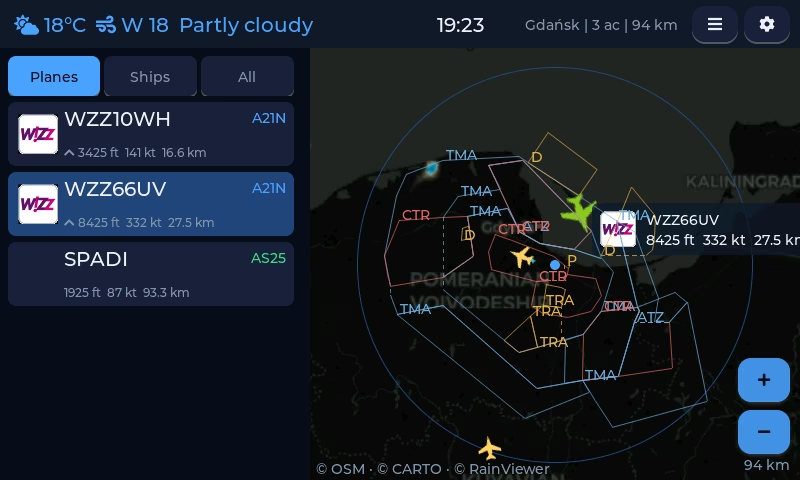
esp32flight
A standalone flight tracking dashboard for ESP32-S3 touchscreen devices that visualizes live ADS-B data, routes, and weather without requiring external servers or subscriptions. It utilizes the ESP-IDF framework, LVGL graphics library, and standard networking protocols to provide a rich, interactive aviation monitoring experience.
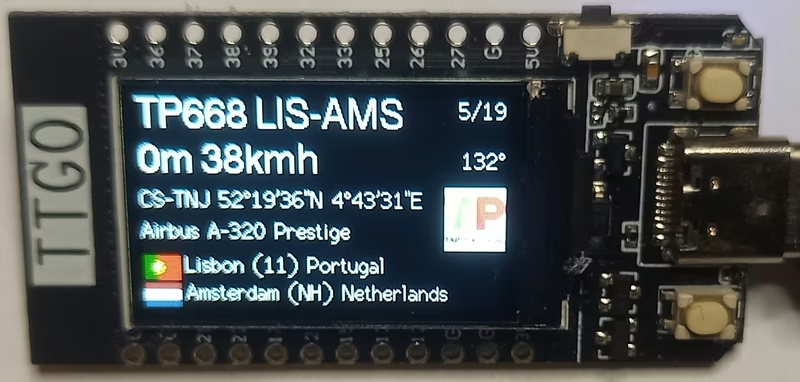
FlightRadar24-TTGO
FlightRadar24-TTGO is an ESP32-based firmware that provides a real-time aircraft tracking display on TTGO and LilyGo-T-Display-S3 modules. It leverages the FlightRadar24 API for live updates and uses the LVGL library to render detailed flight information and carrier logos. The project includes a web-based configuration portal for setting location parameters, units, and traffic filters.
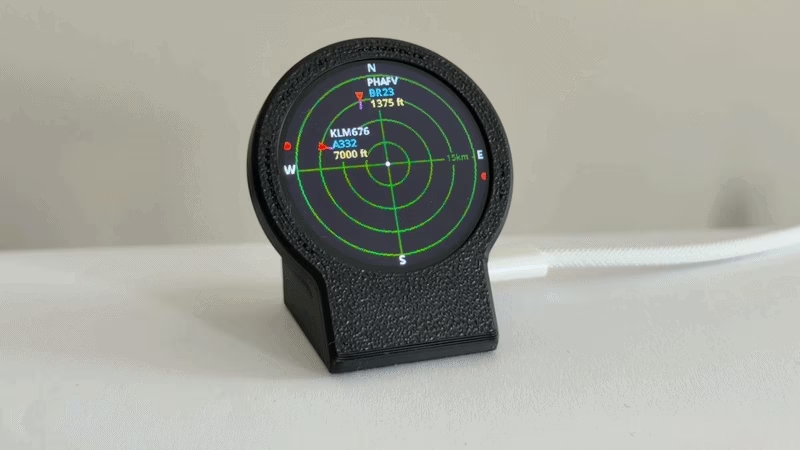
Plane Radar
An embedded flight tracking application for the ESP32-C3 Super Mini and a 1.28-inch round GC9A01 display. It visualizes live ADS-B aircraft data from adsb.fi on a sonar-style interface, providing real-time updates on aircraft headings, altitudes, and speed vectors with a captive portal for easy configuration.
PONS: Pilot Oriented Navigation System for Human-Powered Aircraft
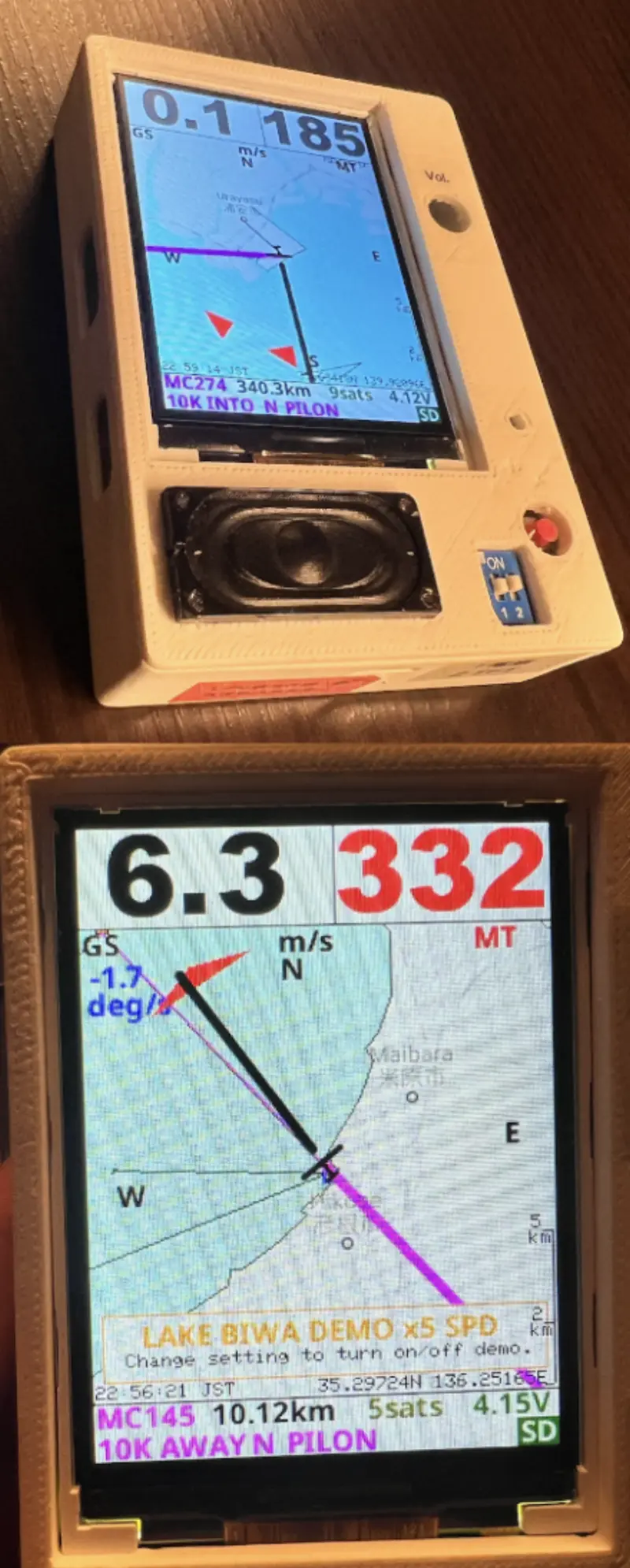
A specialized GNSS navigation system designed for human-powered aircraft pilots, specifically optimized for the Japan International Birdman Rally at Lake Biwa. It features a dual-core architecture on the Raspberry Pi Pico 2 to handle high-speed TFT map rendering, GPS tracking, and SD card data logging simultaneously.
nearPlane ADSB Tracker
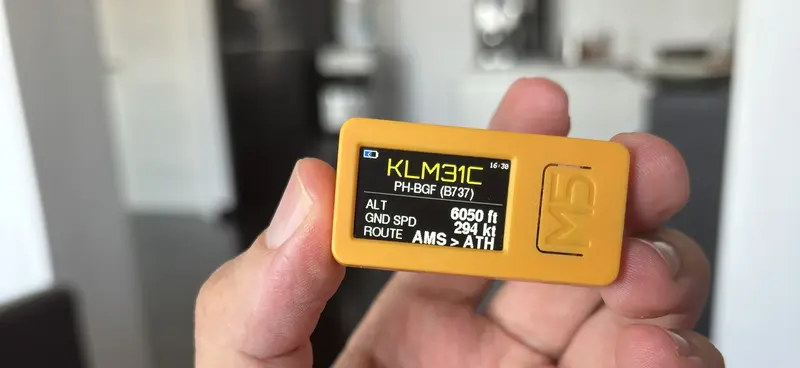
A portable real-time aircraft tracker for the M5StickC Plus 2 that utilizes the adsb.lol API to display flight telemetry and route information. It features a multi-page OLED interface, emergency squawk highlighting, and a web-based setup portal for easy configuration.