Semaphores in Zephyr
How k_sem_take and k_sem_give work on a count, a limit and a wait queue, why a give to a waiting thread never raises the count, and what happens to a give at the limit.
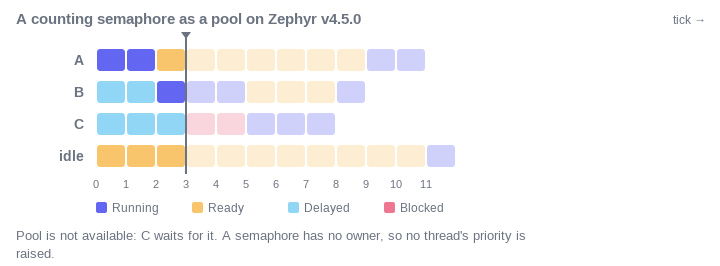
Simulated kernel: Zephyr v4.5.0. This scenario and every other one are in the scheduler playground. The simulator and its data files are not covered by the site's CC BY-SA license; see their license notices.
This walkthrough follows the pool of buffers from the
counting semaphores lesson through Zephyr’s kernel/sem.c. Set the
step level to Line and open the Kernel tab of the code panel.
The three threads, with Zephyr’s priorities (a lower number is more urgent):
A(14) takesPoolat once, works for three ticks, gives it back and works one tick more.B(13) does the same, after sleeping for one tick.C(12) sleeps for two ticks, takesPoolfor two ticks of work, gives it back and works one tick more.
As always on Zephyr, a sleep ends one tick later than the same delay on FreeRTOS (see
scheduling). So B wakes at tick 2 and C at tick 3.
What a semaphore is
K_SEM_DEFINE(Pool, 2, 2);defines a struct k_sem with a count of 2 and a limit of 2. The struct has three fields:
count: how many takes would succeed now.limit: the highest valuecountcan reach. A binary semaphore is one with a limit of 1.wait_q: the threads waiting to take it, most urgent first, in arrival order within a priority.
The kernel panel shows the first two as variables and the third as the semaphore’s waiting list.
(With CONFIG_POLL there is a fourth field, a list for k_poll(), which this scenario does not
use.) There is no buffer and no item size. There is no second list for threads waiting to give,
because a give never waits. K_SEM_DEFINE() checks at build time that the limit is not 0 and the
count is not above it. k_sem_init() checks the same at run time and returns -EINVAL.
FreeRTOS builds its semaphores on a queue whose items have no size.
Zephyr’s is a separate object with its own two functions.
Taking
int z_impl_k_sem_take(struct k_sem *sem, k_timeout_t timeout)
{
	struct k_spinlock *lock = sem_spinlock_get(sem);
	int ret;

	__ASSERT(((arch_is_in_isr() == false) ||
		  K_TIMEOUT_EQ(timeout, K_NO_WAIT)), "");

	k_spinlock_key_t key = k_spin_lock(lock);

	SYS_PORT_TRACING_OBJ_FUNC_ENTER(k_sem, take, sem, timeout);

	if (likely(sem->count > 0U)) {
		sem->count--;
		k_spin_unlock(lock, key);
		ret = 0;
		goto out;
	}

	if (K_TIMEOUT_EQ(timeout, K_NO_WAIT)) {
		k_spin_unlock(lock, key);
		ret = -EBUSY;
		goto out;
	}

	SYS_PORT_TRACING_OBJ_FUNC_BLOCKING(k_sem, take, sem, timeout);

	ret = z_pend_curr(lock, key, &sem->wait_q, timeout);

out:
	SYS_PORT_TRACING_OBJ_FUNC_EXIT(k_sem, take, sem, timeout, ret);

	return ret;
}kernel/sem.c, lines 149–182 · Zephyr v4.5.0 · Apache-2.0 license
There are three cases:
- The count is above 0. It is decremented and the call returns 0, without touching the
scheduler.
Atakes a buffer this way at tick 0 (the count goes from 2 to 1), andBat tick 2 (from 1 to 0). - The count is 0 and the caller passed
K_NO_WAIT. The call returns-EBUSYat once. That is the only way an interrupt handler may callk_sem_take(). The__ASSERTat the top enforces it. - The count is 0 and the caller can wait. It calls
z_pend_curr().
At tick 3, C wakes, preempts B and finds the count at 0. It waits:
int z_pend_curr(struct k_spinlock *lock, k_spinlock_key_t key,
	       _wait_q_t *wait_q, k_timeout_t timeout)
{
	/* A blocking pend from ISR context is a programming error with no
	 * safe recovery: it would sleep whatever thread was interrupted and,
	 * on CONFIG_SWAP_NONATOMIC, corrupt the scheduler. Refuse it fatally
	 * in every build rather than degrading into the corruption traced in
	 * #111518. Placed first so the refusal performs no side effect.
	 */
	if (arch_is_in_isr()) {
		__ASSERT(false, "blocking pend from ISR context");
		k_panic();
	}

#if defined(CONFIG_TIMESLICING) && defined(CONFIG_SWAP_NONATOMIC)
	pending_current = _current;
#endif /* CONFIG_TIMESLICING && CONFIG_SWAP_NONATOMIC */
	__ASSERT_NO_MSG((sizeof(struct k_spinlock) == 0) || !z_is_sched_spinlock(lock));

	/* We do a "lock swap" prior to calling z_swap(), such that
	 * the caller's lock gets released as desired.  But we ensure
	 * that we hold the scheduler lock and leave local interrupts
	 * masked until we reach the context switch.  z_swap() itself
	 * has similar code; the duplication is because it's a legacy
	 * API that doesn't expect to be called with scheduler lock
	 * held.
	 */
	(void) z_sched_spinlock_lock();
	pend_locked(_current, wait_q, timeout);
	k_spin_release(lock);
	return z_swap_locked(key);
}kernel/sched.c, lines 522–553 · Zephyr v4.5.0 · Apache-2.0 license
z_pend_curr() takes the scheduler’s lock and calls pend_locked(). Only then does it release the
semaphore’s lock, so no give can slip in between. pend_locked() does two things:
add_to_waitq_locked()takesCout of the run queue, marks it pending and inserts it intoPool’swait_qby priority.- Unless the timeout is
K_FOREVER,z_add_thread_timeout()putsCin the timeout list as well.
z_swap_locked() switches to B. Whatever z_swap_locked() returns when C runs again is what
k_sem_take() returns. Before the switch, the kernel stores -EAGAIN as that value. A thread
woken by its timeout gets -EAGAIN. A thread woken by a give gets whatever the giver stored in its
place.
Giving
void z_impl_k_sem_give(struct k_sem *sem)
{
	struct k_spinlock *lock = sem_spinlock_get(sem);
	k_spinlock_key_t key = k_spin_lock(lock);
	bool resched;

	SYS_PORT_TRACING_OBJ_FUNC_ENTER(k_sem, give, sem);

	if (z_sched_wake(&sem->wait_q, 0, NULL)) {
		resched = true;
	} else {
		sem->count += (sem->count != sem->limit) ? 1U : 0U;
		resched = sem_handle_poll_events(sem);
	}

	if (unlikely(resched)) {
		z_reschedule(lock, key);
	} else {
		k_spin_unlock(lock, key);
	}

	SYS_PORT_TRACING_OBJ_FUNC_EXIT(k_sem, give, sem);
}kernel/sem.c, lines 116–138 · Zephyr v4.5.0 · Apache-2.0 license
At tick 5, B is done with its buffer and calls k_sem_give(). The first
thing it does is z_sched_wake() on the wait queue. That takes the most urgent waiter off it:
static ALWAYS_INLINE struct k_thread *z_unpend_first_thread_locked(_wait_q_t *wait_q)
{
	struct k_thread *thread = _priq_wait_best(&wait_q->waitq);

	if (unlikely(thread != NULL)) {
		unpend_thread_no_timeout(thread);
		/* Abort the thread's timeout. If its handler is in flight on
		 * another CPU it is blocked on the sched lock; the abort flags
		 * it superseded, and z_thread_timeout() bails on that flag when
		 * it finally runs -- so it won't wake the thread from whatever
		 * it has since re-pended on. We don't wait for it here.
		 */
		(void)z_try_abort_thread_timeout(thread);
	}
	return thread;
}kernel/include/ksched.h, lines 250–265 · Zephyr v4.5.0 · Apache-2.0 license
The waiter is C. It leaves wait_q, and its timeout, if it had one, is cancelled. Then
z_sched_wake() stores 0 as C’s return value and puts C back in the run queue. The count is
not touched: it was 0 and stays 0. The event log shows Give by B followed by Take by C,
both inside B’s call, before C has run.
z_reschedule() then switches to C, which is more urgent than B. C resumes inside
z_pend_curr(), gets 0, and returns from k_sem_take() with the buffer. It does not look at the
count again.
Only when nobody waits does the count go up. C’s own give at tick 7 finds an empty wait queue,
so the count becomes 1. A’s give at tick 10 makes it 2. In that branch, sem_handle_poll_events()
also tells any k_poll() callers that the semaphore is available.
This is the difference from FreeRTOS described in Semaphores as signals. FreeRTOS raises the count and wakes the task, and the woken task takes the count itself when it runs. In Zephyr the count is handed over inside the give. No other thread can take it in between, and the woken thread never has to wait again.
The limit
The last line of the give is the whole rule:
sem->count += (sem->count != sem->limit) ? 1U : 0U;A give to a semaphore that is already at its limit changes nothing. k_sem_give() returns void,
so the caller cannot tell. FreeRTOS’s xSemaphoreGive() returns errQUEUE_FULL in the same case.
For a pool this only happens if the code gives more often than it takes, which is a bug. For a
signal it is the lost event of the interrupts lesson. The limit is at most
K_SEM_MAX_LIMIT, which is UINT_MAX.
k_sem_reset() is the opposite. It sets the count to 0 and wakes every waiter with -EAGAIN,
the same value a timeout gives.
What to try
- Set Pool counts up to 3.
Ctakes a buffer at tick 3 through the first case ofz_impl_k_sem_take(), decrementing the count from 1 to 0. Nobody ever enters the wait queue, andz_pend_curr()is never called. - Set C urgency to 2, the same as
B. At tick 5B’s give still hands the buffer toC: theTakeis recorded inB’s call. ButCis not more urgent, soz_reschedule()does not switch.Bkeeps the CPU until its time slice ends at tick 6. In between, the buffer already belongs toC, and no other thread could have taken it.