Queues between tasks
How a message queue passes data from a producer to a consumer, what happens when it is full or empty, and what its length buys you.
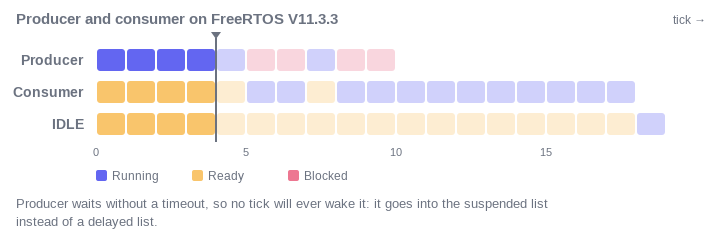
Simulated kernel: FreeRTOS V11.3.3 and Zephyr v4.5.0. This scenario and every other one are in the scheduler playground. The simulator and its data files are not covered by the site's CC BY-SA license; see their license notices.
A semaphore tells a task that something happened. Most of the time the task also needs to know what: the byte that arrived, the reading that was taken, the command that was typed. A message queue carries that data. One task sends items into it, another receives them, oldest first, and the kernel blocks either side when there is nothing it can do:
- Receiving from an empty queue blocks the receiver until an item arrives (or its timeout runs out).
- Sending to a full queue blocks the sender until a slot is free (or its timeout runs out).
Both kernels copy items by value: sending copies the item into the queue’s own storage, and
receiving copies it out into the receiver’s variable. The sender can reuse its variable as soon as
the call returns. FreeRTOS calls the object a queue (xQueueCreate(), xQueueSend(),
xQueueReceive()); in Zephyr it is a message queue, k_msgq (K_MSGQ_DEFINE(), k_msgq_put(),
k_msgq_get()).
The scenario
This is the classic producer and consumer.
Produceris the more urgent task. Six times, it works for one tick and sends an item. Its items are numberedProducer#1toProducer#6; in C each one is auint32_t.Consumerreceives an item and works on it for two ticks, six times.- The queue
Qholds three items:xQueueCreate( 3, sizeof( uint32_t ) ), orK_MSGQ_DEFINE(Q, sizeof(uint32_t), 3, 4).
Producer makes an item every tick, and Consumer needs two ticks per item. The producer is
faster, so the queue will fill.
What happens
Both kernels run this program on the same ticks.
- Tick 0:
Producerruns first, as the more urgent task.Consumeris ready, but does not get the CPU. - Ticks 1, 2 and 3:
ProducersendsProducer#1,#2and#3. Each fits, so it does not wait. The kernel panel shows the three items in their slots, with the oldest marked “out”. - Tick 4:
Producertries to sendProducer#4, butQis full. It blocks, this time waiting for room: on FreeRTOS it is in the queue’sxTasksWaitingToSendlist, on Zephyr in its wait queue marked “to send”. Only now doesConsumerrun. - Still at tick 4,
ConsumerreceivesProducer#1. That frees a slot, which wakesProducer;Produceris more urgent and preemptsConsumerstraight away, withProducer#4sent. - From then on the pattern repeats:
Producerworks one tick, finds the queue full and waits;Consumerfrees a slot two ticks later andProducerfills it at once. At tick 10Producersends its last item and ends. Consumerworks through the three items still in the queue and ends at tick 18.
The queue keeps the two tasks loosely coupled. Producer ran ahead by three items without waiting
for anybody; once it was three items ahead, the queue slowed it down to the consumer’s pace. No
item was lost, and neither task had to poll.
What the length of a queue buys
A queue absorbs bursts. If items come faster than they are handled for a while, the queue
holds the difference, up to its length. It does not help when items come faster on average:
then the queue fills and stays full, and the producer runs at the consumer’s speed anyway, as
Producer did from tick 4.
In this program, the consumer needs 12 ticks of work for six items whatever the length. Set
Q holds to 6 and Producer never waits: it sends all six items by tick 6 and ends, and the
queue drains afterwards. Consumer still ends at tick 18. Set it to 1 and Producer waits for room
after its first item, but again Consumer ends at tick 18. The length decides how far the producer can get
ahead, and how much memory that costs: the storage is length × item size, allocated when the queue
is created.
Priorities decide the shape
Swap the urgencies (Producer urgency 1, Consumer urgency 2). Consumer now runs first and
blocks on the empty queue. Each time Producer sends an item, the waiting Consumer is woken, is
more urgent, and takes it at once: the queue never holds an item for longer than the send call.
The producer waits for the CPU instead of for room.
Neither shape is wrong. A more urgent consumer keeps latency low: each item is handled as soon as it exists. A more urgent producer, the usual choice when the producer is an interrupt or must not miss data, gets its work done first and leaves the queue to smooth things out.
Waiting with a timeout, and interrupts
Like a semaphore take, xQueueSend(), xQueueReceive(), k_msgq_put() and k_msgq_get() take a
timeout. With 0 they never wait: a send to a full queue fails at once (errQUEUE_FULL, -ENOMSG)
and the item is not sent. A timed wait that runs out also fails (errQUEUE_FULL on FreeRTOS,
-EAGAIN on Zephyr).
An interrupt handler may send but never wait: xQueueSendFromISR() on FreeRTOS, k_msgq_put()
with K_NO_WAIT on Zephyr. If the queue is full, the item is lost. This is the usual way to pass
data from an interrupt to a task, with the queue long enough for the longest burst the task may
fall behind by. The interrupts lesson shows the same deferral with a
semaphore.
Who gets an item
When a task is waiting to receive and an item is sent, which task gets that item? Here the answer
is always Consumer, but with more tasks it depends on the kernel: Zephyr copies the item straight
to the waiting receiver, and FreeRTOS lets the woken task try again when it runs. The
queue handoff lesson shows a program where that changes who receives what.
The walkthroughs show how each kernel stores the items:
queues in FreeRTOS and message queues in Zephyr.