The context switch in FreeRTOS
How FreeRTOS on a Cortex-M3 saves one task's registers, picks the next task and restores its registers, in the PendSV handler.
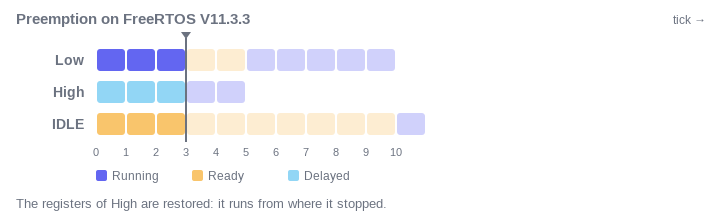
Simulated kernel: FreeRTOS V11.3.3. This scenario and every other one are in the scheduler playground. The simulator and its data files are not covered by the site's CC BY-SA license; see their license notices.
A context switch stops one task and resumes another exactly where it left off. This page reads how FreeRTOS does it on an ARM Cortex-M3, the port the simulator models and runs under QEMU. It assumes you know that every task has its own stack and task control block; if not, start with tasks and stacks.
The scenario: Low (priority 1) computes for eight ticks. High (priority 2) first sleeps for
three ticks, then computes for two and ends. That gives three switches worth reading: one a task
asks for, one an interrupt causes, and one at the end of a task.
Two ways in, one way through
There are two reasons to switch:
- The running task cannot go on. It delays, waits for a semaphore, or deletes itself. The kernel function it called ends with a yield.
- An interrupt made a more urgent task ready. For the tick,
xTaskIncrementTick()returnspdTRUE.
Both end the same way. Neither switches directly; both request the PendSV exception. A yield
from a task is the portYIELD() macro:
#define portYIELD()                                     \
    {                                                   \
        /* Set a PendSV to request a context switch. */ \
        portNVIC_INT_CTRL_REG = portNVIC_PENDSVSET_BIT; \
                                                        \
        /* Barriers are normally not required but do ensure the code is completely \
         * within the specified behaviour for the architecture. */ \
        __asm volatile ( "dsb" ::: "memory" );                     \
        __asm volatile ( "isb" );                                  \
}portable/GCC/ARM_CM3/portmacro.h, lines 85–94 · FreeRTOS V11.3.3 · MIT license
It writes one bit, PENDSVSET, into the interrupt controller. The tick handler writes the same
bit. PendSV is configured at the lowest interrupt priority, so it runs when nothing more urgent is
executing: immediately after a yield from a task, or as soon as the tick handler returns (the
processor chains straight into it without returning to the task first). Doing every switch in one
place, at the lowest priority, means a switch never happens in the middle of another interrupt
handler.
PendSV
void xPortPendSVHandler( void )
{
    /* This is a naked function. */

    __asm volatile
    (
        "   mrs r0, psp                         \n"
        "   isb                                 \n"
        "                                       \n"
        "   ldr r3, =pxCurrentTCB               \n" /* Get the location of the current TCB. */
        "   ldr r2, [r3]                        \n"
        "                                       \n"
        "   stmdb r0!, {r4-r11}                 \n" /* Save the remaining registers. */
        "   str r0, [r2]                        \n" /* Save the new top of stack into the first member of the TCB. */
        "                                       \n"
        "   stmdb sp!, {r3, r14}                \n"
        "   mov r0, %0                          \n"
        "   msr basepri, r0                     \n"
        "   bl vTaskSwitchContext               \n"
        "   mov r0, #0                          \n"
        "   msr basepri, r0                     \n"
        "   ldmia sp!, {r3, r14}                \n"
        "                                       \n" /* Restore the context, including the critical nesting count. */
        "   ldr r1, [r3]                        \n"
        "   ldr r0, [r1]                        \n" /* The first item in pxCurrentTCB is the task top of stack. */
        "   ldmia r0!, {r4-r11}                 \n" /* Pop the registers. */
        "   msr psp, r0                         \n"
        "   isb                                 \n"
        "   bx r14                              \n"
        "                                       \n"
        "   .ltorg                              \n"
        ::"i" ( configMAX_SYSCALL_INTERRUPT_PRIORITY )
    );
}portable/GCC/ARM_CM3/port.c, lines 455–488 · FreeRTOS V11.3.3 · MIT license
It is written in assembly because it must touch registers that C code cannot control. Before the
first instruction runs, the hardware has already done part of the job. On exception entry the
Cortex-M3 pushes eight registers onto the stack the task was using (the process stack, PSP):
r0–r3, r12, the link register, the program counter and the status register. Those are the
registers a C function may change freely; the hardware saves them so that an interrupt handler can
be ordinary C.
The handler then:
- Reads the task’s stack pointer (
mrs r0, psp). - Saves the rest:
stmdb r0!, {r4-r11}pushes the eight remaining registers onto the same stack. The task’s whole state is now on its own stack: sixteen words. - Records where it stopped:
str r0, [r2]stores the new stack pointer in the first field of the current TCB,pxTopOfStack. That field must be first in the structure, precisely so this one instruction can find it. - Picks the next task: with interrupts that may call the kernel masked (
basepri), it callsvTaskSwitchContext(), which changespxCurrentTCB. See choosing the next task. - Restores the other task: it loads
pxTopOfStackfrom the newpxCurrentTCB, popsr4–r11from that stack and sets PSP to what remains. - Returns with
bx r14. The return from the exception makes the hardware pop the other eight registers, including the program counter, so the new task continues from the instruction where it was stopped.
The simulator collapses the register saving into two steps, shown at the lines where something you
can see changes: the call to vTaskSwitchContext() (step 4) and the msr psp, r0 that makes the
new task’s stack current (step 5). The ContextSwitch event is on the second one. In between,
the Kernel tab shows vTaskSwitchContext() and the search for the next task.
A task asks for it
At tick 0, High calls vTaskDelay(3). vTaskDelay() moves it to
the delayed list and ends with taskYIELD_WITHIN_API(), which on this port is portYIELD(). PendSV
runs at once: High’s registers are saved on High’s stack, the search finds Low, and Low’s
registers are restored. Low has never run before, so where do its registers come from? When
xTaskCreate() made the task, it built a fake saved frame at the top of its new stack, with the
program counter set to the task’s function. The first switch to a task “restores” that frame.
An interrupt asks for it
At tick 3, the SysTick handler calls xTaskIncrementTick(), which finds
High’s wake-up time reached, moves it to the ready list and sees that it is more urgent than Low.
The function returns pdTRUE, and the handler pends PendSV with the same register write as
portYIELD().
When SysTick returns, PendSV runs. This time the registers it saves
are Low’s, in the middle of its computation; Low did nothing to deserve it, which is what
preemption means. High continues inside vTaskDelay(), right after its
yield, and returns to its own code. Notice that vTaskDelay() did not return at tick 0: from
High’s point of view the call simply took three ticks.
A task that ends
At tick 5, High has finished and calls vTaskDelete( NULL ). The function
moves it to xTasksWaitingTermination and yields like vTaskDelay() did. PendSV saves High’s
registers one last time, onto a stack that nobody will ever restore. The task cannot free that
stack itself, because it is still running on it; the
idle task frees it later.
What a switch costs
On a Cortex-M3 a switch is a few dozen instructions plus the search in vTaskSwitchContext(): one
or two exception entries and exits (PendSV, after SysTick when the tick caused it), sixteen words
copied each way. Nothing in it depends on how many tasks exist, except the search, and with the
generic selection that search is bounded by the number of priorities (here five). That is why an
RTOS can switch tasks thousands of times a second.
Zephyr does the same job very differently on the simulated board, where each thread is a host thread: see the context switch in Zephyr.
What to try
- Turn Preemption off (
configUSE_PREEMPTION 0). At tick 3xTaskIncrementTick()still wakesHigh, but the preemption check is not compiled in, so the function returnspdFALSEand nothing pends PendSV.Highwaits untilLowends at tick 8 and itsvTaskDelete()yields. - Set the step level to Event and step through: every stop with a ContextSwitch is the
msr psp, r0line of the PendSV handler.