How FreeRTOS chooses the next task
vTaskSwitchContext, the search through the ready lists and the walking index that makes tasks of one priority take turns, in the FreeRTOS source.
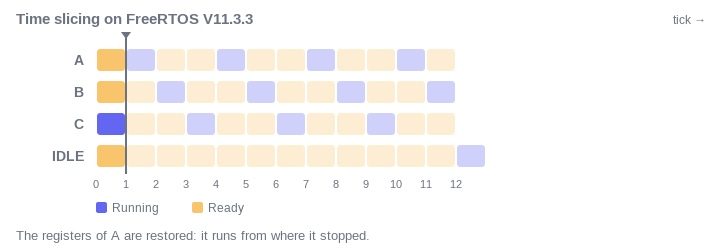
Simulated kernel: FreeRTOS V11.3.3. This scenario and every other one are in the scheduler playground. The simulator and its data files are not covered by the site's CC BY-SA license; see their license notices.
Every context switch asks one question: which task runs next? The scheduling lesson gives the rule, the most urgent ready task, and shows the macro that applies it. This page reads that code closely, together with the code that keeps the ready lists in a state where the answer is quick, and shows why tasks of the same priority take turns.
The scenario: three tasks A, B and C, all priority 1, each with four ticks of work. With
time slicing on, the tick takes the CPU from one to give it to the next.
Set the step level to Line, open the Kernel tab, and watch the pxIndex marker in the
priority 1 ready list.
What the kernel keeps
pxReadyTasksLists[]: one list per priority,configMAX_PRIORITIESof them (here five, 0 to 4). Each ready task’sxStateListItemis in the list for its priority.uxTopReadyPriority: the highest priority that may have a ready task.pxCurrentTCB: the task that runs, or is about to run.
Each list also has its own pxIndex, a pointer to one of its items, which plays the main part
below.
Adding a task to a ready list
#define prvAddTaskToReadyList( pxTCB )                                                                     \
    do {                                                                                                   \
        traceMOVED_TASK_TO_READY_STATE( pxTCB );                                                           \
        taskRECORD_READY_PRIORITY( ( pxTCB )->uxPriority );                                                \
        listINSERT_END( &( pxReadyTasksLists[ ( pxTCB )->uxPriority ] ), &( ( pxTCB )->xStateListItem ) ); \
        tracePOST_MOVED_TASK_TO_READY_STATE( pxTCB );                                                      \
} while( 0 )tasks.c, lines 287–293 · FreeRTOS V11.3.3 · MIT license
Two lines matter. taskRECORD_READY_PRIORITY() raises uxTopReadyPriority if the task’s priority
is above it. It never lowers it. listINSERT_END() adds the task to the list for its priority.
“End” needs a closer look. A FreeRTOS list is circular, with an end marker, and listINSERT_END()
inserts the new item just before pxIndex. When pxIndex is at the end marker, that is the end
of the list. When pxIndex has moved into the list, it is the place the walk will reach last. Either
way, a task that becomes ready joins the back of the queue for its priority, behind the tasks that
were already waiting for a turn.
The switch: vTaskSwitchContext
void vTaskSwitchContext( void )
{
    traceENTER_vTaskSwitchContext();

    if( uxSchedulerSuspended != ( UBaseType_t ) 0U )
    {
        /* The scheduler is currently suspended - do not allow a context
         * switch. */
        xYieldPendings[ 0 ] = pdTRUE;
    }
    else
    {
        xYieldPendings[ 0 ] = pdFALSE;
        traceTASK_SWITCHED_OUT();

        #if ( configGENERATE_RUN_TIME_STATS == 1 )
        {
            #ifdef portALT_GET_RUN_TIME_COUNTER_VALUE
                portALT_GET_RUN_TIME_COUNTER_VALUE( ulTotalRunTime[ 0 ] );
            #else
                ulTotalRunTime[ 0 ] = portGET_RUN_TIME_COUNTER_VALUE();
            #endif

            /* Add the amount of time the task has been running to the
             * accumulated time so far.  The time the task started running was
             * stored in ulTaskSwitchedInTime.  Note that there is no overflow
             * protection here so count values are only valid until the timer
             * overflows.  The guard against negative values is to protect
             * against suspect run time stat counter implementations - which
             * are provided by the application, not the kernel. */
            if( ulTotalRunTime[ 0 ] > ulTaskSwitchedInTime[ 0 ] )
            {
                pxCurrentTCB->ulRunTimeCounter += ( ulTotalRunTime[ 0 ] - ulTaskSwitchedInTime[ 0 ] );
            }
            else
            {
                mtCOVERAGE_TEST_MARKER();
            }

            ulTaskSwitchedInTime[ 0 ] = ulTotalRunTime[ 0 ];
        }
        #endif /* configGENERATE_RUN_TIME_STATS */

        /* Check for stack overflow, if configured. */
        taskCHECK_FOR_STACK_OVERFLOW();

        /* Before the currently running task is switched out, save its errno. */
        #if ( configUSE_POSIX_ERRNO == 1 )
        {
            pxCurrentTCB->iTaskErrno = FreeRTOS_errno;
        }
        #endif

        /* Select a new task to run using either the generic C or port
         * optimised asm code. */
        /* MISRA Ref 11.5.3 [Void pointer assignment] */
        /* More details at: https://github.com/FreeRTOS/FreeRTOS-Kernel/blob/main/MISRA.md#rule-115 */
        /* coverity[misra_c_2012_rule_11_5_violation] */
        taskSELECT_HIGHEST_PRIORITY_TASK();
        traceTASK_SWITCHED_IN();

        /* Macro to inject port specific behaviour immediately after
         * switching tasks, such as setting an end of stack watchpoint
         * or reconfiguring the MPU. */
        portTASK_SWITCH_HOOK( pxCurrentTCB );

        /* After the new task is switched in, update the global errno. */
        #if ( configUSE_POSIX_ERRNO == 1 )
        {
            FreeRTOS_errno = pxCurrentTCB->iTaskErrno;
        }
        #endif

        #if ( configUSE_C_RUNTIME_TLS_SUPPORT == 1 )
        {
            /* Switch C-Runtime's TLS Block to point to the TLS
             * Block specific to this task. */
            configSET_TLS_BLOCK( pxCurrentTCB->xTLSBlock );
        }
        #endif
    }

    traceRETURN_vTaskSwitchContext();
}tasks.c, lines 5215–5298 · FreeRTOS V11.3.3 · MIT license
The PendSV handler calls this function between saving the old task’s registers and restoring the
new task’s. Most of it is optional (run-time statistics, stack overflow checks, errno), compiled out
in the simulated configuration. Two parts remain:
- If the scheduler is suspended, it does not switch. It sets
xYieldPendings[ 0 ]and returns;xTaskResumeAll()or the next tick will act on it. - Otherwise it clears that flag and calls
taskSELECT_HIGHEST_PRIORITY_TASK().
The search
    #define taskSELECT_HIGHEST_PRIORITY_TASK()                                       \
do {                                                                                 \
    UBaseType_t uxTopPriority = uxTopReadyPriority;                                  \
                                                                                     \
    /* Find the highest priority queue that contains ready tasks. */                 \
    while( listLIST_IS_EMPTY( &( pxReadyTasksLists[ uxTopPriority ] ) ) != pdFALSE ) \
    {                                                                                \
        configASSERT( uxTopPriority );                                               \
        --uxTopPriority;                                                             \
    }                                                                                \
                                                                                     \
    /* listGET_OWNER_OF_NEXT_ENTRY indexes through the list, so the tasks of \
     * the  same priority get an equal share of the processor time. */                    \
    listGET_OWNER_OF_NEXT_ENTRY( pxCurrentTCB, &( pxReadyTasksLists[ uxTopPriority ] ) ); \
    uxTopReadyPriority = uxTopPriority;                                                   \
} while( 0 ) /* taskSELECT_HIGHEST_PRIORITY_TASK */tasks.c, lines 197–212 · FreeRTOS V11.3.3 · MIT license
This is the generic version, used when configUSE_PORT_OPTIMISED_TASK_SELECTION is 0, as here.
- It starts at
uxTopReadyPriorityand walks down while the list at that priority is empty. TheconfigASSERT( uxTopPriority )says it can never walk past 0: the idle task is always ready at priority 0. listGET_OWNER_OF_NEXT_ENTRY()advances that list’spxIndexby one item, skipping the end marker, and makes the owner of the item it lands on the newpxCurrentTCB.- It stores the priority it found back in
uxTopReadyPriority.
Step 3 is where uxTopReadyPriority comes down. When a task leaves its ready list, the generic code
does not lower it (taskRESET_READY_PRIORITY() is an empty macro in this configuration). The
variable stays too high until the next search walks down and corrects it. That trades a few wasted
loop iterations in the search for nothing to do on the much more frequent “task blocks” path.
The search costs at most one step per priority level, however many tasks there are, so FreeRTOS
recommends keeping configMAX_PRIORITIES small. The port-optimised version replaces the loop with a
bitmap of non-empty lists and the Cortex-M “count leading zeros” instruction; the result is the same.
Taking turns
The scenario starts with all three tasks in the priority 1 list, in the order they were created:
A, B, C. The first task to run is C, the last one created.
xTaskCreate() makes each new task pxCurrentTCB if its priority is at least that of the one chosen
so far, so among equals the last one wins. The scheduler starts whatever pxCurrentTCB is, without
a search, so pxIndex is still at the end marker.
At tick 1, xTaskIncrementTick() sees that the list of the running
task’s priority holds more than one task and requests a switch. The search starts at priority 1,
finds the list not empty, and advances pxIndex from the end marker to the first item: A. Not the
task after C, because the index had never been moved to C; the scheduler start skipped the
search.
At tick 2, the index moves on to B, at tick 3 to C, at tick 4 back
round to A, skipping the end marker. That is all round robin takes: the list does not change
order, only the index walks. The tasks never move between lists, so time slicing costs no list
operations at all.
The walk is per list. A task of priority 2 that becomes ready interrupts the rotation, and when the priority 1 tasks run again the index carries on from where it was.
The end of the run
At tick 12 the three tasks have done their work and end one after another.
After the last one, B, deletes itself, the search starts at priority 1, finds that list empty,
walks down to 0 and picks IDLE. That is the only time in this run that the loop body executes, and
the only time the search stores a lower uxTopReadyPriority.
What to try
- Give
Ban urgency of 2.Bruns ticks 0 to 3 alone: the search never reaches priority 1 whileBis ready. WhenBends,AandCtake turns. - Turn Time slicing off. The time-slice check in the tick is compiled out, so
Ckeeps the CPU until it ends at tick 4. The index then moves toA, which keeps it until tick 8.
Zephyr keeps a single sorted queue instead of an array of lists; compare how Zephyr chooses the next thread.