Tasks and stacks
What a task is made of (a function, a stack of its own and a control block), why every task needs its own stack, and how to size one.
A task (a thread in Zephyr) is the unit the kernel schedules. From the programmer’s side it is just a C function that usually loops forever. From the kernel’s side it is three things:
- the function it runs;
- a stack of its own, a block of RAM reserved for that task alone;
- a control block, the kernel’s record of the task: its priority, its state, which list it is in, and where its stack pointer was when it last stopped. See task control block.
With one CPU, only one task executes at a time. The kernel creates the illusion that they all run side by side by stopping one task and continuing another, many times per second. The stack is what makes that possible.
Why each task needs its own stack
A C function keeps a lot of its state on the stack: its local variables, the arguments of the
functions it calls, and the return address that tells each function where to go back to. A task
that is stopped in the middle of update_display(), three calls deep, has all of that on its stack.
Another task running in the meantime must not overwrite it, so it needs a stack of its own.
The stack also holds the last piece of state: the CPU’s registers. When the kernel stops a task, it saves the registers the task was using (the program counter, the stack pointer, the working registers) and later restores them, so the task continues with its next instruction as if nothing had happened. That is a context switch.
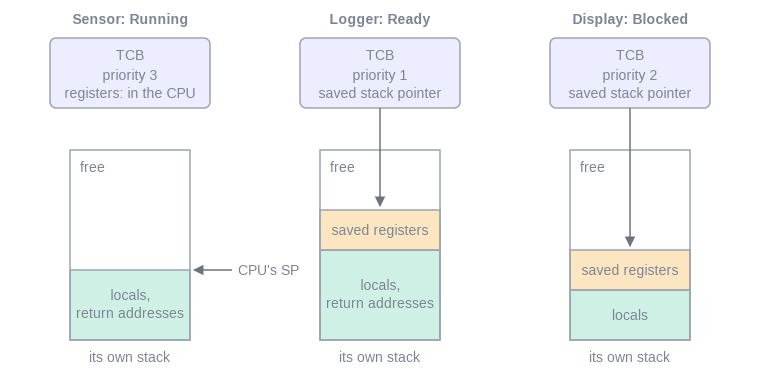
Where exactly the registers go depends on the port. On ARM Cortex-M, the processor itself pushes
eight registers onto the current stack when an interrupt arrives, and FreeRTOS’s switch handler
pushes the other eight next to them. The only thing left to remember is the stack pointer, which is
stored in the TCB (pxTopOfStack). Zephyr’s Cortex-M port keeps the same hardware-pushed frame on
the stack but stores the other registers in the thread structure itself (callee_saved). Either
way, the task’s whole context is in its stack and its control block.
Creating a task
In FreeRTOS a task is created at run time, usually in main() before the scheduler starts:
void sensor_task(void *arg)
{
    for (;;) {
        read_sensor();
        vTaskDelay(pdMS_TO_TICKS(10));
    }
}

xTaskCreate(sensor_task, "Sensor", 256 /* words */, NULL, 3 /* priority */, NULL);
vTaskStartScheduler();   /* never returns */
The stack size is given in words, not bytes: 256 words is 1 KB on a 32-bit microcontroller.
xTaskCreate() allocates the stack and the TCB from the FreeRTOS heap; xTaskCreateStatic()
takes memory you provide instead.
In Zephyr, threads are usually defined statically, so their stacks are reserved at build time:
void sensor_thread(void *p1, void *p2, void *p3)
{
    for (;;) {
        read_sensor();
        k_sleep(K_MSEC(10));
    }
}

K_THREAD_DEFINE(sensor, 1024 /* bytes */, sensor_thread, NULL, NULL, NULL,
                5 /* priority */, 0, 0);
Here the size is in bytes, and a lower number is a more urgent priority. A thread can also be
created at run time with k_thread_create() and a stack declared with K_THREAD_STACK_DEFINE().
On Zephyr, the Application tab of the simulator’s code panel shows the K_THREAD_DEFINE line of each thread.
When the function ends
A task function is not supposed to fall off its end. In FreeRTOS, a task that has finished must
delete itself with vTaskDelete(NULL); returning from the function is an error (the Cortex-M port
sends it to prvTaskExitError(), which stops in an endless loop). The simulator’s tasks end with
vTaskDelete(NULL), and the idle task later frees their memory.
Zephyr is more forgiving: the kernel calls every thread’s function through a small wrapper, and if the function returns, the wrapper aborts the thread.
FUNC_NORETURN void z_thread_entry(k_thread_entry_t entry,
				 void *p1, void *p2, void *p3)
{
/*
 * Inform the unwinder that the current return address is undefined.
 *
 * This is typically used at points in the code where execution does not
 * return like a normal function (for example, thread entry routines).
 * Marking the return address as undefined prevents stack unwinding or
 * backtrace tools from following a bogus return address, which could
 * otherwise lead to reading invalid memory and cause faults during
 * unwinding or debugging.
 */
	ARCH_CFI_UNDEFINED_RETURN_ADDRESS();
#ifdef CONFIG_CURRENT_THREAD_USE_TLS
	z_tls_current = k_sched_current_thread_query();
#endif
#ifdef CONFIG_STACK_CANARIES_TLS
	uintptr_t stack_guard;

	sys_rand_get((uint8_t *)&stack_guard, sizeof(stack_guard));
	__stack_chk_guard = stack_guard;
	__stack_chk_guard <<= 8;
#endif	/* CONFIG_STACK_CANARIES_TLS */
	entry(p1, p2, p3);

	k_thread_abort(k_current_get());

	/*
	 * Compiler can't tell that k_thread_abort() won't return and issues a
	 * warning unless we tell it that control never gets this far.
	 */

	CODE_UNREACHABLE; /* LCOV_EXCL_LINE */
}kernel/sys/thread_entry.c, lines 36–70 · Zephyr v4.5.0 · Apache-2.0 license
How big should a stack be?
Big enough for the deepest chain of calls the task can make, with all their local variables, plus
the saved registers, plus whatever an interrupt pushes when it arrives while the task runs. That
last part is why stacks need slack even for simple tasks. Some library functions are surprisingly
hungry: a printf() with floating-point formatting can need a kilobyte or more on its own.
Nobody computes that exactly by hand. The usual practice is to start generously, run the
application through its heaviest paths, measure how much of each stack was ever used, and trim.
Both kernels can measure it: they fill a new stack with a known pattern and later look for the
highest point where the pattern was overwritten. FreeRTOS reports it with
uxTaskGetStackHighWaterMark(); Zephyr with k_thread_stack_space_get() and its thread analyzer
(with CONFIG_INIT_STACKS).
Stacks are the main RAM cost of an RTOS design. Ten tasks with 1 KB each is 10 KB, a large share of a small microcontroller. That is one reason to keep the number of tasks modest, and to give work that is not urgent to a task that already exists.
Stack overflow
If a task uses more stack than it was given, it writes over whatever lies next to its stack in memory: another task’s stack or TCB, or global variables. The program then fails somewhere else, often much later, which makes stack overflow one of the hardest bugs to find on a microcontroller.
Both kernels can watch for it:
- FreeRTOS: with
configCHECK_FOR_STACK_OVERFLOWset to 1, the kernel checks at each context switch whether the stack pointer has gone past the end of the stack; set to 2, it also checks that the last bytes of the stack still hold their fill pattern. Either way it callsvApplicationStackOverflowHook(). The check catches most overflows, not all: one that happens and recovers between two switches can go unseen. - Zephyr:
CONFIG_STACK_SENTINELkeeps a magic value at the end of each stack and checks it at context switches and interrupts. On processors with a memory protection unit,CONFIG_HW_STACK_PROTECTIONplaces a guard region below the stack, so an overflow faults at the very instruction that causes it.
Stack overflow and memory allocation are taught here in prose only: the simulator models scheduling, and its tasks have no real stacks.
Next: the states a task moves through while it runs, waits and sleeps, in Task states.