Z906 Remote
An ESP8266-based IoT solution for remote management of the Logitech Z906 5.1 surround sound system. It provides a web interface and MQTT integration for volume control, input switching, and status monitoring via the system's DE-15 console port.
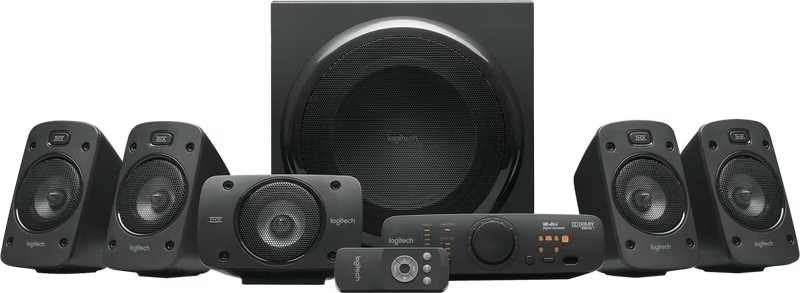
The Logitech Z906 has long been a staple for home theater enthusiasts seeking a THX-certified 5.1 surround sound experience. However, its physical control console lacks the modern connectivity required for a truly integrated smart home. Z906 Remote bridges this gap by utilizing an ESP8266 microcontroller to interface directly with the amplifier’s hardware, adding WiFi, MQTT, and Web API capabilities to this classic audio system.
Hardware Integration
Unlike simple IR-based remotes, this project interacts with the Z906 via the DE-15 connector located on the back of the subwoofer. By using a Wemos D1 Mini and a DE-15 breakout board, the system intercepts and mimics the serial communication usually handled by the physical control console.
The communication protocol is technical and specific: it operates at a baud rate of 57600 bps with 8-bit data, odd parity, and one stop bit. Interestingly, the protocol is designed so that the console (in this case, the ESP8266) initiates all communication, allowing for precise control over the amplifier’s internal state.
Features and Capabilities
Z906 Remote is more than just a power toggle. It provides granular control over the entire system, including:
- Input Management: Switch between TRS 5.1, RCA 2.0, Optical, and Coaxial inputs.
- Advanced Volume Control: Independent adjustment of Main, Subwoofer, Center, and Rear levels.
- Effect Processing: Toggle between 3D, 2.1, 4.1, and Decode modes.
- System Telemetry: Monitor system temperature, firmware version, and power-on time.
Smart Home and Web Interface
The firmware includes a modern web interface built with VueJS, served directly from the ESP8266 using the LittleFS filesystem. For those looking to automate their audio setup, the project features native MQTT support with Home Assistant Discovery. This allows the Z906 to appear automatically as a media entity in Home Assistant, enabling complex automations—such as automatically muting the speakers when a phone call is received or powering on the system when the TV is activated.
Technical Implementation
The project is built using the Arduino framework within the PlatformIO ecosystem. It leverages several high-performance libraries to handle its networking stack, including ESPAsyncWebServer for the API and PubSubClient for MQTT messaging.
One of the more unique aspects of the firmware is its handling of the Z906 EEPROM. Users can trigger an EEPROM_SAVE command to persist settings, though the documentation wisely cautions against excessive writes to preserve the hardware’s lifespan.
Getting Started
To deploy Z906 Remote, developers need to clone the repository and configure their environment variables in a .env.local file. This file manages WiFi credentials and MQTT server details. Flashing is handled via PlatformIO, with the first installation requiring a serial connection. Subsequent updates can be performed over-the-air (OTA).
For wiring, the project requires connecting the D1 Mini to specific pins on the DE-15 connector. The minimal requirement involves GND, 3.3V power (drawn directly from the Z906), TX/RX lines, and a Console Enable pin. This setup effectively replaces or augments the original control pod, giving the user total digital control over their audio environment.
Related Projects
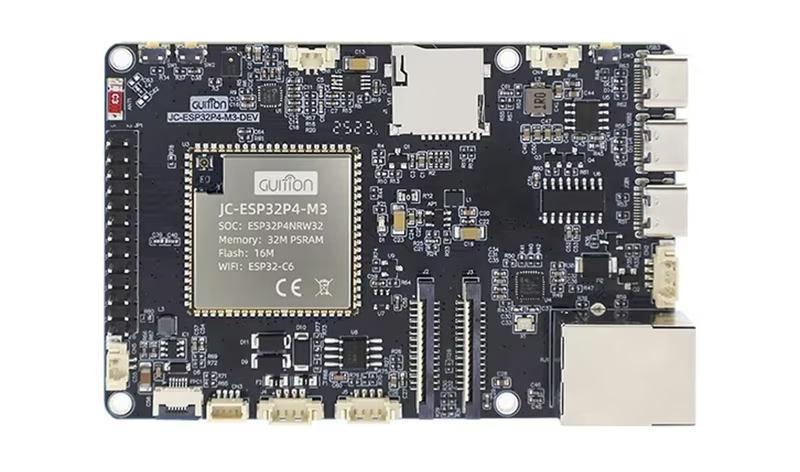
ESP32-P4 Home Assistant MQTT Voice Assistant
This project provides local voice assistant firmware for the ESP32-P4 platform, built natively on ESP-IDF and integrated with Home Assistant's Assist pipeline. It utilizes WakeNet9 for wake-word detection, MQTT for control and discovery, and features a local MP3 player and web-based management dashboard.