Periscope-OS (v2.0.0-SIGINT)
Periscope-OS is a passive 2.4GHz RF spectrum analyzer and signals intelligence tool for the M5Stack M5StickS3. It utilizes the ESP32-S3's promiscuous mode for deep packet inspection of 802.11 frames, featuring a sonar-style radar UI and IMU-based spatial tracking. The project leverages SPIFFS for telemetry logging and the M5Unified library for hardware abstraction.
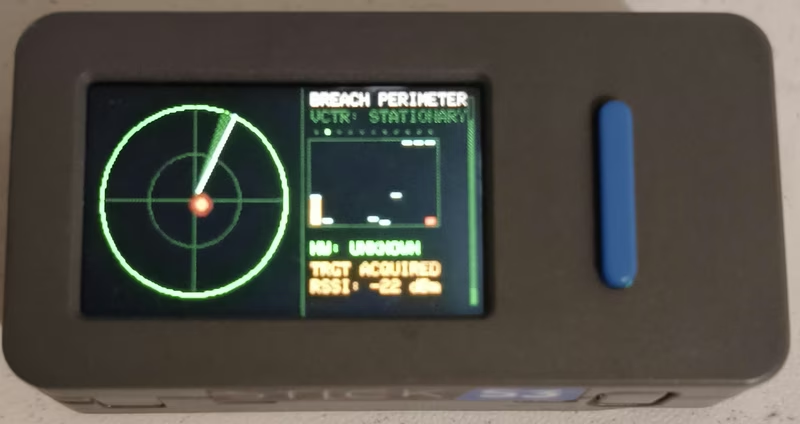
In the world of wireless security auditing, visibility is often the difference between a secure perimeter and a silent breach. Periscope-OS transforms the compact M5Stack M5StickS3 into a specialized signals intelligence (SIGINT) powerhouse, offering a passive 2.4GHz RF spectrum analyzer and tactical sonar radar deck in a handheld form factor. By focusing on passive reconnaissance, it allows security professionals to map the invisible landscape of Wi-Fi traffic without emitting detectable signals themselves.
Core Signal Intelligence Engine
At its heart, Periscope-OS utilizes the ESP32-S3 radio driver in promiscuous mode. This bypasses standard hardware MAC filtering, allowing the device to ingest raw 802.11 management frames. The Deep Packet Inspection (DPI) engine specifically targets Type 0xC0 (Deauthentication) and 0xA0 (Disassociation) frames. By dissecting these packets in real-time, the tool extracts critical forensic data: attacker MAC addresses, victim client IDs, target BSSIDs, and specific 802.11 reason codes.
One of the most practical features of this engine is its acoustic fingerprinting capability. By parsing the first three bytes of the MAC address (OUI), the system can classify weaponized hardware in the field. It identifies common offensive tools such as Flipper Zero units, Wi-Fi Marauder builds, Raspberry Pi drop-boxes, and high-power Alfa adapters, providing the operator with immediate context regarding the nature of the threat.
Visual and Spatial Instrumentation
The user interface is designed for high-stakes environments, featuring a landscape split-screen dashboard. The left pane hosts a phosphor-style CRT circular radar sweep. Utilizing a five-layer ghosting decay trail, it plots targets as glowing red blips. The distance from the crosshairs is dynamically scaled based on the Received Signal Strength Indicator (RSSI), providing a visual representation of proximity. Complementing this is the right pane, which functions as a volumetric traffic equalizer, showing frequency distribution across the 2.4GHz spectrum (Channels 1–11) with peak-hold indicators to catch intermittent or hidden transmitters.
Beyond simple visualization, Periscope-OS employs spatial inertial processing. By integrating data from the internal BMI270 6-axis IMU, the firmware tracks the user’s physical yaw. As the operator rotates, their body acts as a natural RF shield. The system calculates the precise physical angle where signal attenuation is lowest, effectively pinpointing the directional vector of a threat. This “body shielding” math turns the operator into a human antenna array, guiding them toward the source of interference through visual indicators and haptic pulses.
Tactical Operational Modes
For covert operations, the “Silent Running” mode shifts all telemetry to the internal haptic motor. By cutting the display backlight and muting the speaker, the device provides tactile feedback that increases in frequency as the user aligns with the threat vector. This allows for complete touch-based tracking in low-profile situations where a glowing screen would be a liability.
When a threat is detected, the system can trigger a Perimeter Breach Alarm. If a target crosses a critical signal threshold (≥ -42 dBm), the display flashes red, and the speaker emits a dual-frequency naval klaxon horn. For post-operational analysis, the “Captain’s Logbook” provides an interface to review forensic logs stored on the internal SPIFFS filesystem. These logs include compressed, pipe-delimited strings containing hardware profiles, signal metrics, and micro-script verification, ensuring that every identified breach is documented for later security auditing and defensive validation.
Related Projects
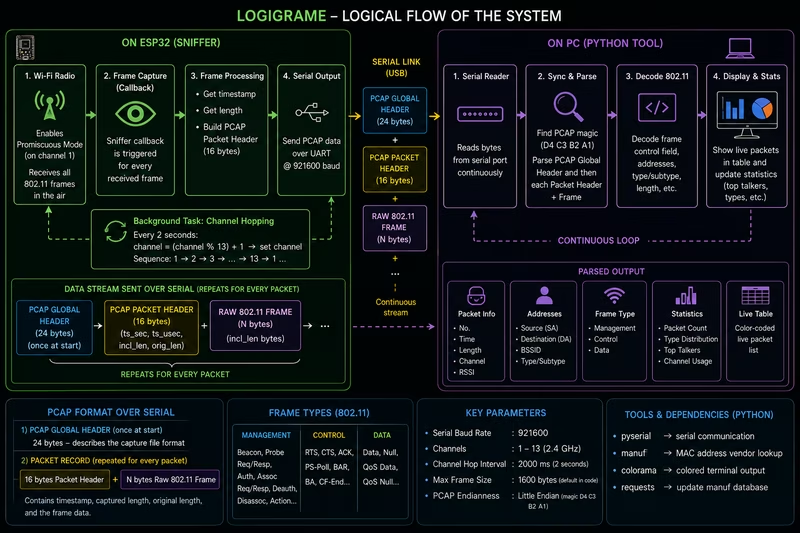
ESP-Sniffer
A real-time Wi-Fi packet capture and analysis tool built for the ESP32 platform. It utilizes the microcontroller's promiscuous mode to intercept raw 802.11 frames, which are then streamed over serial in PCAP format to a Python host for live decoding and color-coded visualization.
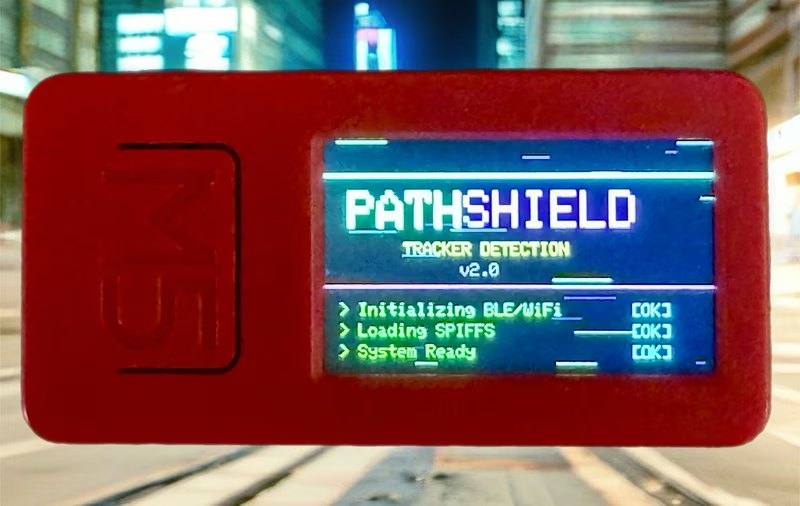
PathShield
PathShield is a privacy-focused RF monitoring tool for the M5StickC-Plus, designed to detect and alert users to persistent WiFi and BLE devices. It employs a multi-threaded ESP32 architecture and a sophisticated persistence scoring algorithm to distinguish potential trackers from ambient wireless noise. The system features an offline manufacturer database and customizable detection thresholds for enhanced situational awareness.
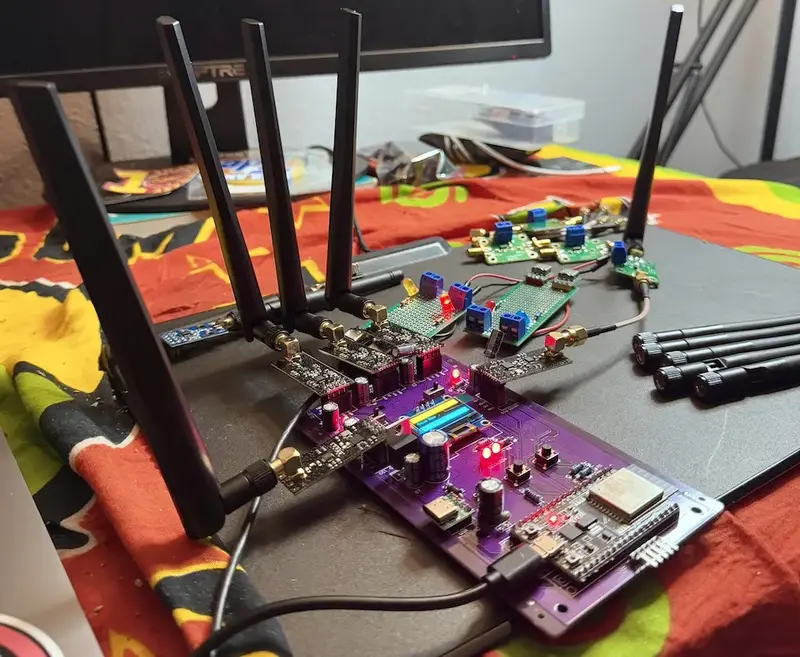
Project Starbeam
An ESP32-based signal intelligence platform for RF analysis, signal generation, and manipulation. It utilizes multiple NRF24 and CC1101 radio modules to provide versatile frequency coverage and is compatible with HackRF One for extended range up to 6 GHz.
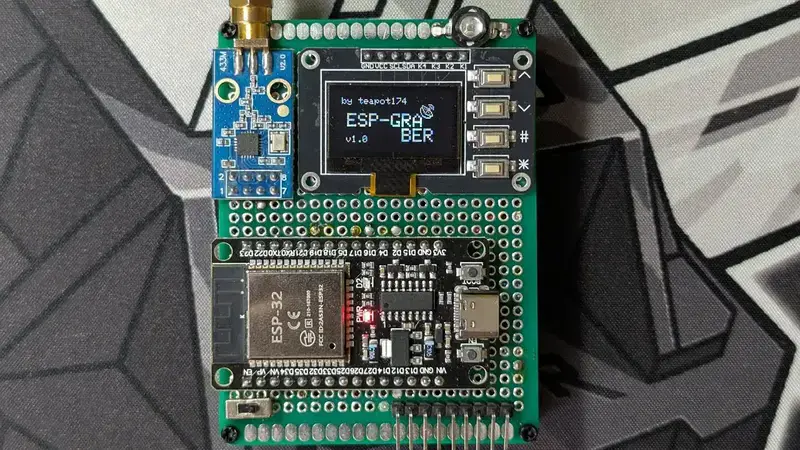
ESP-GRABER
A versatile Sub-GHz radio frequency tool for the ESP32 platform using the CC1101 transceiver. It enables reading, replaying, and storing signals across 315, 433, 868, and 915 MHz frequencies, supporting protocols like Princeton, KeeLoq, and StarLine.