OpenToys
OpenToys is an open-source framework for building local voice AI companions and robots using ESP32-S3 hardware and Apple Silicon for edge processing. It leverages Whisper ASR, Qwen3-TTS, and MLX-optimized LLMs to provide a fully offline, multilingual conversational experience without cloud dependencies. The project includes a desktop control application built with Tauri and React, alongside specialized Arduino-based firmware.
OpenToys is an open-source platform designed to bring high-performance, local voice AI to toys, companions, and robots. By shifting the computational heavy lifting to local Apple Silicon hardware, the project enables sophisticated conversational capabilities without the need for cloud subscriptions, data harvesting, or persistent internet connectivity. This approach ensures that user data stays on-device while providing a free, low-latency AI experience.
Why OpenToys?
The project addresses several key concerns in the smart toy industry, primarily privacy and longevity. Because it is fully local, there is no risk of data leaving the home. It supports a wide array of languages and accents, including English, Chinese, Spanish, French, Japanese, and more. One of its standout features is voice cloning, allowing users to clone specific characters or personal voices with less than 10 seconds of audio. The system is highly customizable, allowing developers to build unique personalities using an ESP32-S3 microcontroller.
App Design and User Experience
The OpenToys ecosystem revolves around a desktop application that manages the AI models and communicates with the hardware. The interface allows users to select different personalities, configure settings, and flash firmware directly to connected devices.
Through the app, users can create “Cards & Stories”—experiences with distinct personalities that can tell stories, play games, or engage in educational dialogue. These personalities are defined in a structured JSON format, making it easy to expand the toy’s repertoire of behaviors.
Technical Stack
The architecture is split between a high-power host (Mac) and a low-power edge device (ESP32-S3).
- Speech-to-Text (STT): Utilizes Whisper Turbo ASR for fast, accurate transcription.
- Text-to-Speech (TTS): Employs Qwen3-TTS and Chatterbox-turbo for natural-sounding voice synthesis.
- Large Language Models (LLMs): Supports various models from the
mlx-community(such as Qwen3, Llama, and Mistral) optimized for Apple Silicon. - Frontend/Backend: The desktop app is built with Tauri, React, and Rust, while the local AI backend utilizes a Python 3.11 runtime.
- Firmware: The ESP32-S3 firmware is developed using the Arduino framework, incorporating WebSockets for real-time communication and Opus encoding for efficient audio streaming.
DIY Hardware and Firmware
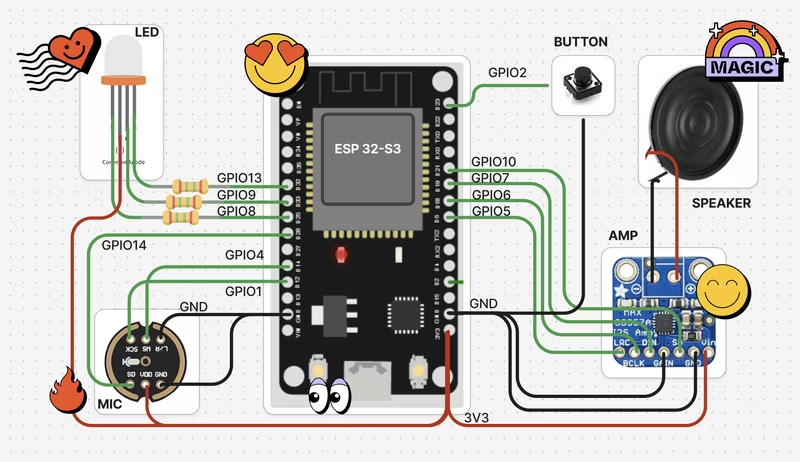
The hardware component is based on the ESP32-S3, chosen for its built-in AI acceleration and robust connectivity. A typical setup includes an I2S microphone (INMP441), an I2S amplifier (MAX98357A), a speaker, and basic control elements like LEDs and buttons.
Key pin connections for the standard setup involve GPIO 14, 4, and 1 for the microphone (Data, Word Select, and Clock) and GPIO 5, 6, and 7 for the speaker. The firmware manages several critical tasks:
- Networking: Includes a WiFi captive portal named
ELATOfor easy network configuration. - Storage: Uses Non-Volatile Storage (NVS) to persist WiFi credentials and authentication tokens.
- Visual Feedback: A multi-color LED system communicates the device state, such as listening (yellow), speaking (blue), or processing (red).
Flashing and Setup
OpenToys simplifies the deployment process by bundling firmware images directly within the desktop app. Users can connect their ESP32-S3 to their Mac and initiate the flash process via the settings menu. Once flashed, the device creates a soft AP for setup. After the initial configuration, the toy automatically reconnects to the local network to communicate with the OpenToys desktop server.
Safety and Limitations
While OpenToys prioritizes privacy, it acknowledges the inherent limitations of current AI technology. Users should be aware of potential hallucinations where the LLM provides incorrect information. The project is intended as a tool for exploration and education, and parental supervision is recommended when used by children to ensure appropriate interactions.
Related Projects
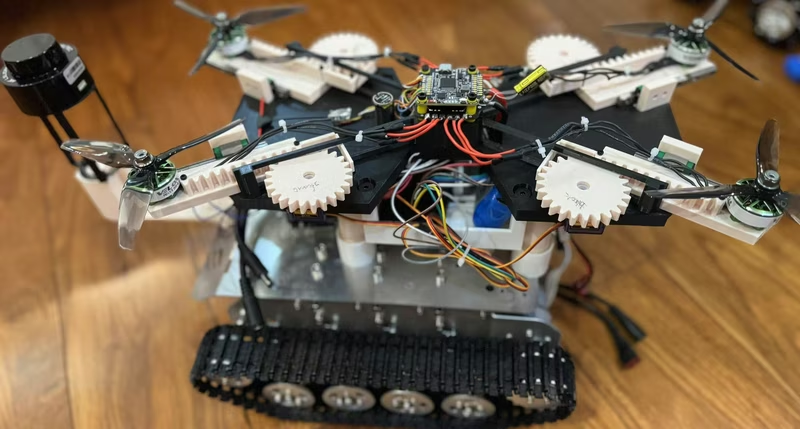
Voice-Controlled Ground and Aerial Robot
A multi-modal robotic control system that translates spoken commands into physical actions using an ESP32-S3 for audio capture and an Arduino UNO for motor execution. The project integrates high-level AI services including Deepgram for transcription, GPT-4o for intent analysis, and 60db for text-to-speech feedback.
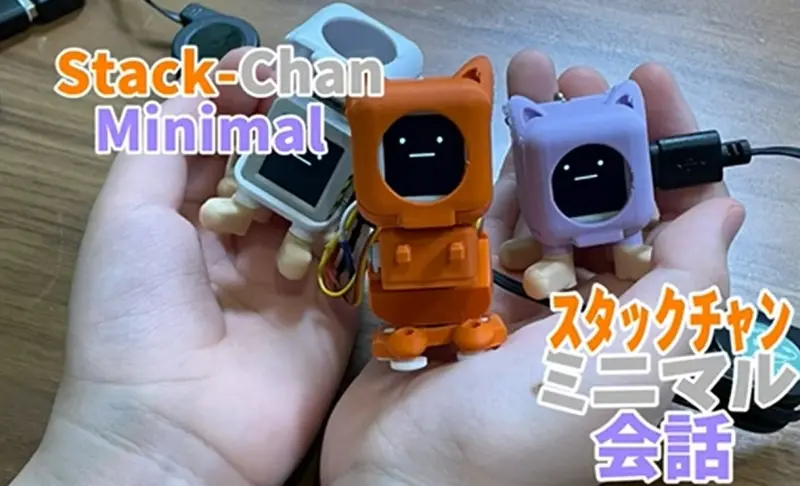
StackChan Minimal
An AI companion robot project for the M5Stack AtomS3R that connects an ESP32-based body to local AI services. It supports speech recognition, local LLM chat, and text-to-speech integration while providing a hardware interface for sensors and servos.
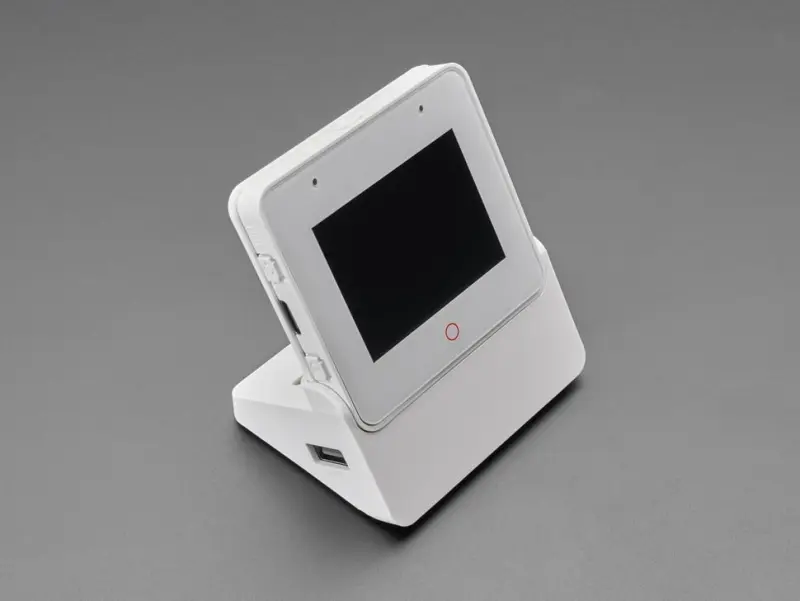
XiaoClaw: AI Voice Assistant with Local Agent Brain
XiaoClaw is an integrated firmware for the ESP32-S3 that combines voice interaction with a local AI agent. It utilizes the ESP-IDF framework and FreeRTOS to provide a complete system for voice I/O, LLM-powered reasoning, tool calling, and autonomous task execution.

Starmoon: Open-Source Conversational AI Device
A compact, open-source AI-enabled device powered by the ESP32-S3 for real-time voice interaction. It features voice-enabled emotional intelligence, custom AI characters, and a self-hostable backend architecture using FastAPI and Docker.