ESP32Berry
A comprehensive handheld OS-like application for the LilyGO T-Deck, leveraging LVGL for its user interface and LovyanGFX for high-performance display driving. It features a ChatGPT client, dynamic WiFi configuration, and system-level controls for audio and brightness.
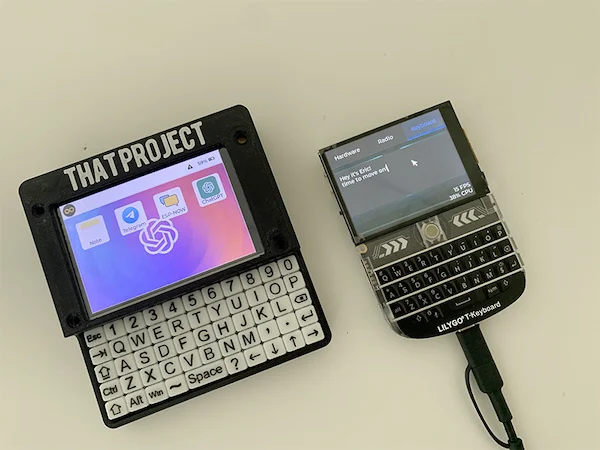
ESP32Berry is an ambitious project that transforms the LilyGO T-Deck—a portable ESP32-S3 based handheld with a keyboard and screen—into a functional, miniature computing device. Developed by Eric Nam (ThatProject), the project aims to provide a cohesive user experience similar to a mobile operating system, tailored specifically for the constraints and capabilities of embedded hardware.
The Evolution of ESP32Berry
The project has seen significant architectural shifts to improve performance and usability. While earlier versions experimented with VNC clients and ESP-NOW chat applications, the current iteration (Version 0.5 and beyond) focuses on a robust UI framework. A key technical decision in the recent updates was the migration from the standard TFT_eSPI library to LovyanGFX. This change was driven by the need for faster screen updates and better integration with the LilyGO T-Deck’s hardware, allowing for a much smoother user interface experience.
Core Features and Capabilities
ESP32Berry is more than just a simple demo; it is a multi-app environment. Key features include:
- LVGL-Based Interface: Utilizing LVGL 8.4.0 (with preparations for LVGL 9), the project features a home screen, an app drawer, and a control panel.
- ChatGPT Client: A built-in application that allows users to interact with OpenAI’s ChatGPT directly from their handheld device, utilizing the T-Deck’s physical keyboard for input.
- System Controls: A dedicated control panel for managing hardware parameters like screen brightness and speaker volume.
- Dynamic Networking: A WiFi selection tool that allows users to scan for and connect to access points through the GUI, rather than hardcoding credentials.
- Hardware Integration: Full support for the T-Deck’s peripherals, including the keyboard, trackball, SD card slot, and audio I2S interface.
Technical Architecture
The software is structured around an AppBase class, which facilitates the creation of modular applications within the ESP32Berry ecosystem. This object-oriented approach allows the system to manage different states—such as the home screen, settings, or the ChatGPT client—efficiently. The project relies on the ESP32’s dual-core architecture, typically running the UI tasks on one core while handling network requests or background system tasks on the other, managed by the underlying FreeRTOS kernel.
Hardware Requirements and Setup
The project is specifically optimized for the LilyGO T-Deck. To compile the project, developers need to configure the Arduino IDE with specific settings to handle the ESP32-S3’s OPI PSRAM and the 16MB Flash size. The partition scheme is particularly important, requiring a large FATFS area to store system assets and user data.
// Example of the board initialization sequence in ESP32Berry
void initBoard(){
  pinMode(BOARD_POWERON, OUTPUT);
  digitalWrite(BOARD_POWERON, HIGH);

  pinMode(BOARD_SDCARD_CS, OUTPUT);
  pinMode(RADIO_CS_PIN, OUTPUT);
  pinMode(BOARD_TFT_CS, OUTPUT);

  digitalWrite(BOARD_SDCARD_CS, HIGH);
  digitalWrite(RADIO_CS_PIN, HIGH);
  digitalWrite(BOARD_TFT_CS, HIGH);

  pinMode(BOARD_SPI_MISO, INPUT_PULLUP);
  SPI.begin(BOARD_SPI_SCK, BOARD_SPI_MISO, BOARD_SPI_MOSI);
}
Future Directions
The developer is currently working on integrating LVGL 9 to further enhance the visual fidelity and performance of the system. With its open-source MIT license, ESP32Berry serves as both a functional tool for T-Deck owners and a comprehensive reference for developers looking to build sophisticated, multi-app GUI environments on ESP32 hardware.