ESP32-8048S050C with LVGL 9.4 and FreeRTOS
An implementation for the Sunton ESP32-S3 800x480 capacitive touch display utilizing ESP-IDF 5.5.2 and LVGL 9.4. It features optimized memory management strategies for PSRAM-based framebuffers and leverages FreeRTOS for efficient task orchestration.
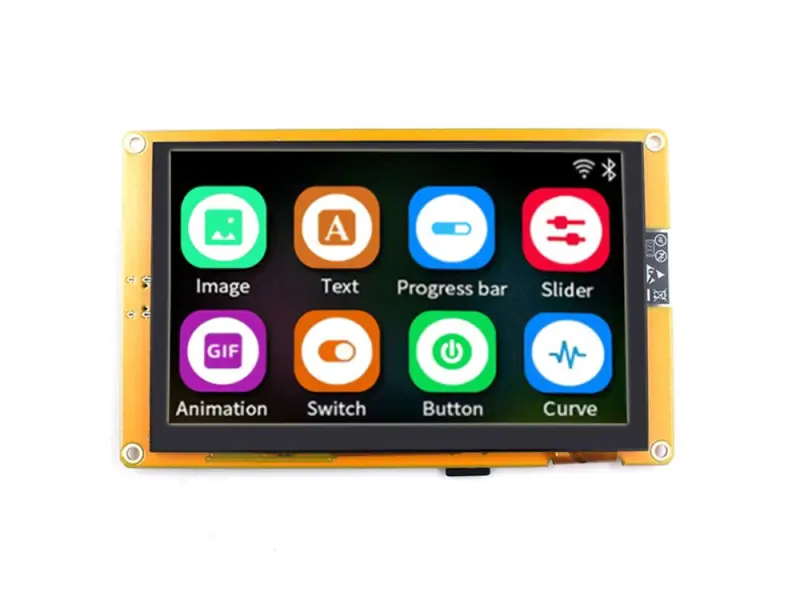
High-Resolution Graphics on the ESP32-S3
The Sunton ESP32-8048S050C is a powerful hardware platform featuring an ESP32-S3 SoC paired with a large 5-inch 800x480 capacitive touch display. Driving such a high resolution on a microcontroller requires careful resource management, particularly when it comes to memory allocation and display bus throughput. This project provides a robust implementation using the latest ESP-IDF (v5.5.2) and LVGL 9.4 to achieve fluid user interfaces on this specific hardware.
At the heart of the implementation is the integration of the LVGL graphics library with the FreeRTOS Operating System Abstraction Layer (OSAL). By enabling CONFIG_LV_OS_FREERTOS, the project ensures that the graphics stack plays nicely with the underlying real-time operating system, allowing for responsive touch interactions and smooth animations without blocking critical system tasks.
Navigating Hardware Constraints
One of the primary challenges with an 800x480 resolution is the memory footprint of the framebuffer. At this size, a full color framebuffer exceeds the internal RAM capacity of the ESP32-S3. Consequently, the framebuffer must be located in external PSRAM (SPIRAM). This project utilizes Octal SPIRAM at 80MHz to maximize bandwidth, but even with high-speed serial RAM, the hardware faces a bottleneck: both the program memory (Flash) and the PSRAM share the same SPI bus.
To address this, the project explores two distinct rendering strategies:
Bounce Buffer Mode
In this mode, the system uses a smaller “bounce” buffer in internal RAM to facilitate DMA transfers. While this setup allows for a higher pixel clock (around 18 MHz) and produces fluent medium-speed animations, it can struggle with complex full-screen operations like sliding or scrolling due to the overhead of moving data from PSRAM to internal RAM.
Double Buffer Mode
By using two buffers, the system can achieve much smoother sliding and scrolling effects. However, due to the increased bus contention, the pixel clock is typically reduced to 14 MHz to maintain stability. This mode is ideal for applications requiring high-quality UI transitions where “tearing” or glitches must be avoided.
Touch and Display Integration
The project utilizes the esp_lcd component framework for display interfacing and the gt911_touch component for handling user input. A critical part of the setup is the registration of a callback in gt911_touch_init, which maps the raw measured touch coordinates from the GT911 controller to the actual display coordinates, ensuring that UI elements respond accurately to user finger placement.
Performance Optimization
Because the SPI bus is a shared resource, the project highlights the importance of pixel clock tuning. If you encounter panel distortion or glitchy animations, it is often a sign of a DMA/SPI bottleneck. The provided sdkconfig.defaults includes specific optimizations like CONFIG_SPIRAM_XIP_FROM_PSRAM, which helps increase the PCLK frequency when the Frame Buffer is allocated from PSRAM and fetched via EDMA.
For developers looking to build modern, touch-heavy applications on the ESP32-S3, this repository serves as a practical blueprint for balancing high-resolution graphics with the inherent architectural limits of the hardware.
Related Projects
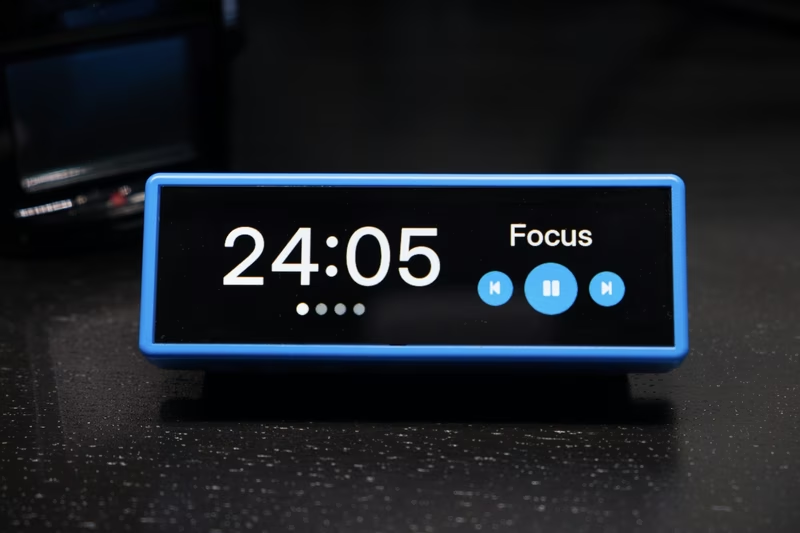
Tomato32
Tomato32 is a Pomodoro timer application specifically designed for the Waveshare ESP32-S3-Touch-LCD-3.49 development board. It features a responsive touchscreen interface built with the LVGL graphics library and runs on the ESP-IDF framework using FreeRTOS. The project supports customizable timer profiles, smart power management, and personalized background assets.
ESP32-TUX
ESP32-TUX is a comprehensive Touch UX template for ESP32 and ESP32-S3 microcontrollers, leveraging the LVGL graphics library and LovyanGFX driver. It provides a ready-to-use framework for building sophisticated HMI applications with features like Wi-Fi provisioning, OTA updates, and theme switching across various 3.5-inch display modules.