ESP E-Paper Component
A flexible e-paper display driver for the ESP-IDF framework featuring LVGL 9 integration. It supports a wide range of panels including black/white, 4-color BWRY, and 6-color displays with advanced features like Floyd-Steinberg dithering and partial refresh. Designed for low-power IoT devices, electronic shelf labels, and photo frames on ESP32 series microcontrollers.
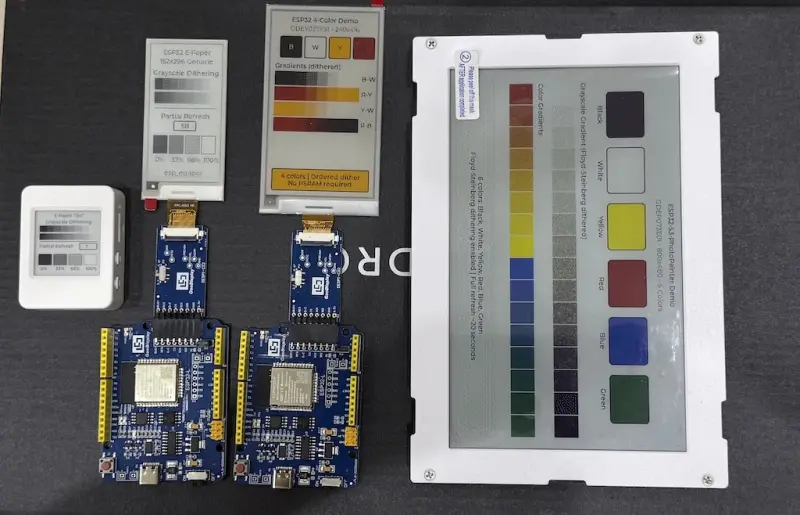
Overview
The ESP E-Paper Component is a high-performance display driver designed specifically for the ESP-IDF ecosystem. It provides a robust bridge between the LVGL 9 graphics library and various e-paper (EPD) panels, enabling developers to create sophisticated user interfaces on low-power, sunlight-readable displays. The project is particularly well-suited for IoT devices, electronic shelf labels (ESL), and digital photo frames.
Key Features and Capabilities
One of the standout features of this component is its support for a diverse range of color depths and panel types. While many e-paper drivers are limited to simple black-and-white updates, this library handles:
- Black/White (1-bit): Optimized for the fastest possible refresh rates.
- 4-Color BWRY (2-bit): Support for Black, White, Red, and Yellow panels.
- 6-Color (4-bit): Support for advanced panels (like the PhotoPainter) featuring Black, White, Yellow, Red, Blue, and Green.
Advanced Dithering
To overcome the color limitations of e-paper hardware, the component implements Floyd-Steinberg error-diffusion dithering. This algorithm allows for smooth gradients and photo-quality imagery by distributing quantization errors to neighboring pixels. It automatically handles RGB565 to panel palette conversion, making it easy to display complex images on limited-color hardware.
Smart Partial Refresh
For black-and-white panels, the driver supports partial refresh modes. This technique tracks base images to perform differential updates, significantly reducing the “flashing” effect associated with full e-paper refreshes. It includes configurable ghosting prevention and automatic mode switching between partial and full updates to maintain image clarity over time.
Data-Driven Architecture
The project employs a highly extensible, data-driven architecture. Adding support for a new panel often requires only a single line of code in the panel registry if it uses a compatible controller (like the SSD16xx series). The system uses a controller abstraction layer that separates hardware-specific commands from the high-level drawing logic. Capability flags allow the application to detect features like partial refresh or grayscale support at runtime.
Technical Implementation
The component is optimized for the ESP32 series, including the ESP32-S3 and C-series. It efficiently manages memory by automatically allocating large buffers (required for high-resolution displays like 800x480) from PSRAM when available. It utilizes chunked SPI transfers to ensure compatibility with DMA, maintaining performance even during complex image processing.
Basic Usage Example
#include "epaper.h"
#include "epaper_lvgl.h"
#include "lvgl.h"

void app_main(void)
{
    lv_init();

    // Configure for a specific board preset
    epd_config_t cfg = EPD_CONFIG_ESP32S3_154();

    // Initialize hardware
    epd_handle_t epd;
    ESP_ERROR_CHECK(epd_init(&cfg, &epd));

    // Initialize LVGL display interface
    epd_lvgl_config_t lvgl_cfg = EPD_LVGL_CONFIG_DEFAULT();
    lvgl_cfg.epd = epd;
    lv_display_t *disp = epd_lvgl_init(&lvgl_cfg);

    // Standard LVGL UI code
    lv_obj_t *label = lv_label_create(lv_screen_active());
    lv_label_set_text(label, "Hello E-Paper!");
    lv_obj_center(label);

    // Trigger refresh
    epd_lvgl_refresh(disp);
}
Hardware Support
The library includes built-in presets for popular Waveshare and Good Display modules, such as the ESP32-S3-ePaper-1.54 and the 7.3” PhotoPainter. It supports a wide array of SSD16xx-based generic panels ranging from 1.54” to 4.2”. Because it is built as a standard ESP-IDF component, it integrates seamlessly into existing projects via the Espressif Component Registry.