Edge AI on Embedded Linux — i.MX 8M Plus
A full-stack embedded Linux project for the NXP i.MX 8M Plus EVK featuring real-time NPU-accelerated object detection and NIR spectral monitoring. It demonstrates a complete development workflow from Yocto BSP bring-up and custom kernel module development to high-level Python applications using TensorFlow Lite and GStreamer.
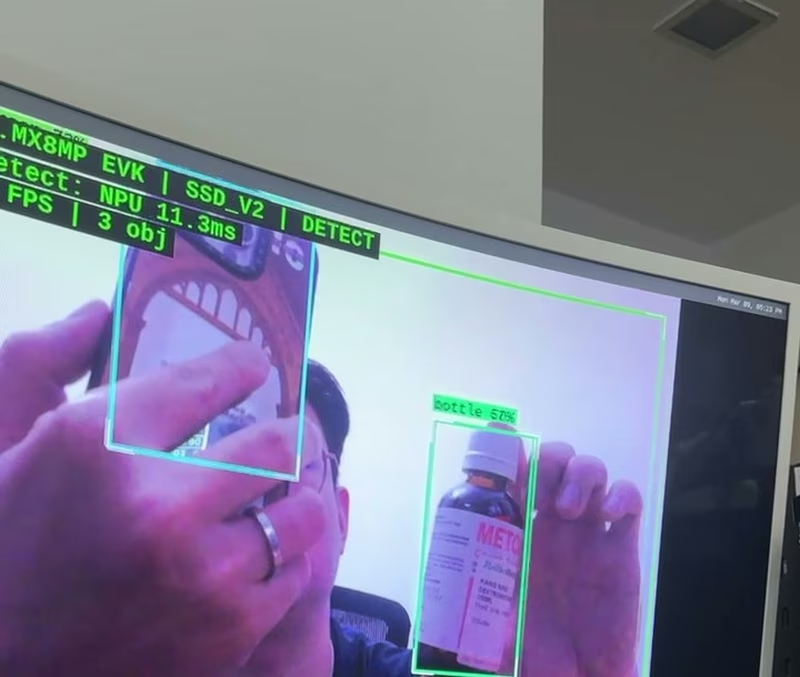
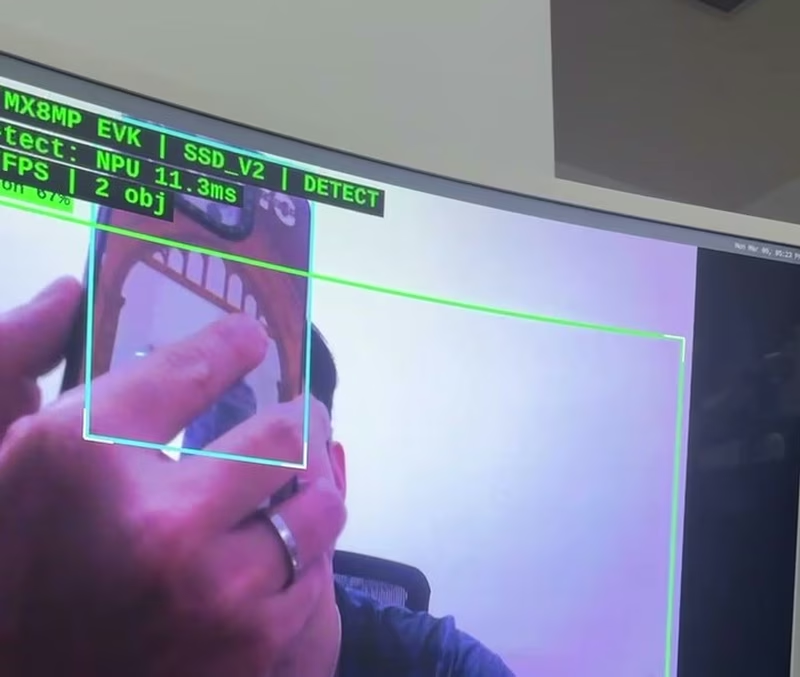
This project provides a comprehensive implementation of an Edge AI system on the NXP i.MX 8M Plus EVK. It spans the entire embedded stack, starting from Yocto BSP bring-up to deploying real-time neural network inference using the onboard 2.3 TOPS NPU. The primary demonstration features a live camera feed processed through a MobileNet SSD v2 model, delivering bounding boxes to an HDMI display with a low latency of 11ms per inference.
Real-Time Object Detection Performance
The core of the project is a high-performance detection pipeline. By utilizing the NPU via TensorFlow Lite and the VX Delegate, the system achieves significant speedups compared to CPU-only execution. For example, MobileNet SSD v2 runs 4x faster on the NPU (11ms) than on the CPU (45ms), while MoveNet Lightning for pose estimation sees a 2x improvement.
The architecture leverages a zero-copy pipeline: an OV5640 camera captures frames via MIPI-CSI2, which are handled by the ISI DMA and passed into GStreamer. The application uses an appsink to feed data into NumPy and then into the TFLite engine. Finally, a PIL-based overlay is applied before the video is rendered via waylandsink on HDMI.
NIR Tissue Monitoring
Beyond standard computer vision, the repository includes a specialized NIR Spectral Monitor designed for medical safety applications, specifically cold therapy monitoring. Using an AS7263 6-channel sensor, the system reads tissue reflectance to calculate a tissue oxygenation index (TOI).
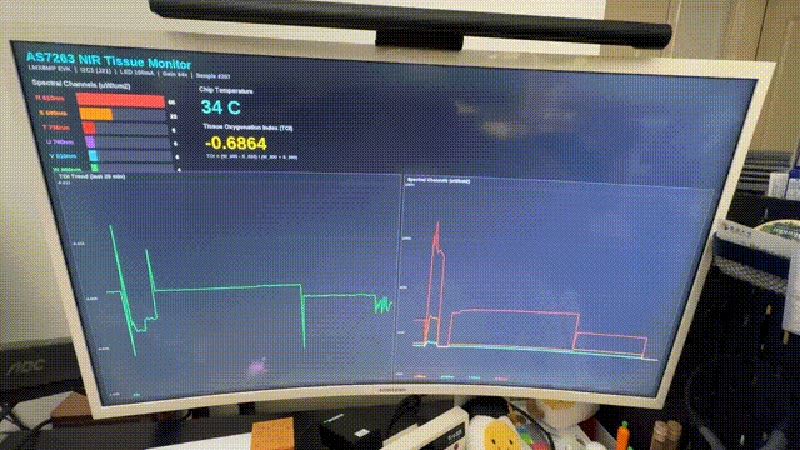
This data is visualized on a full-screen GTK3 and Cairo dashboard. In testing, the sensor successfully detected physiological changes such as vasoconstriction during ice-pack application and reactive hyperemia during rewarming, demonstrating the platform’s utility for real-time clinical monitoring.
Hardware and Software Stack
The project targets the NXP i.MX 8M Plus EVK, which features a quad-core A53 processor and an integrated NPU. Key hardware components include:
- Camera: OV5640 MIPI CSI-2
- Sensors: AS7263 NIR spectral sensor and BME280
- Connectivity: AzureWave AW-CM276NF (WiFi/BT)
- Display: HDMI output via Weston/Wayland
The software environment is built using Yocto (Scarthgap release) with Kernel 6.6.52-lts. The repository includes helper scripts to automate the multimedia image build process and configure the hardware switches for SD card booting.
Custom Kernel Modules
A significant portion of the project focuses on low-level driver development. It includes three out-of-tree kernel modules that serve as a learning path for Linux driver architecture:
- hello: A minimal module demonstrating initialization, exit routines, and kernel logging.
- chardev: A complete character device implementation featuring file operations, user-space memory copying, and mutex-based synchronization.
- bme280: An I2C client driver that utilizes device tree matching, sysfs attributes for sensor data access, and managed resource allocation (
devm).
Development and Debugging
The project documents real-world bring-up challenges, providing a valuable debug log for embedded developers. Issues addressed include V4L2 device mapping (where the VPU encoder often claims /dev/video0), color space mismatches in the ISI output, and networking configuration hurdles like empty DNS resolution files. This documentation ensures a smoother path for developers replicating the setup or building similar high-performance edge AI applications.
Related Projects
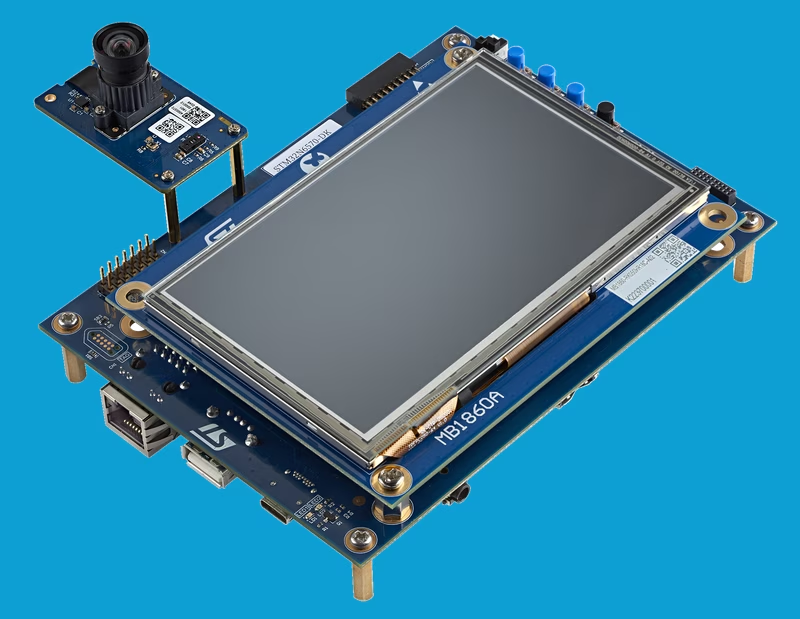
STM32N6 AI Object Detection and H.264 USB Video Streaming
This project demonstrates high-performance computer vision on the STM32N6570-DK discovery board, utilizing an NPU-accelerated quantized AI model for real-time object detection. It leverages a multi-threaded FreeRTOS architecture to manage a complex pipeline including DCMIPP image processing, hardware H.264 encoding, and USB Video Class (UVC) streaming.
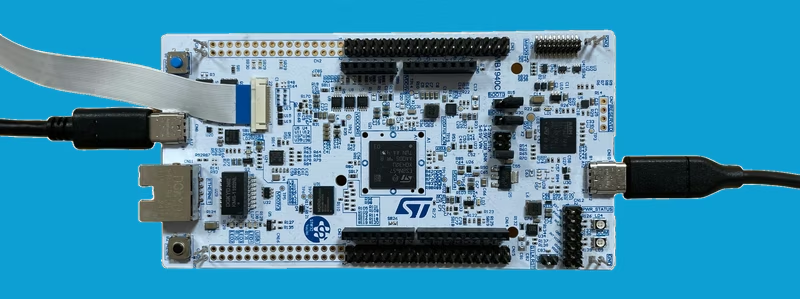
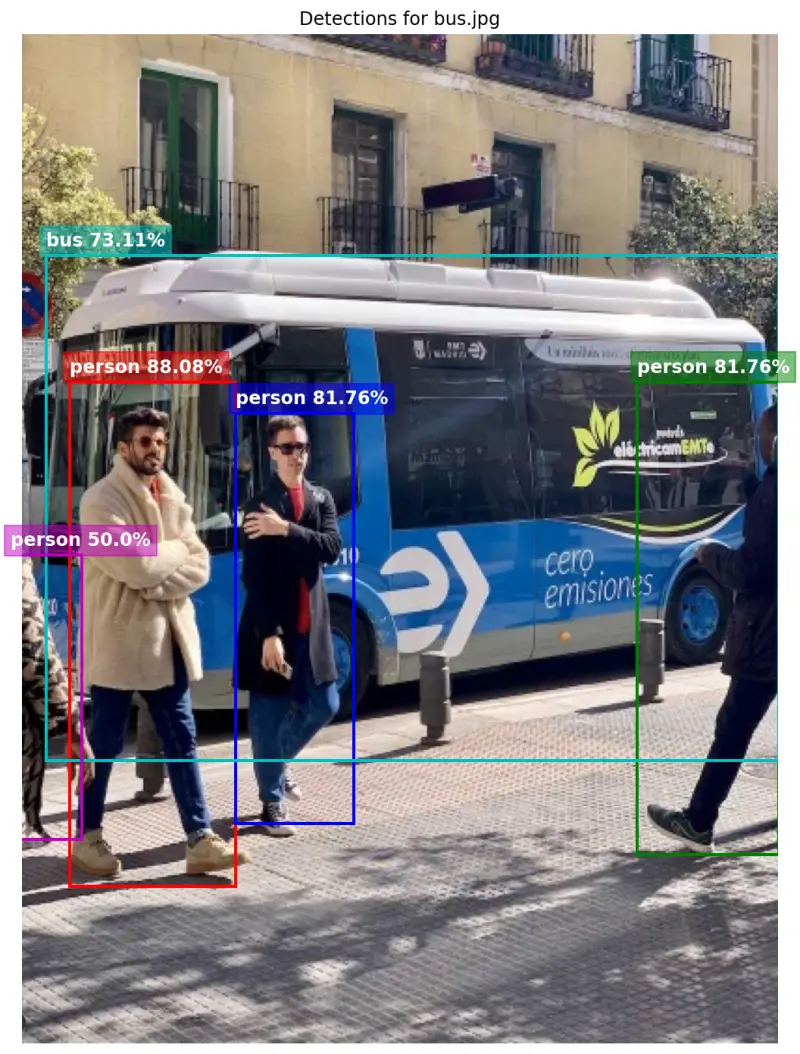
Image Classification Getting Started for STM32N6
This project provides a real-time bare-metal environment for STM32N6 microcontrollers to execute image classification models accelerated by the on-chip NPU. It features a complete camera-to-display pipeline using STEdgeAI, DCMIPP, and ISP hardware blocks for high-performance edge AI.
YOLOv26n: Optimized QAT & Deployment on ESP32-P4
An end-to-end workflow for Quantization Aware Training (QAT) and deployment of YOLOv26n on the ESP32-P4 SoC. It utilizes the ESP-DL library and a custom dual-head architecture to achieve high-performance, NMS-free inference. The project includes both a Python-based quantization pipeline and an optimized C++ firmware engine.
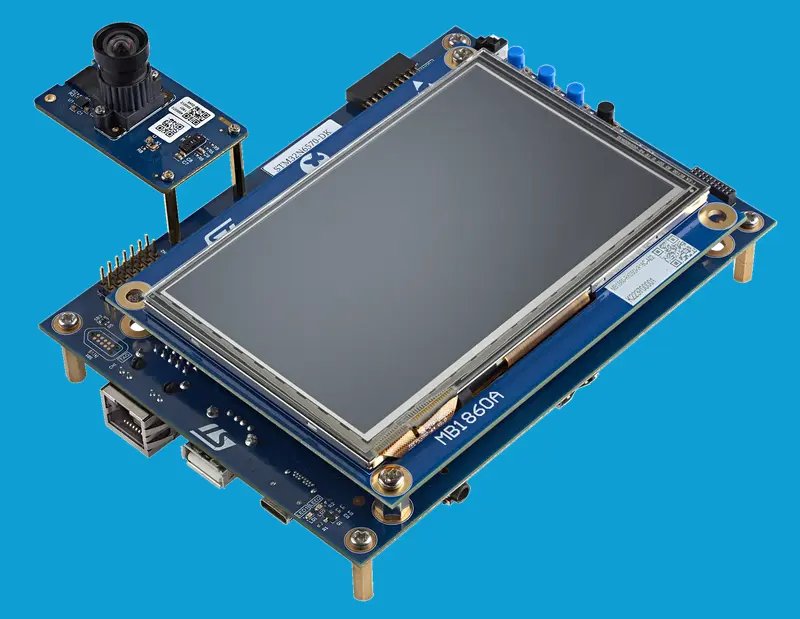
STM32N6 Getting Started for Object Detection
A real-time object detection application for STM32N6 microcontrollers, showcasing NPU-accelerated AI inference using STEdgeAI. It features a sophisticated vision pipeline with dual DCMIPP pipelines, ISP integration, and support for external flash booting on STM32N6570-DK and NUCLEO-N657X0-Q boards.