Software timers
How a software timer runs a callback after a delay or every period, and why FreeRTOS runs it in a task of its own while Zephyr runs it in the tick interrupt.
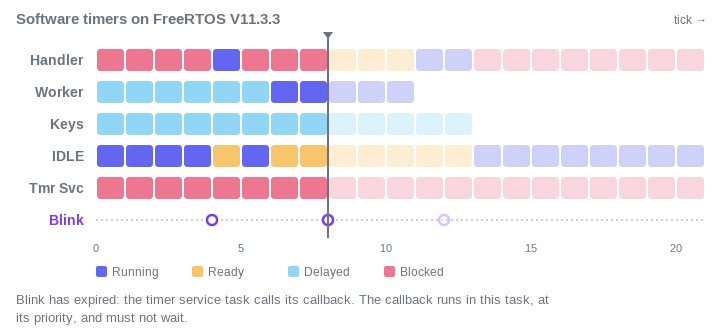
Simulated kernel: FreeRTOS V11.3.3 and Zephyr v4.5.0. This scenario and every other one are in the scheduler playground. The simulator and its data files are not covered by the site's CC BY-SA license; see their license notices.
A task that has to do something every 4 ticks can loop on a delay. But many jobs are too small to deserve a task and a stack of their own: blink an LED, time out a key press, poll a sensor now and then. A software timer does them with no task of its own. You give the kernel a period and a callback, a short function, and the kernel calls it when the time is up:
- A one-shot timer expires once, a period after it is started.
- An auto-reload timer expires every period, until it is stopped.
Starting a timer again while it runs restarts its period from now, which is how a timeout that should only fire after a quiet spell (a screen that dims when no key has been pressed for a while) is built: every key press restarts it.
The callback must be short and must never wait, because it does not run in a task you own. Where it does run is the big difference between the two kernels:
- FreeRTOS runs every callback in the timer service task
(
Tmr Svc), a task the kernel creates for itself atconfigTIMER_TASK_PRIORITY. A task does not even touch a timer itself:xTimerStart()andxTimerStop()send a command to that task through a queue. - Zephyr runs the callback, its expiry function, inside the tick interrupt, as soon as the
timer’s timeout comes due. There is no timer task and no command queue:
k_timer_start()puts the timer straight into the kernel’s timeout list.
The scenario
Blinkis an auto-reload timer with a period of 4 ticks.main()starts it before any task runs. Its callback gives the binary semaphoreS, and that is all.Handlerdoes the work: it loops onSand works one tick each time. It has urgency 2.Worker, the most urgent task (urgency 3), sleeps until tick 6 and then works for five ticks.Keys(urgency 1) wakes at tick 13 and stopsBlink.
Giving a semaphore from the callback and doing the work in a task is the same deferred handling used for interrupts: the callback stays short.
What happens on FreeRTOS
- Tick 0:
main()has createdBlinkand calledxTimerStart( xBlink, 0 ). The scheduler is not running yet, so the commandstart(Blink, 0)just waits in the timer command queue (xTimerQueuein the kernel panel).Tmr Svchas priority 4, above every task, so it runs first: it takes the command, putsBlinkinto its list of active timers, due at 0 + 4 = 4, and waits on its queue until then. - Tick 4: the tick wakes
Tmr Svc. It findsBlinkdue, puts it back in the list for tick 8 and calls the callback, which givesS.Tmr Svcwaits again andHandlerruns. - Tick 6:
Workerstarts its five ticks of work. - Tick 8:
Blinkis due again.Tmr Svcis more urgent thanWorker, so it preempts it and runs the callback on time.Handleris ready now, but it is less urgent thanWorkerand waits untilWorkerends at tick 11. - Tick 12: the third expiry, and
Handlerruns at once. - Tick 13:
KeyscallsxTimerStop(). That only sendsstop(Blink)toTmr Svc, which is more urgent and runs beforeKeyshas even returned: it takesBlinkout of the list. The expiry due at tick 16 never comes.
The timer task’s own lane in the timeline shows what all this costs: it runs for a moment at each expiry and each command, and is blocked the rest of the time.
What happens on Zephyr
The timer expires at tick 5, 9 and 13, one tick later than on FreeRTOS.
k_timer_start() was called from a thread, and a relative timeout from a thread always gets one
extra tick (why). After that first expiry the next one is
computed from when the timer was due, as an absolute tick, so the period stays 4.
Each expiry function runs inside the timer interrupt, before any thread switch. At tick 9 it gives
S while Worker is still busy; Handler gets the semaphore but waits for Worker, as on
FreeRTOS. Keys wakes at tick 14 (the same extra tick on its own sleep) and k_timer_stop() takes
the timer out of the timeout list straight away, so the expiry due at tick 17 never comes.
When the timer task is not the most urgent
On FreeRTOS a callback runs only when the timer task gets the CPU. Set Timer task urgency to
2, below Worker. At tick 8 Blink is due, but Worker keeps the CPU, and the callback only runs
at tick 11, three ticks late. The next expiry is still at tick 12: an auto-reload timer counts its
next expiry from when it was due, not from when its callback ran, so being late once does not
shift every later expiry. If the timer task falls behind by more than a whole period, it runs the
missed callbacks back to back.
This is why the FreeRTOS documentation suggests a high priority for the timer task, and why callbacks must be short: while one runs, no other callback can, and no command is processed. Zephyr has no such setting, and the parameter is not offered there. Its expiry functions are never late, but they run with interrupts at the timer’s level, so they must be even shorter.
What to try
- Untick Blink reloads:
Blinkbecomes a one-shot timer and expires only once, at tick 4 (Zephyr: 5).Keysstops a timer that is no longer running, which does nothing. - Set Blink period to 3: FreeRTOS expires at ticks 3, 6, 9 and 12, Zephyr at 4, 7, 10 and 13. The extra tick on Zephyr only ever applies to the first expiry.
- On FreeRTOS, follow a command at the Line level: from
xTimerStop()inKeys, throughxQueueSend()into the timer queue, toprvProcessReceivedCommands()inTmr Svc. The walkthroughs for FreeRTOS and for Zephyr go through the kernel code.