Task states
Running, ready, delayed, blocked, suspended and ended, followed through one task's life, with the names each kernel uses for them.
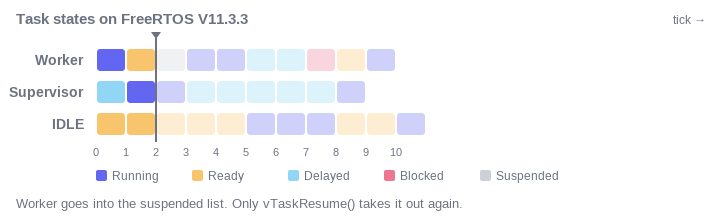
Simulated kernel: FreeRTOS V11.3.3 and Zephyr v4.5.0. This scenario and every other one are in the scheduler playground. The simulator and its data files are not covered by the site's CC BY-SA license; see their license notices.
A task spends most of its life not running. At any moment the kernel puts each task in one state, and the state decides whether the scheduler may choose it. Learning the states is most of learning how a kernel works: every later lesson is about how and when tasks move between them.
The simulator above follows one task, Worker, through every state. A second task, Supervisor,
is more urgent and causes most of what happens to Worker:
Workerhas three ticks of work, then sleeps for two ticks, then waits for the semaphoreS, then does one more tick of work and ends.Supervisorsleeps for one tick, works for one tick, suspendsWorker, works for another tick, resumesWorker, sleeps for five ticks, givesSand works for one last tick.
Watch the label on Worker’s task card, and its lane in the timeline. Tick numbers below are for
FreeRTOS, with Zephyr’s in brackets: Zephyr’s sleeps last one tick longer (the
scheduling lesson explains why).
Running
The task whose code the CPU is executing. With one CPU there is exactly one, and if no application
task can run, it is the kernel’s idle task. Worker starts out running at tick 0, because
Supervisor goes to sleep first.
Ready
A ready task could run, but a more urgent task has the CPU. At tick 1 (2) Supervisor wakes up,
and because it is more urgent, the kernel
takes the CPU away from Worker. Worker is now ready: it has done
nothing wrong and is not waiting for anything, it simply has to wait its turn. This is
preemption.
Suspended
Supervisor then suspends Worker (vTaskSuspend();
k_thread_suspend() in Zephyr). A suspended task is ignored by the scheduler until another task
resumes it, whatever its priority. Nothing in the kernel ends a suspension by itself: no timeout,
no event.
A tick later Supervisor resumes it and goes to sleep, so Worker is ready
again and runs at once. Suspending is a blunt tool, and real programs use it rarely; waiting on a
semaphore or queue is almost always the better way to stop a task.
Delayed
At tick 5 Worker has finished its three ticks of work and
sleeps for two ticks (vTaskDelay(2); k_sleep() in Zephyr). A delayed
task waits for time to pass and nothing else. The kernel keeps it in a list sorted by wake-up
time, and the tick interrupt moves it back to ready when its time comes, at tick 7 (8).
The kernel panel shows the list: xDelayedTaskList1 in FreeRTOS, the timeout list in Zephyr.
Both tasks are delayed between ticks 5 and 7 (5 and 8), so the CPU runs the idle task.
Blocked
Back from its sleep, Worker asks for the semaphore S, which nobody has given yet. It
blocks: it waits for an event that another task (or an interrupt) must cause,
here a give of S. A blocked task uses no CPU. It sits in the semaphore’s list of waiting tasks,
which the kernel panel shows under S.
At tick 8 (10) Supervisor wakes and gives S. That makes Worker ready,
but Supervisor is still more urgent and has one tick of work left. Only when Supervisor ends
does Worker run and do its last tick of work. (FreeRTOS lets Worker take S when it runs;
Zephyr hands S to it at the moment of the give. The
mutex handoff lesson is about that difference.)
A wait can have a timeout (“wait for S, but at most 10 ticks”), and then the task is in two
places at once: the object’s waiting list, and the list of tasks waiting for time. It becomes ready
on whichever comes first. Worker waits without a timeout.
Ended
After its last tick of work, Worker ends. In FreeRTOS it deletes itself
with vTaskDelete(NULL) and waits in xTasksWaitingTermination until the idle task frees its
memory. In Zephyr its function returns and the kernel aborts the thread. An ended task can never run
again.
The kernels’ own names
The simulator’s labels are the same for every kernel. Each kernel names things its own way:
| Simulator | FreeRTOS eTaskGetState() |
Where FreeRTOS keeps it | Zephyr base.thread_state |
|---|---|---|---|
| Running | eRunning |
pxCurrentTCB, and still in its ready list |
_current, and still in the run queue |
| Ready | eReady |
pxReadyTasksLists[priority] |
_THREAD_QUEUED: in the run queue |
| Delayed | eBlocked |
the delayed list | _THREAD_SLEEPING, with a timeout |
| Blocked | eBlocked |
the object’s waiting list, plus the delayed list (with a timeout) or xSuspendedTaskList (without one) |
_THREAD_PENDING: in the object’s wait queue, with a timeout if it has one |
| Suspended | eSuspended |
xSuspendedTaskList |
_THREAD_SUSPENDED |
| Ended | eDeleted until the idle task frees it |
xTasksWaitingTermination |
_THREAD_DEAD |
Two details stand out.
FreeRTOS does not tell delayed and blocked apart: both are eBlocked, because a delay is a wait
for nothing but a timeout. The difference is only whether the task’s event list item is in an
object’s list as well.
FreeRTOS also puts a task that waits forever in the suspended list, because there is no wake-up
time to sort it by. Step to the moment Worker blocks on FreeRTOS and look at the kernel panel:
Worker is in xSuspendedTaskList. It is still blocked, not suspended. eTaskGetState() tells
the two apart by checking whether the task is also waiting on an object (or for a task
notification).
In Zephyr, the state is a set of flags, and a thread can have more than one: a thread that is
suspended while it waits keeps _THREAD_PENDING as well. The simulator shows the flags on each
Zephyr task card. The running thread stays in the run queue in Zephyr’s single-CPU configuration,
which makes choosing the next thread simpler.
The whole picture
| Change | Caused by |
|---|---|
| Ready → Running | the scheduler, when it is the most urgent ready task |
| Running → Ready | preemption by a more urgent task, or giving up its turn (taskYIELD(), k_yield(), a time slice ending) |
| Running → Delayed | the task sleeps (vTaskDelay(), k_sleep()) |
| Running → Blocked | the task waits for something that is not available yet |
| Delayed or Blocked → Ready | the tick, when its time is up; another task or an interrupt, when it gives what was waited for |
| any → Suspended → Ready | vTaskSuspend() and vTaskResume() (k_thread_suspend(), k_thread_resume()) |
| Running → Ended | the task deletes itself or returns |
Only the first change is the scheduler’s choice. Every other change happens because of something a task, an interrupt or the tick did, after which the scheduler applies its rule again.
What to try
- Give
Supervisoran urgency of 1, the same asWorker. Neither preempts the other now: they take turns tick by tick (time slicing), soWorkergoes between ready and running before it is ever suspended. - Set the step level to Line, go to the suspension, and step through
vTaskSuspend()(ork_thread_suspend()) to see the task leave its ready list.
Next: the scheduler’s rule and its lists in detail, in How an RTOS scheduler decides what runs.