WUTE Dashboard for Formula Student Electric
A high-performance multi-function digital dashboard for Formula Student electric racing cars based on the STM32H7B0VET6 microcontroller. It utilizes the LVGL graphics library to provide real-time visualization of vehicle data such as battery status, motor temperature, and CAN bus telemetry on a high-brightness 5-inch TFT display.
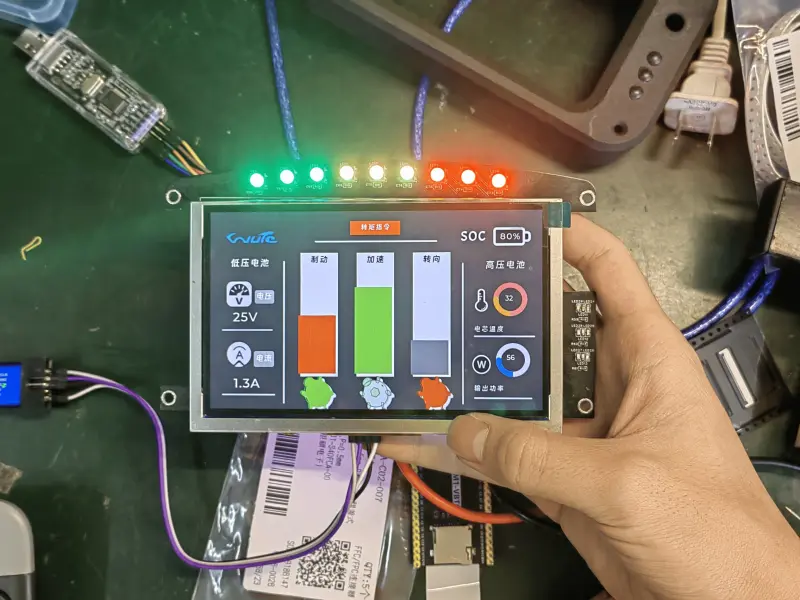
Overview
The WUTE Dashboard is a custom-designed human-machine interface (HMI) developed for the WUTE Formula Student team’s electric racing cars. Built to provide drivers with critical real-time telemetry, the system was successfully deployed on the E33 (2023 season) and E10 (2024 season) vehicles. The project centers around the STM32H7B0VET6 microcontroller, leveraging its high-performance capabilities to drive a 5-inch high-brightness (800 nit) TFT screen.
Hardware and System Architecture
The hardware is built on a custom four-layer PCB designed using LCEDA. To manage the high-resolution assets required for a modern GUI, the system employs a Bootloader and App split architecture, allowing the application to load resources from external flash memory.
Unlike many complex embedded systems that rely on an RTOS, this dashboard is built on a foreground-background bare-metal architecture. This choice ensures deterministic performance for real-time data processing while maintaining a layered software structure consisting of CORE, BSP (Board Support Package), Middleware (LVGL), and APP layers.
Key Features and Capabilities
The dashboard serves as the central monitoring hub for the vehicle, integrating several critical subsystems:
- Real-time Data Visualization: Using the LVGL graphics library, the display provides a comprehensive overview of the car’s status, including high-voltage battery metrics (voltage, current, temperature, SoC), motor controller data, and motor RPM.
- CAN Bus Integration: The system communicates directly with the vehicle’s CAN network to parse and display sensor data such as brake oil pressure, accelerator position, and torque percentages.
- Environmental Adaptation: An integrated ambient light sensor allows the screen brightness to adjust automatically, ensuring visibility in various racing conditions.
- Wireless Connectivity: An ESP8266 module is integrated to provide 2.4G wireless data transmission capabilities.
- Safety and Status Indicators: The board includes physical activation and Ready-To-Drive (RTD) buttons, along with dedicated LED indicators for TSOFF, BMS, and IMD faults.
- Visual Feedback: A built-in marquee LED strip provides immediate peripheral visual cues to the driver.
GUI and Model Design
The user interface is designed for maximum readability during high-speed maneuvers. It utilizes a single-screen layout that consolidates all essential information, including DRS and TCS status, into a cohesive dashboard. The physical enclosure is a two-part assembly (front and back plates) designed to house the driver board and screen securely using countersunk bolts and heat-set inserts, with sealant used to ensure water and vibration resistance—critical for the harsh environment of a racing car.
Project Impact
This dashboard has proven its reliability through multiple racing seasons, demonstrating excellent vibration resistance and waterproofing. It serves as a vital tool for driver feedback and vehicle health monitoring, representing a significant step forward in the WUTE team’s body electronics and HMI development.