Swift Embedded ESP32-C6 OLED Demo
A demonstration project showcasing Embedded Swift on the ESP32-C6 microcontroller. It features a rotating 3D cube animation on an OLED display using the U8g2 library and I2C communication within the ESP-IDF framework.
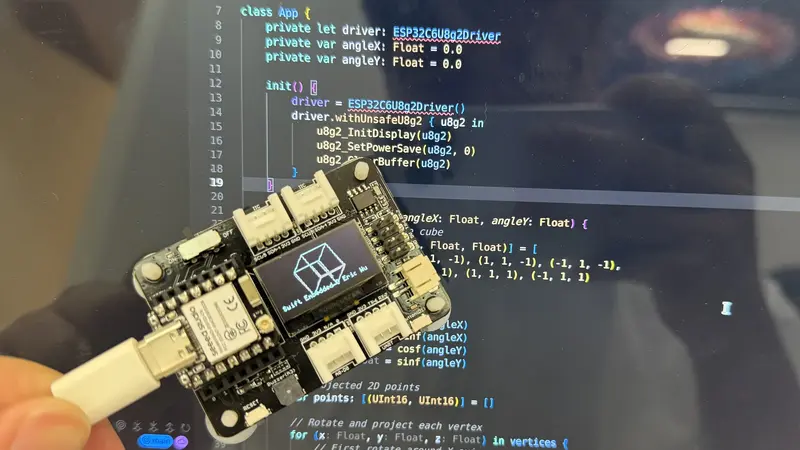
Embedded Swift is an emerging frontier for developers looking to bring the safety and expressiveness of the Swift programming language to resource-constrained environments. This project serves as a practical demonstration of Swift running on the ESP32-C6, specifically targeting the Seeed Studio XIAO ESP32-C6 expansion board. The demo features a real-time 3D graphics rendering of a rotating cube displayed on an OLED screen.
Hardware and Platform
The project targets the ESP32-C6, a RISC-V based SoC from Espressif that supports modern wireless protocols like Wi-Fi 6, Bluetooth 5, and Zigbee/Thread. By utilizing the XIAO ESP32-C6 expansion board, the project leverages an integrated OLED display via I2C communication. The underlying system relies on the ESP-IDF (Espressif IoT Development Framework), which provides the FreeRTOS kernel and essential hardware abstraction layers.
Graphics and Rendering
At the heart of the visual experience is the U8g2 library, a popular choice for monochrome displays in the embedded world. The project uses a Swift wrapper (U8g2Kit) to interface with the C-based U8g2 library. The 3D animation logic is implemented in Swift, demonstrating the language’s ability to handle mathematical computations and frame-buffer manipulation efficiently enough for smooth animations on a microcontroller.
To keep the binary size manageable—a critical requirement for embedded systems—the project includes a guide on U8g2 font optimization. By extracting only the necessary font data into separate C files, developers can significantly reduce the memory footprint of the final firmware.
Technical Integration
One of the most interesting aspects of this repository is the integration of the Swift Package Manager (SPM) with the CMake-based ESP-IDF build system. Since ESP-IDF does not natively support Swift, the project uses a custom CMake configuration to invoke the Swift toolchain. This process involves:
- Compiling Swift source code into a static library (
libApp.a). - Using a specific RISC-V triple (
riscv32-none-none-eabi) for the Swift compiler. - Enabling experimental embedded features in the Swift compiler to strip away the standard library overhead.
- Linking the resulting Swift archive with the rest of the ESP-IDF components.
Swift and C Interoperability
The project highlights the seamless interoperability between Swift and C, which is vital for accessing ESP-IDF’s extensive driver library. For instance, the code demonstrates how to call i2c_driver_install and other peripheral drivers directly from Swift. It also addresses common pitfalls, such as ensuring symbols are correctly referenced to prevent them from being stripped during the linking process.
Getting Started
To build the project, developers need both the ESP-IDF environment and a Swift toolchain capable of cross-compiling for RISC-V. The workflow follows the standard ESP-IDF pattern using idf.py for configuration and flashing, while the Swift code is managed via Package.swift within the component directory. This setup provides a modern development experience, allowing for high-level application logic in Swift while maintaining low-level control through C and the FreeRTOS-based SDK.