SparkMiner
A high-performance Bitcoin solo miner firmware for ESP32, ESP32-S3, and ESP32-C3 microcontrollers. It utilizes hardware-accelerated SHA-256 and pipelined assembly optimizations to deliver hashrates up to 1+ MH/s while supporting various TFT and OLED displays.
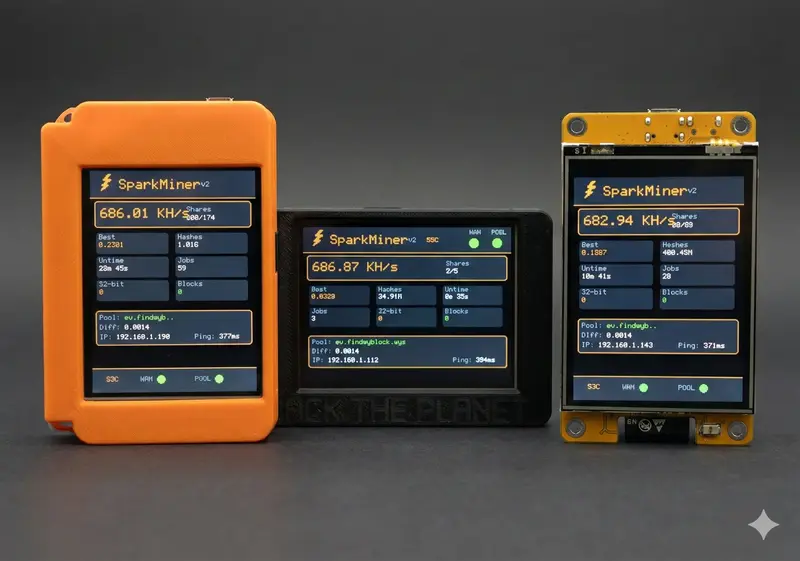
Overview
SparkMiner is a specialized firmware designed for the ESP32 family of microcontrollers, transforming them into compact, low-power Bitcoin solo miners. While solo mining on microcontrollers is often described as a “lottery” due to the astronomical odds of finding a block, SparkMiner serves as an educational tool and a way to support network decentralization. The project is highly optimized for performance, leveraging hardware-accelerated SHA-256 and pipelined assembly to maximize hashrate on resource-constrained hardware.
Technical Architecture
The project is built on the Arduino framework and utilizes the dual-core nature of the ESP32 and ESP32-S3 to ensure mining stability. SparkMiner assigns specific tasks to each core to prevent network activity from interrupting the mining process:
- Core 1 (High Priority): Dedicated to pipelined hardware SHA-256 mining. It uses direct register access and unrolled assembly loops to achieve maximum efficiency.
- Core 0 (Low Priority): Manages the WiFi stack, Stratum v1 protocol communication, display updates, and user interaction via buttons.
This architecture allows the device to maintain a consistent hashrate even while updating the UI or fetching live Bitcoin network statistics. For the single-core ESP32-C3, the project utilizes a software-based SHA-256 implementation optimized for the RISC-V architecture.
Key Features
Hardware Support and Display Abstraction
SparkMiner supports a wide array of hardware, most notably the “Cheap Yellow Display” (CYD) boards (ESP32-2432S028). It includes a display abstraction layer that allows it to work seamlessly with TFT displays (via TFT_eSPI) and OLED displays (via U8g2). For boards without screens, a headless mode provides status feedback through serial output or RGB LEDs.
Persistent Statistics
To ensure mining progress isn’t lost during power cycles, SparkMiner implements a robust statistics system. It saves lifetime hashes, accepted shares, and best difficulty found to the device’s Non-Volatile Storage (NVS). If a microSD card is present, it also maintains a stats.json backup, allowing totals to survive firmware updates or factory resets.
HTTPS Stats Proxy
Fetching live Bitcoin prices and network data over HTTPS is memory-intensive for the ESP32 and can lead to heap fragmentation. SparkMiner addresses this by supporting an optional HTTP-to-HTTPS proxy. This offloads the heavy SSL/TLS encryption to an external server or Cloudflare Worker, saving approximately 30KB of RAM and improving overall system stability.
Configuration and Setup
SparkMiner offers three flexible ways to configure the device:
- SD Card: Users can place a
config.jsonon a FAT32-formatted microSD card for a “plug-and-play” experience. - WiFi Portal: If no configuration is found, the device creates a captive portal (
SparkMiner-XXXX) with a dark-themed web interface for setting up WiFi and pool credentials. - NVS: Settings are automatically cached in flash memory after the first successful connection.
Performance Expectations
Performance varies significantly by chip generation due to the availability of hardware acceleration:
- ESP32 (Dual-core): ~715-725 KH/s (utilizes hardware SHA-256 registers).
- ESP32-S3 (Dual-core): ~280-400 KH/s (utilizes software SHA-256 with midstate caching).
- ESP32-C3 (Single-core): ~200-300 KH/s (RISC-V software implementation).
The firmware is compatible with popular solo mining pools such as Public Pool, CKPool, and FindMyBlock, supporting various Bitcoin address formats including Bech32 (SegWit) and Taproot.