Solar Concentrator
An automated solar concentrator system that uses an ESP32-CAM and Arduino Pro Mini to focus sunlight onto a thermal target. It utilizes the ESP-IDF framework and FreeRTOS for computer-vision-based sun tracking and mirror orientation.
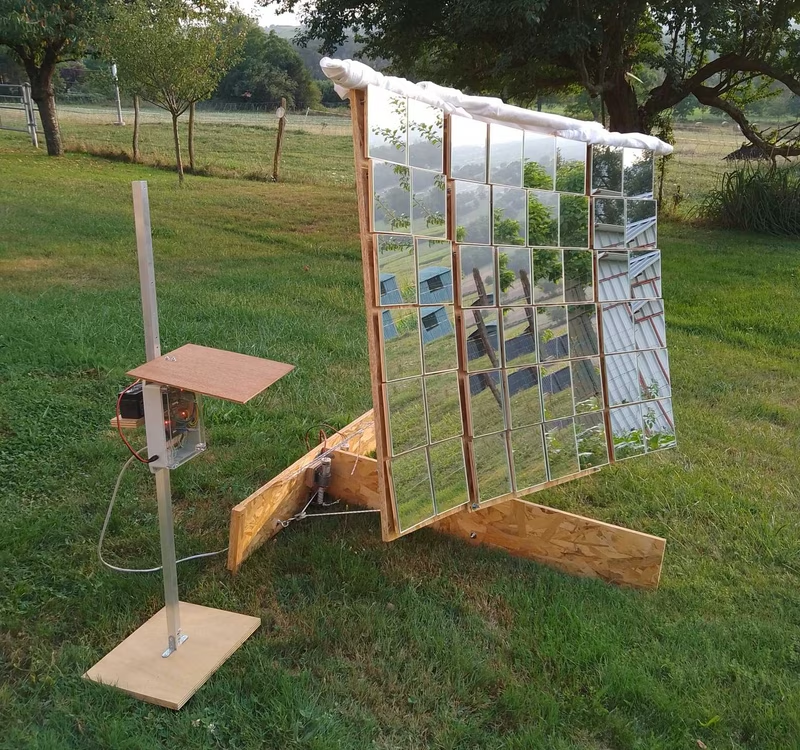
The Solar Concentrator project is an open-source hardware and software ecosystem designed to harness solar energy through automated mirror alignment. By concentrating sunlight from a 1m² array of 48 mirrors onto a single focal point, the system can generate approximately 1000 watts of thermal heat. This energy is directed into a custom-built oven, capable of reaching temperatures over 210°C in just 30 minutes, all while the electronic control system consumes a mere 3.8 watts of power.
Distributed Control Architecture
The project employs a tiered control strategy to manage the complexity of sun tracking and hardware manipulation. The system is split into two primary software domains:
- The Supervisor (ESP32-CAM): Running on the Espressif IoT Development Framework (ESP-IDF) and the FreeRTOS operating system, the supervisor is the “brain” of the operation. It handles high-level tasks such as target detection via the onboard camera, sun trajectory calculation, and hosting a web interface for user interaction. It utilizes the LWIP stack for network communication, allowing users to monitor the device remotely.
- The Motors Controller (Arduino Pro Mini): This component acts as the hardware abstraction layer. It receives serial commands from the supervisor and translates them into precise PWM signals for the motor drivers. It also monitors sensor feedback to trigger safety stops if mechanical limits are reached.
Intelligent Sun Tracking
What sets this concentrator apart is its use of image processing to maintain focus. The supervisor’s firmware includes a dedicated target detector and sun tracker. By analyzing the visual data from the ESP32-CAM, the system can identify the target’s position and adjust the mirror panel’s orientation in real-time. This compensates for the sun’s movement across the sky without requiring high-precision mechanical construction; the software handles the alignment nuances that would otherwise require expensive hardware.
Hardware and Mechanics
The mechanical design is optimized for accessibility, utilizing 3D-printed parts and common materials. The mirrors are standard 15x15 cm decorative bathroom mirrors, and the thermal target uses tempered glass from IKEA furniture. The project includes detailed 3D models for the mechanics, ensuring that anyone with a 3D printer and basic tools can replicate the build.
Safety and Future Potential
Due to the intense heat generated by focusing sunlight 48 times, safety is a primary concern. The documentation provides clear warnings regarding the risk of blindness and fire, noting that the focal point moves along a path that can be difficult to predict without active monitoring.
Looking forward, the project aims to scale up to multiple mirror panels. By controlling an array of these concentrators, the output could reach several kilowatts, enabling applications like water desalination, large-scale sterilization, and even melting materials like plastic or glass for recycling purposes. The modular nature of the software, particularly the communication protocol between the ESP32 supervisor and the Arduino motor controllers, makes this scaling feasible for future development.