Quectel UniKnect Project
Quectel UniKnect is an embedded software framework designed to simplify the integration of Quectel wireless modules with STM32 microcontrollers. It utilizes FreeRTOS for real-time task management and provides an API-driven interface that eliminates the need for manual AT command handling. The project includes a complete build system, cross-compilation toolchain, and support for essential network protocols like MQTT, HTTP, and FTP.
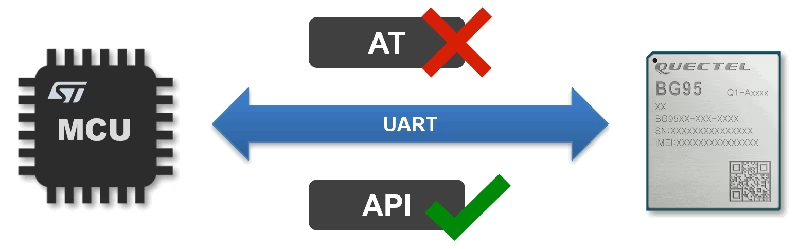
The Quectel UniKnect Project is a specialized software framework designed to streamline the development process for engineers working with cellular modules. By providing a high-level API, the framework allows developers to implement complex wireless functionalities without the burden of managing raw AT command data interactions between the host MCU and the wireless module. This approach addresses the common pain points of traditional modem integration, making development more intuitive and user-friendly.
Benefits of the UniKnect Framework
Adopting the UniKnect framework offers several strategic advantages for embedded projects. By replacing traditional AT commands with structured API function calls, developers can significantly shorten their learning curve. There is no longer a strict requirement to master extensive AT manuals, which reduces the initial development investment. Consequently, this leads to a faster time-to-market, allowing teams to accelerate their development cycles and seize market opportunities more effectively.
Key Features and Capabilities
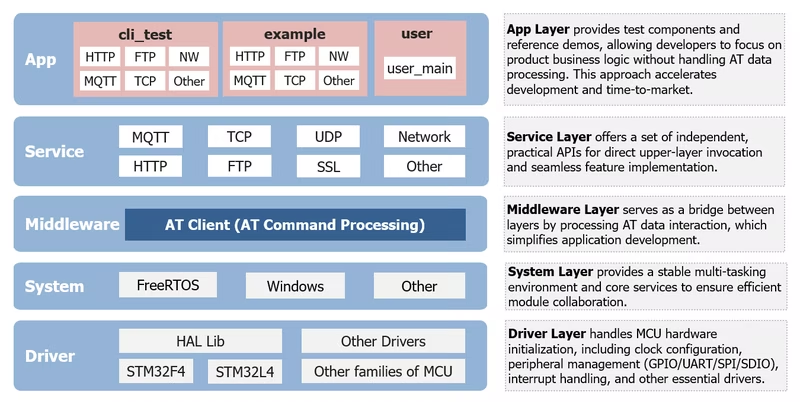
The framework is feature-rich, supporting automated handling of AT commands, data interaction, Unsolicited Result Code (URC) processing, and exception handling. It provides built-in support for various practical network protocols, including HTTP, FTP, TCP, UDP, and MQTT.
On the hardware side, UniKnect targets mainstream STM32 MCU models, specifically the F1, F3, and F4 series, with built-in extensibility for other models. It is designed to run on FreeRTOS and supports development in both Windows and Linux environments. One of its standout features is the out-of-the-box cross-compilation toolchain, which removes the need for complex local environment setup. Additionally, it supports one-click automated generation of project files like CMakeLists.txt and MCU-specific parameters, enabling a full build-to-debug workflow without relying on proprietary IDEs like Keil or IAR.
Software Architecture
The architecture is structured to abstract the hardware and module complexities away from the application layer. By utilizing the STM32 HAL library and CMSIS for core processor access, and FatFs for file system operations, the framework maintains a modular design that is easy to adapt.
Directory Structure
The repository is organized to separate application logic from system adaptation:
- apps: Contains application programs, functional examples, and test cases.
- quectel: Dedicated to Quectel code adaptation and module-specific logic.
- system: Handles system platform adaptation, including OS-specific code and MCU drivers.
- tools: Includes the cross-compilation toolchain, scripts, and configuration files.
- build: The output directory for compiled artifacts.
Hardware and Development Environment
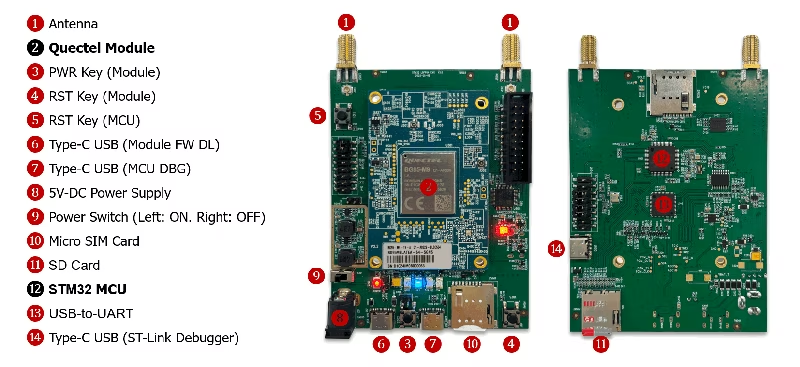
For hardware validation, the project is optimized for the QSTM32-L064M-SL-EVB development board. This board integrates an STM32 MCU, a Quectel module, an ST-Link debugger, and a USB-to-UART bridge, providing a complete sandbox for testing the UniKnect framework.
Development is supported on Windows 10 (64-bit) and various Linux distributions such as Ubuntu and Debian. The framework relies on a robust set of automated scripts (build.bat for Windows and build.sh for Linux) to handle everything from configuration and compilation to firmware downloading and debugging. For instance, configuring the system for a specific MCU model like the STM32F413RGT6 can be done through a simple command-line interface, which then prepares the environment for the subsequent build phases.
By combining a simplified API approach with a comprehensive toolchain and RTOS support, UniKnect provides a modern, efficient path for developing connected embedded systems.