Project Starbeam
An ESP32-based signal intelligence platform for RF analysis, signal generation, and manipulation. It utilizes multiple NRF24 and CC1101 radio modules to provide versatile frequency coverage and is compatible with HackRF One for extended range up to 6 GHz.
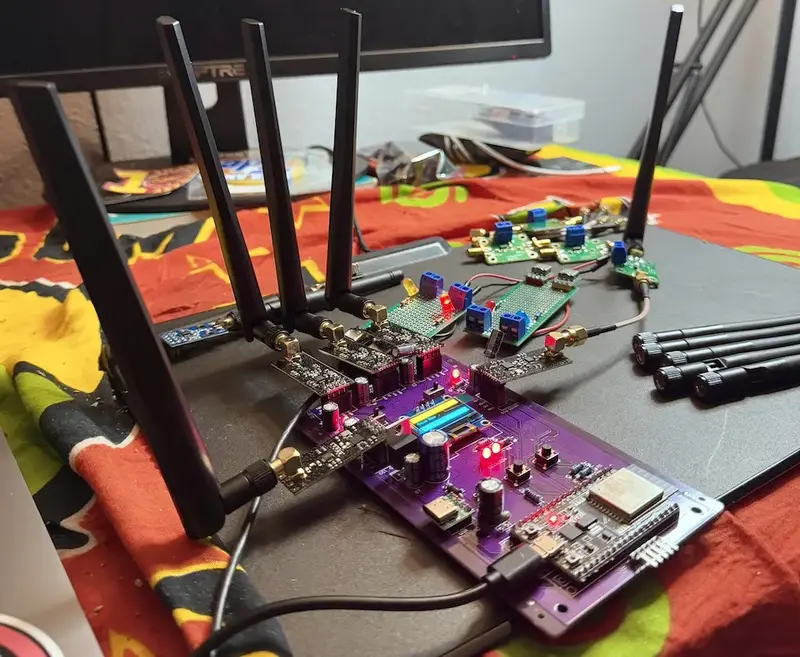
Project Starbeam is an innovative signal intelligence (SIGINT) platform designed for security professionals, researchers, and hardware enthusiasts. At its core, the project leverages the ESP32-WROOM-32D microcontroller to coordinate a complex array of radio frequency modules, enabling advanced signal analysis, generation, and manipulation. By combining cost-effective open-source hardware with a custom 4-layer PCB, Starbeam provides a versatile toolset for exploring and securing the wireless spectrum.
Hardware Architecture
The system’s architecture is centered around modularity and high-density radio integration. The primary board supports multiple radio configurations, typically utilizing up to five NRF24L01+PA+LNA modules for 2.4 GHz operations or a combination of NRF24 and CC1101 modules for sub-GHz (433 MHz) tasks. This flexibility allows users to tailor the hardware to specific operational needs, such as frequency scanning, packet sniffing, or signal replay attacks.
Key hardware components include:
- ESP32-WROOM-32D: A powerful dual-core microcontroller with integrated Wi-Fi and Bluetooth.
- Multi-Radio Array: Support for up to five NRF24 radios or a mix of NRF24 and CC1101 modules.
- SSD1306 OLED Display: A 128x64 0.96-inch screen for real-time data visualization and menu navigation.
- Custom 4-Layer PCB: Designed to handle complex RF routing and power management for multiple high-gain antennas.
Extended Capabilities with HackRF One
One of the most powerful features of Project Starbeam is its integration with the HackRF One. By connecting this software-defined radio (SDR) peripheral via the system’s UART pins, the platform’s frequency coverage is extended significantly, reaching from 1 MHz up to 6 GHz. This integration transforms the Starbeam from a localized 2.4 GHz/433 MHz tool into a comprehensive wide-band signal intelligence station capable of monitoring a vast array of wireless protocols and identifying signal-based threats across a massive spectrum.
Practical Applications
Project Starbeam is designed with tactical and security applications in mind, serving as a valuable asset for several critical fields:
- Tactical Operations: Secure communications testing, unauthorized transmission detection, and counter-surveillance.
- Critical Infrastructure Protection: Vulnerability assessments of wireless systems and security testing of IoT deployments.
- Forensic Investigations: Analyzing RF evidence, signal pattern matching, and reconstructing communication timelines.
- Training and Simulation: Supporting SIGINT training by simulating various RF threat scenarios in a controlled environment.
Software and Development
The project is built within the familiar Arduino ecosystem, making it accessible for customization. The firmware handles complex tasks like packet processing, radio state management, and user interface rendering. For those looking to build the project, it requires the Arduino IDE and specific drivers for the CC1101 modules to enable advanced sub-GHz testing. The open-source nature of the architecture encourages continuous development, with future versions (Starbeam 2.0) already exploring the use of dual ESP32 processors and additional radio types like the BW16.
Safety and Legal Considerations
Given the powerful nature of the hardware, Project Starbeam emphasizes safety and legal compliance. Transmitting or jamming radio signals without authorization is illegal in many jurisdictions. Users are strongly encouraged to operate only on permitted frequencies and to use shielded environments, such as Faraday cages, when experimenting with transmission features to avoid unintended interference with public services or private communications.