Papaya Pathfinder
An open-source family of ESP32-based remote-controlled rovers featuring 3D-printable mechanical designs and a rocker-bogie suspension system. The project supports multiple control methods including WiFi via a custom HTTP API and ExpressLRS (ELRS) for long-range operation. It includes two variants: the standard Pathfinder for high-torque applications and the Pathfinder Mini for compact, camera-enabled exploration.
Overview
Papaya Pathfinder is an open-source robotics project designed to provide a modular and accessible platform for building remote-controlled rovers. Centered around the versatile ESP32 microcontroller, the project offers a complete ecosystem including mechanical designs, firmware, and control applications. The rovers are characterized by their use of a rocker-bogie suspension system—a design famously used by NASA’s Mars rovers—which allows the vehicles to maintain stability and traction while traversing highly uneven terrain.
The project is divided into two primary variants to suit different use cases: the standard Papaya Pathfinder and the Papaya Pathfinder Mini. Both variants emphasize ease of assembly, utilizing 3D-printable parts and off-the-shelf electronic components.
Rover Variants
Papaya Pathfinder (Standard)
The flagship model is a robust six-wheeled rover designed for outdoor environments and higher payloads. It is powered by six GA25 DC gear motors and steered by four MS24 servos. To handle the significant current requirements of these motors, the system employs dual BTS7960 43A motor drivers. Power management is handled by a 3S LiPo battery, with dedicated UBECs providing regulated 5V for the ESP32 logic and 6V for the high-torque steering servos.
Papaya Pathfinder Mini
The Mini variant is a compact version optimized for indoor exploration and first-person view (FPV) capabilities. It utilizes six N20 DC gear motors and a 2S LiPo battery. A key feature of the Mini is its support for the ESP32-CAM or ESP32-S3-CAM, enabling live video streaming over WiFi. This makes it an excellent platform for learning about computer vision and remote teleoperation in a smaller form factor.
Mechanical Design and 3D Printing
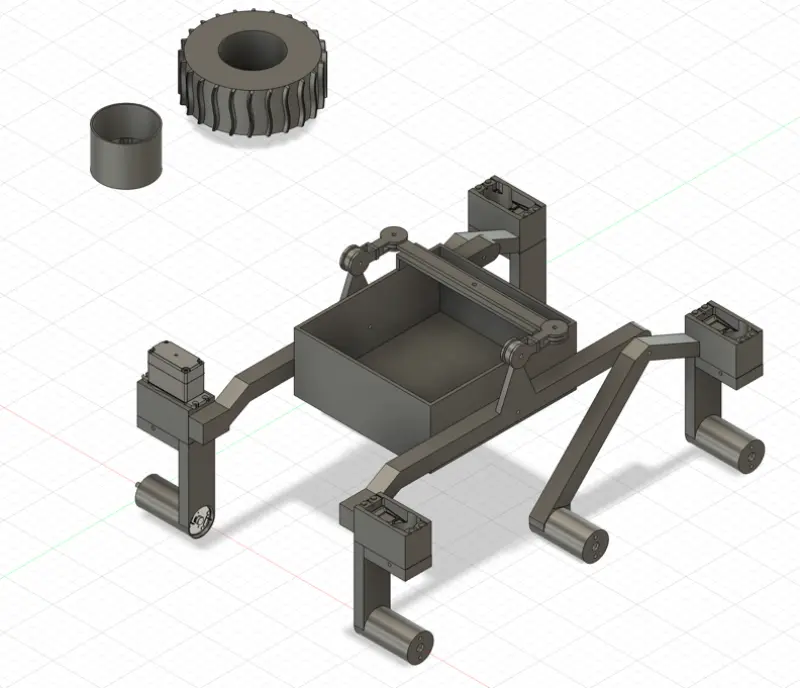
One of the most impressive aspects of the Papaya Pathfinder project is its mechanical engineering. Every structural component is designed to be 3D-printed, typically using PETG or PLA for rigidity and TPU for the tires to provide grip. The project provides both STL files for immediate printing and STEP files for those who wish to modify the CAD design.
The suspension system uses a central differential bar and suspension arms that allow the wheels to move independently over obstacles. For the standard Pathfinder, the project even offers a “Pro” rim option that utilizes 12mm brass hex adapters to prevent the motor shafts from stripping the plastic under high torque—a common failure point in 3D-printed robotics.
Firmware and Control Ecosystem
The rovers are designed to be flexible in how they are operated. The project provides two distinct firmware configurations:
- firmware-wifi: This configuration turns the ESP32 into a web-connected device. It exposes an HTTP API that receives movement commands. This mode is ideal for use with the project’s custom Python desktop controller or the Android mobile app, both of which support gamepad input and (in the case of the Mini) live video feeds.
- firmware-elrs: For users requiring long-range control and low latency, this configuration integrates ExpressLRS (ELRS). By connecting an ELRS receiver to the ESP32, the rover can be controlled using standard RC transmitters, making it suitable for wide-area exploration where WiFi signals would fail.
Technical Implementation
Under the hood, the project leverages the FreeRTOS-based environment of the ESP32 to manage concurrent tasks such as PWM generation for motor speed, servo positioning, and network communication. The WiFi firmware utilizes the lwIP stack to handle incoming HTTP requests, while the motor control logic implements differential steering and coordinated servo movement for precise navigation.
For developers and hobbyists, the repository is well-organized, providing clear wiring diagrams for power distribution, motor connections, and servo integration. This documentation ensures that even those new to embedded systems can successfully assemble and configure their own autonomous or remote-controlled explorer.