Minigotchi-ESP32
A security-focused firmware for ESP32 microcontrollers that replicates Pwnagotchi-style peer detection and network interaction. It supports Wi-Fi scanning, deauthing, and BLE functions while providing an emotional interface through various display modules.
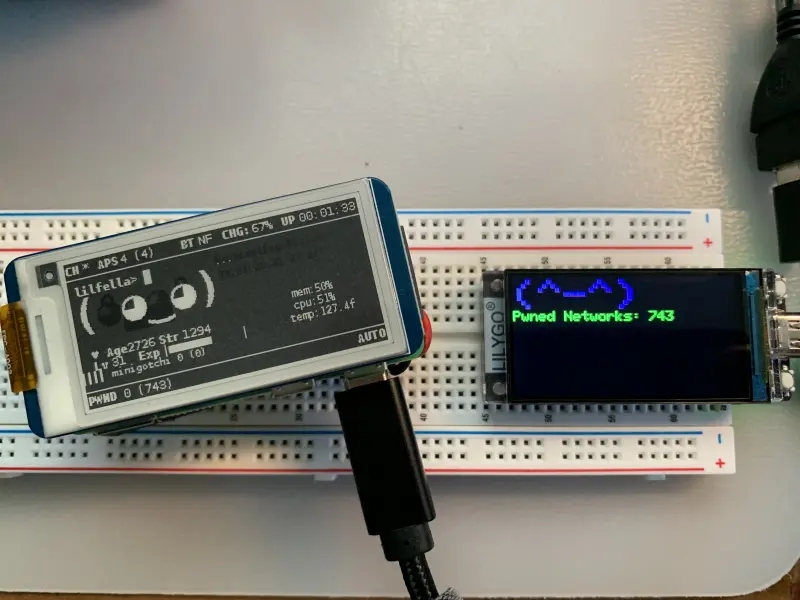
Minigotchi-ESP32 is a specialized firmware designed for the ESP32 platform, serving as a port of the original Minigotchi project. It is built to replicate the peer detection and environmental interaction behaviors of the Pwnagotchi, a popular DIY security tool. While the original Pwnagotchi runs on Linux-based hardware like the Raspberry Pi Zero, Minigotchi-ESP32 brings similar capabilities to the more power-efficient and cost-effective ESP32 microcontroller ecosystem.
The project leverages the dual-core capabilities of the ESP32 to handle multiple tasks concurrently, such as Wi-Fi scanning, packet injection, and managing a user interface. It is developed using the Arduino framework and ESP-IDF, ensuring compatibility with a wide range of development boards and peripheral hardware.
Core Functionality and Security Auditing
At its heart, Minigotchi-ESP32 is designed for network interaction and security research. Its primary features include:
- Peer Detection: Replicating the Pwnagotchi’s system of detecting other units in the vicinity via beacon frames.
- Wi-Fi Scanning and Deauthing: The firmware can scan for access points and, if configured, perform deauthentication attacks. It includes a whitelist feature to prevent accidental disruption of authorized networks.
- BLE Capabilities: Utilizing the ESP32’s Bluetooth stack for additional interaction and detection features.
- Parasite Mode: A unique feature that allows the Minigotchi to communicate with a full Pwnagotchi over a serial connection, acting as a hardware extension or companion.
Hardware and Display Support
One of the strengths of this port is its extensive support for various hardware configurations. Unlike projects tied to a specific board, Minigotchi-ESP32 can be deployed on a variety of popular modules:
- M5Stack Series: Including M5StickC Plus, M5StickC Plus2, M5Cardputer, and M5Atom series.
- Cheap Yellow Display (CYD): Popular ESP32-2432S028R boards.
- Generic OLEDs: Support for SSD1306, SH1106, and SSD1305 displays via I2C or SPI.
- T-Display-S3: High-performance boards from LilyGO.
The Emotional Interface
Following the aesthetic of its predecessor, Minigotchi-ESP32 features an emotional interface represented by ASCII-style “faces.” These faces are not just cosmetic; they provide immediate visual feedback on the system’s state. For example, the Happy (^-^) face indicates a successful connection or peer detection, while Looking around (0-o) is shown during active Wi-Fi scanning. If the device is performing resource-heavy tasks like sending frames, it displays an Intense (>-<) expression. A Broken (X-X) face serves as a visual indicator that a system error has occurred, often accompanied by a serial error message.
Configuration and Deployment
The project is highly configurable through a centralized configuration system. Users can define universal delays, toggle specific features like deauthing or advertising, and set up their Wi-Fi whitelist before flashing. Post-installation, the firmware launches a temporary web server (WebUI), allowing users to finalize settings and input SSIDs for the whitelist through a browser interface without needing to recompile the code.
By bridging the gap between low-power microcontrollers and security auditing tools, Minigotchi-ESP32 provides a portable, versatile platform for enthusiasts and researchers to explore network environments and peer-to-peer interactions.