Git Contributions E-Ink Display
An ESP32-based wireless e-ink display designed to track and showcase GitHub contribution streaks. Utilizing the Lilygo T5 development board, the project features ultra-low power consumption for months of battery life and a captive portal for easy WiFi configuration.
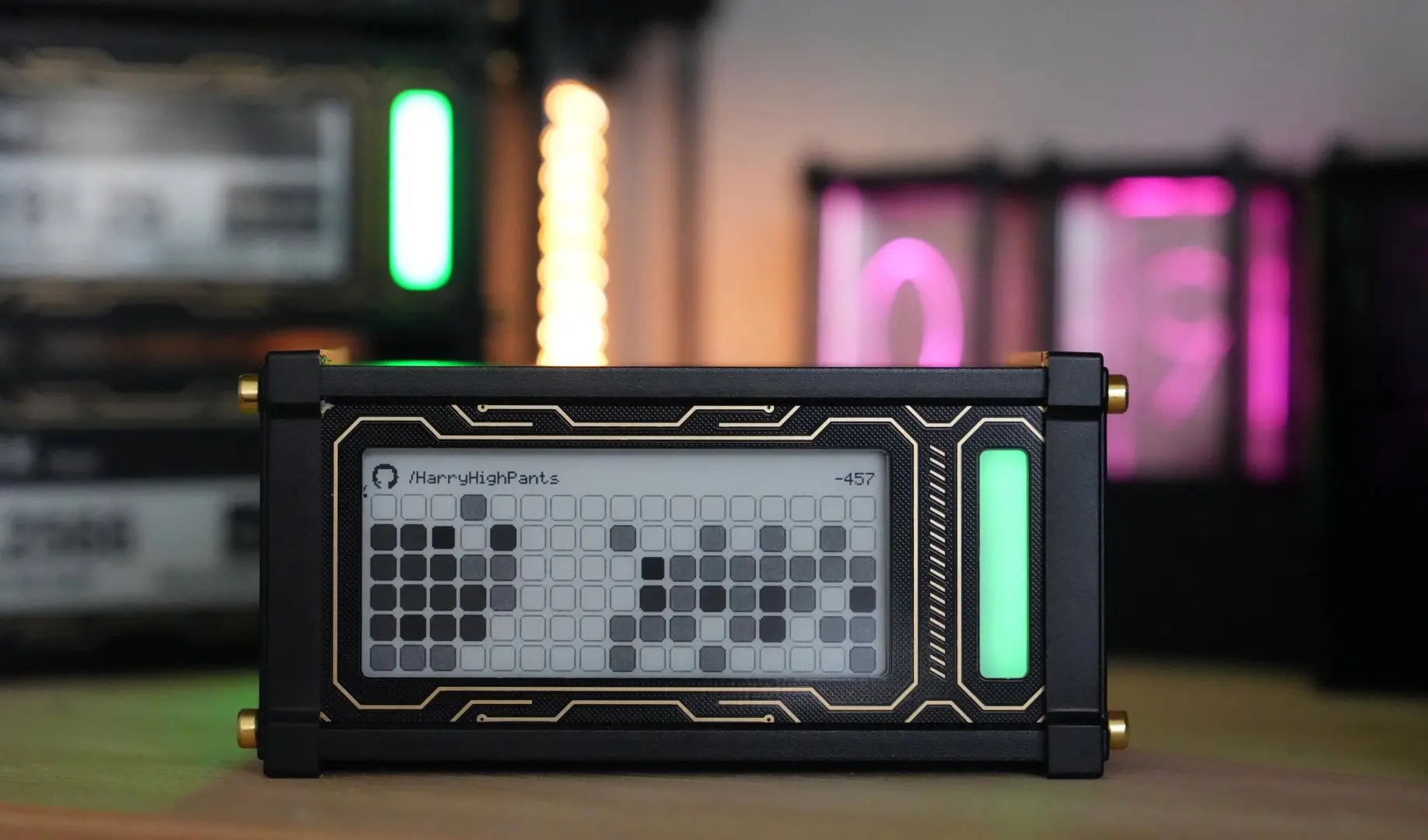
Showcasing Your Commit Streaks in Low Power
The Git Contributions E-Ink Display is a specialized firmware for the ESP32 that allows developers to visualize their GitHub activity on a wireless, low-power screen. By leveraging the energy-efficient nature of e-paper technology, this project creates a dedicated physical dashboard for commit history that can run for approximately three months on a single 1200mAh battery charge.
Hardware Architecture
The project is built around the LILYGO® T5 2.13-inch E-Paper Development Board. This specific board is an ideal choice for the project as it integrates an ESP32 microcontroller with a high-contrast e-ink display. The developer notes that while the board supports various display drivers, the GDEM0213B74 panel provides a sharper image for this specific application.
To make the device portable and desk-friendly, the project includes designs for a 3D-printed case and stand. The hardware setup is rounded out with a 3.7V LiPo battery, which fits snugly within the custom enclosure, and M3 hardware for assembly.
Software and Configuration
One of the standout features of this project is its user-friendly configuration mode. Rather than hardcoding credentials, the device uses a captive portal system:
- Captive Configuration: By holding a physical button for two seconds, the ESP32 enters a configuration mode, creating its own WiFi access point named “Contributions screen.”
- Web Interface: Once connected, users are presented with a web form to enter their WiFi credentials and GitHub settings.
- Persistence: Configuration values are stored in RTC memory, which persists through deep sleep cycles, ensuring the device remembers settings without needing to write to flash constantly.
Data Fetching and Rendering
Because the GitHub GraphQL API can be heavy for a microcontroller to parse directly, the project utilizes a custom github-contributions-api written in NodeJS and TypeScript. This middleware fetches the user’s data and transforms it into a simplified integer array representing commit levels (0-4).
The ESP32 fetches this data at a configurable interval (defaulting to every 4 hours). If the data has changed, the device updates the display using the Adafruit GFX Library and the GxEPD2_4G library, which supports greyscale rendering on e-ink panels. This allows for the classic “GitHub Green” grid to be represented accurately in shades of grey.
Power Management
To achieve its three-month battery life, the system makes extensive use of the ESP32’s deep sleep capabilities. The device spends the vast majority of its time in a low-power state, only waking up to perform a quick WiFi handshake, fetch a small JSON payload, update the display if necessary, and return to sleep. The use of esp_sleep_get_wakeup_cause allows the firmware to distinguish between a scheduled update and a user-triggered configuration request.