Gingoduino
A high-performance music theory engine for embedded systems that provides advanced analysis of notes, chords, scales, and harmonic progressions. It features a zero-heap architecture and supports MIDI 1.0 and MIDI 2.0 UMP serialization across Arduino, ESP-IDF, and PlatformIO platforms.
Gingoduino is a sophisticated music theory engine specifically engineered for the constraints of embedded systems. While many libraries focus on the transport layer of musical data—parsing MIDI bytes or handling USB descriptors—Gingoduino occupies the “musical domain.” It provides the logic required to understand what those notes actually mean, how they relate to one another, and how they fit into broader harmonic structures like scales and fields.
Architecture and Philosophy
The library is a port of the gingopy C++17 library, redesigned for the embedded world with a zero-heap architecture and C++11 compatibility. This ensures that it can run on everything from 8-bit AVR microcontrollers to modern 32-bit SoCs without the risk of memory fragmentation. It uses PROGMEM lookup tables to minimize RAM usage, making it suitable for resource-constrained environments.
Gingoduino follows a “tier” system to scale its features based on the target hardware’s capabilities:
- Tier 1: Basic note, interval, and chord logic (optimized for AVR/Uno/Nano).
- Tier 2: Adds scales, harmonic fields, fretboard engines, and MIDI 1.0 adapters (optimized for ESP8266).
- Tier 3: Includes advanced features like harmonic trees, progression analysis, chord comparison, and MIDI 2.0 UMP adapters (targeting ESP32, RP2040, Teensy, and Daisy Seed).
Comprehensive Musical Logic
At its core, Gingoduino handles the 12-note chromatic system with full support for enharmonic equivalents. It includes a massive database of over 42 chord formulas with reverse lookup capabilities, allowing a system to identify a chord from a set of active MIDI notes in real-time.
For melodic and harmonic composition, the engine supports over 40 scale types and modes. It can calculate signatures, brightness levels, and relative/parallel relationships. The harmonic field analysis tool is particularly powerful, enabling the deduction of T/S/D (Tonic, Subdominant, Dominant) functions and roles from a sequence of notes or chords.
Fretboard and Instrument Support
One of the unique aspects of Gingoduino is its integrated fretboard engine. It comes pre-configured for various instruments, including guitar, violão, cavaquinho, mandolin, and ukulele. It supports alternate tunings like Drop D and DADGAD and can calculate fingerings for common chords or open-position patterns, making it an excellent foundation for digital instrument projects or educational tools.
MIDI 1.0 and 2.0 Integration
Gingoduino is designed to sit between a hardware transport and the application logic. It does not “own the wire”—meaning it doesn’t handle the physical serial or USB communication—but it provides stateless output adapters that translate musical structures into serialized formats. This includes raw MIDI 1.0 byte streams and the newer MIDI 2.0 Universal MIDI Packet (UMP) Flex Data.
For developers working with modern protocols, the MIDI 2.0 adapters support encoding chord names, key signatures, and per-note controllers into 128-bit Flex Data packets. This makes Gingoduino a bridge between traditional music theory and the next generation of musical instrument communication.
Quick Start Example
The library’s API is designed to be intuitive for musicians and developers alike:
#include <Gingoduino.h>

using namespace gingoduino;

void setup() {
    Serial.begin(9600);

    // Analyze a note
    GingoNote note("C");
    Serial.println(note.midiNumber(4));    // 60

    // Explore a chord
    GingoChord chord("Dm7");
    GingoNote notes[4];
    chord.notes(notes, 4);                 // D, F, A, C

    // Analyze a harmonic field
    GingoField field("C", SCALE_MAJOR);
    GingoChord triads[7];
    field.chords(triads, 7);               // CM, Dm, Em, FM, GM, Am, Bdim
}
Real-Time Monitoring
The GingoMonitor module allows for real-time tracking of musical events. By feeding it noteOn and noteOff events from a MIDI keyboard, the monitor can track held notes, the sustain pedal state, and automatically detect the current chord or harmonic field. This is ideal for creating visualizers, auto-accompaniment systems, or intelligent MIDI processors.
Related Projects
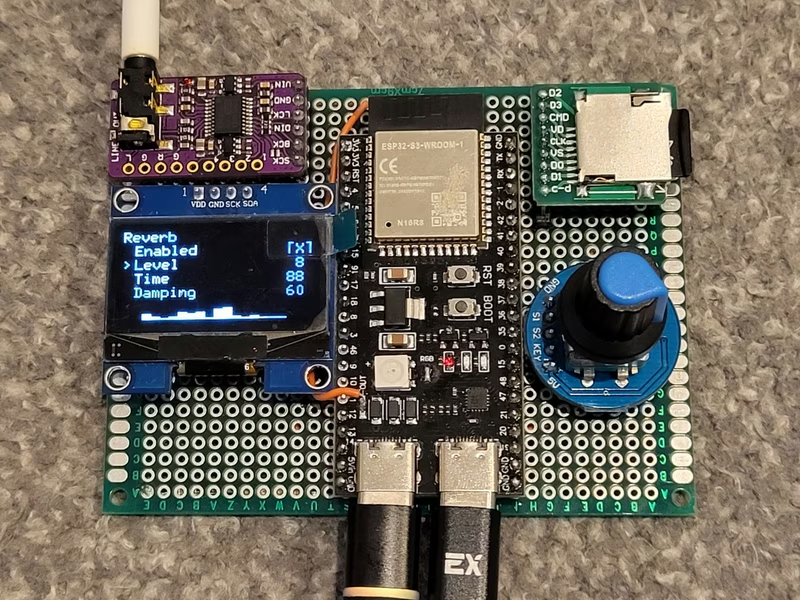
ESP32 SoundFont (SF2) Sampler Synthesizer
A high-performance wavetable synthesizer firmware for ESP32-S3 and ESP32-P4 microcontrollers that plays SoundFont 2 (SF2) samples. It utilizes PSRAM for large sample banks, supports USB MIDI for plug-and-play connectivity, and features real-time audio effects like reverb and chorus.
PicoSound Audio Library for RP2040
PicoSound is a dual-core audio engine for the Raspberry Pi Pico (RP2040) that offloads audio processing to Core1 to ensure glitch-free playback. It supports an 8-channel mixer, synthesized waveforms, and WAV file streaming via LittleFS or PROGMEM, targeting both Arduino IDE and PlatformIO environments.
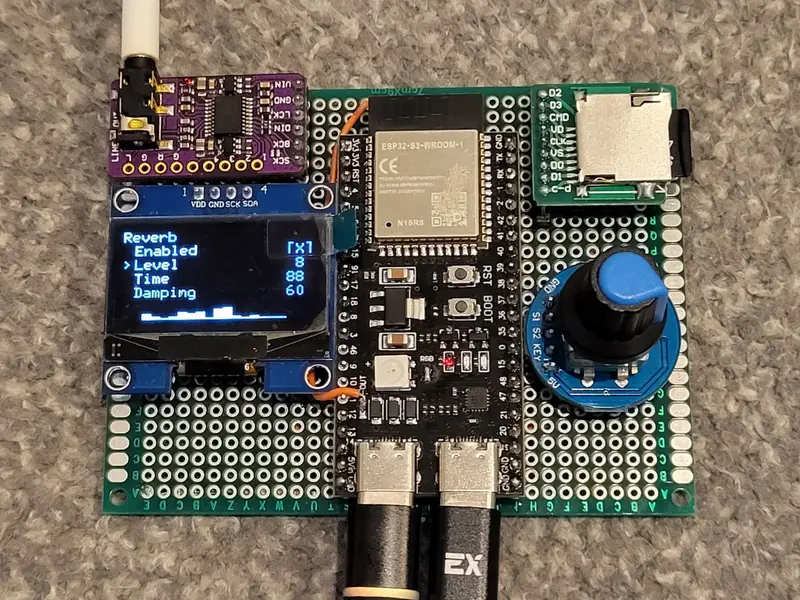
ESP32-S3 SoundFont (SF2) Sampler Synthesizer
A high-performance wavetable synthesizer firmware for the ESP32-S3 that enables high-quality SoundFont 2 (SF2) playback. It leverages PSRAM for sample loading and supports USB MIDI, external I2S DACs, and runtime switching between LittleFS and SD card storage.