Engineering DIY ESP32 Sensors & Cameras for Home Assistant
A comprehensive DIY project for building ESP32-based environmental sensors and cameras integrated with Home Assistant via the ESPHome framework. It covers hardware selection, 3D casing design, wiring, and non-linear calibration to ensure accurate readings despite internal heat generation.
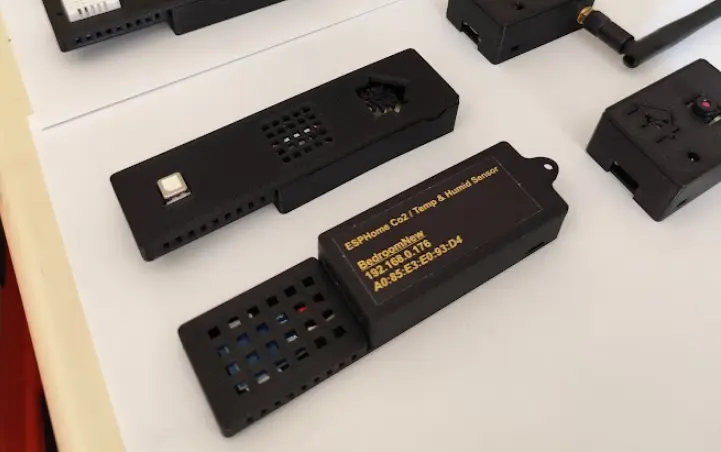
Overview
Creating a truly integrated smart home often requires moving beyond off-the-shelf commercial products that are frequently cloud-dependent or limited in flexibility. This project documents a deep dive into engineering custom ESP32-based sensors and cameras designed specifically for the Home Assistant ecosystem using the ESPHome framework. By combining 3D design, prototyping, and precise calibration, this repository provides a blueprint for building aesthetic and functional IoT devices that prioritize local control and privacy.
Hardware and Components
The project utilizes a variety of affordable yet capable hardware components to monitor indoor environments and provide visual surveillance:
- Microcontrollers: ESP32-S3 WROOM-1 Dev Boards for sensors and ESP32-CAM modules for video streaming.
- Environmental Sensors: The SCD41 for CO2, temperature, and humidity, and the DHT22 (AM2302) for simpler temperature and humidity builds.
- Imaging: OV2640 camera modules integrated with ESP32-S boards.
- Visual Feedback: Onboard WS2812 RGB LEDs used as status indicators for air quality levels.
Engineering and 3D Design
A significant portion of this project focuses on the mechanical engineering aspect of IoT devices. Using Autodesk Inventor, the project evolved through multiple iterations to solve a common DIY pitfall: heat dispersion. Initial designs suffered from internal heat buildup from the ESP32 chip, which skewed sensor readings by as much as 8°C. The second iteration introduced redesigned casings with optimized airflow, external sensor holders, and decorative Home Assistant-themed vents to ensure the electronics remained cool and the data remained accurate.
Software Configuration with ESPHome
The devices run on the ESPHome framework, which simplifies firmware management through YAML configuration files. The project provides detailed configurations for:
- Sensor Nodes: Handling I2C communication for the SCD41 and GPIO-based data for the DHT22.
- Camera Nodes: Tuning parameters like JPEG quality, resolution (SVGA), and frame rates to balance stream stability with image quality.
- Networking: Implementing static IP configurations and manual DHCP entries to ensure system resilience during power outages or network resets.
The Importance of Calibration
Raw data from hardware sensors often requires post-processing to be reliable. This project highlights a non-linear calibration method to correct for temperature drift caused by component proximity. By using a lab-grade thermometer to create a calibration table, a custom lambda function was implemented in ESPHome:
// Example of non-linear temperature correction
lambda: |-
  float slope = -0.31;
  float reference_temp = 24.0;
  float base_error = 2.3;
  return id(scd41_temperature).state + (slope * (id(scd41_temperature).state - reference_temp)) - base_error;
This approach reduced measurement error from a massive +8°C deviation down to a manageable range of +0.6 to +1.2°C.
Home Assistant Integration
Integration with Home Assistant is handled natively via the ESPHome API. The project showcases advanced dashboard designs using HACS components like stack-in-card, card-mod, and browser-mod. These enhancements allow for sophisticated UI elements, such as live camera pop-ups with interactive overlay buttons for controlling lights and locks directly from the video feed.
Beyond simple monitoring, the data feeds into automated climate control systems, triggering humidifiers or air recuperators based on real-time CO2 and humidity thresholds, moving toward a fully autonomous indoor micro-climate.