EchoLens: AI-Powered Smart Glasses
An ESP32-CAM based assistive technology project designed for the deaf and mute community. It leverages AI to provide real-time speech-to-text conversion and American Sign Language (ASL) to speech translation, integrated into a wearable smart glasses form factor.
Overview
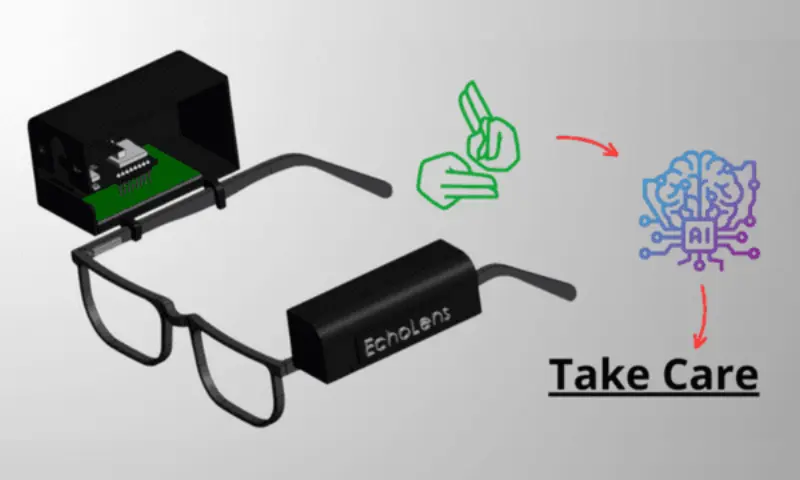
EchoLens is an innovative open-source project aimed at breaking communication barriers for the deaf and mute community. By combining the power of the ESP32-CAM microcontroller with artificial intelligence, EchoLens functions as a pair of smart glasses capable of bidirectional communication assistance. The device focuses on two primary functions: converting spoken language into readable text for the wearer and translating the wearer’s sign language into audible speech for others.
Key Features
The project is designed as a complete wearable solution, integrating hardware design, embedded software, and machine learning models. Its core capabilities include:
- Speech-to-Text Conversion: Captures ambient speech and displays it as text, allowing the wearer to “hear” conversations through a visual interface.
- Sign Language Translation: Utilizes the onboard camera to recognize American Sign Language (ASL) gestures and converts them into spoken words.
- Wearable Form Factor: Includes custom 3D-printable frames designed to house the ESP32-CAM and necessary circuitry.
- AI-Powered Recognition: Employs specialized sign language models optimized for embedded execution.
Technical Implementation
EchoLens is built upon the ESP32-CAM platform, a popular choice for low-cost embedded vision projects. The system utilizes the FreeRTOS-based environment inherent to the ESP32 ecosystem to manage concurrent tasks such as image acquisition, model inference, and display updates.
Hardware Components
- ESP32-CAM: The central processing unit providing both Wi-Fi/Bluetooth connectivity and a camera interface.
- Custom Circuitry: The repository includes detailed circuit diagrams for power management and peripheral integration.
- 3D Models: The project provides STL files for the glasses’ frame, ensuring that the technology is accessible to anyone with a 3D printer.
Software and AI
The intelligence of EchoLens resides in its Sign Language Model. By processing video frames from the ESP32-CAM, the system performs real-time gesture recognition. While the project acknowledges that sign interpretation is a complex challenge, it provides a functional framework for ASL recognition using embedded machine learning techniques, likely leveraging frameworks like TensorFlow Lite Micro for on-device inference.
Getting Started
Developers and makers interested in EchoLens can find all necessary resources in the repository. The project is organized into several key directories:
- Programs: Contains the firmware and source code for the ESP32.
- Sign Language Model: Includes the trained models used for gesture recognition.
- Circuit Diagram: Provides the electrical schematics for assembling the hardware.
- 3D Models: Contains the design files for the wearable chassis.
By providing the full stack of design files—from the physical frame to the AI models—EchoLens serves as a comprehensive reference for developers looking to build assistive technologies using modern embedded systems.