EchoKit Firmware
Rust-based firmware for the EchoKit ESP32-S3 voice interaction device. It utilizes the ESP-IDF framework to provide voice processing, display management, and network connectivity for AI-driven hardware applications.
Overview
EchoKit is an open-source firmware project designed for the EchoKit device, a voice-interaction platform built on the ESP32-S3 SoC. Developed primarily in Rust, the project leverages the safety and concurrency features of the language to manage complex tasks such as audio processing, wireless networking, and user interface rendering. The firmware acts as the bridge between the physical hardware and an EchoKit server, enabling voice-controlled AI applications.
Technical Architecture
The project is built on the esp-idf-svc ecosystem, which provides Rust bindings for the Espressif IoT Development Framework (ESP-IDF). This allows the firmware to utilize the underlying FreeRTOS kernel for task scheduling and system management while writing high-level logic in idiomatic Rust.
Key technical components include:
- Async Runtime: The project uses
tokiofor managing asynchronous I/O, which is essential for handling simultaneous network requests and hardware interrupts. - Voice Processing: Integration with
esp-sr(Speech Recognition) andesp-opusfor audio encoding/decoding allows the device to handle voice commands and stream audio data efficiently. - Connectivity: It features robust networking capabilities via WiFi and Bluetooth Low Energy (using the NimBLE stack), supporting WebSocket communication for real-time interaction with backend servers.
- Graphics and UI: The firmware supports various display configurations using
embedded-graphicsandu8g2-fontsto render information, QR codes, and status indicators on the device’s LCD screen.
Hardware Support
The firmware is specifically optimized for the ESP32-S3 microcontroller, targeting boards with 16MB of flash memory. It supports multiple hardware configurations through Rust features:
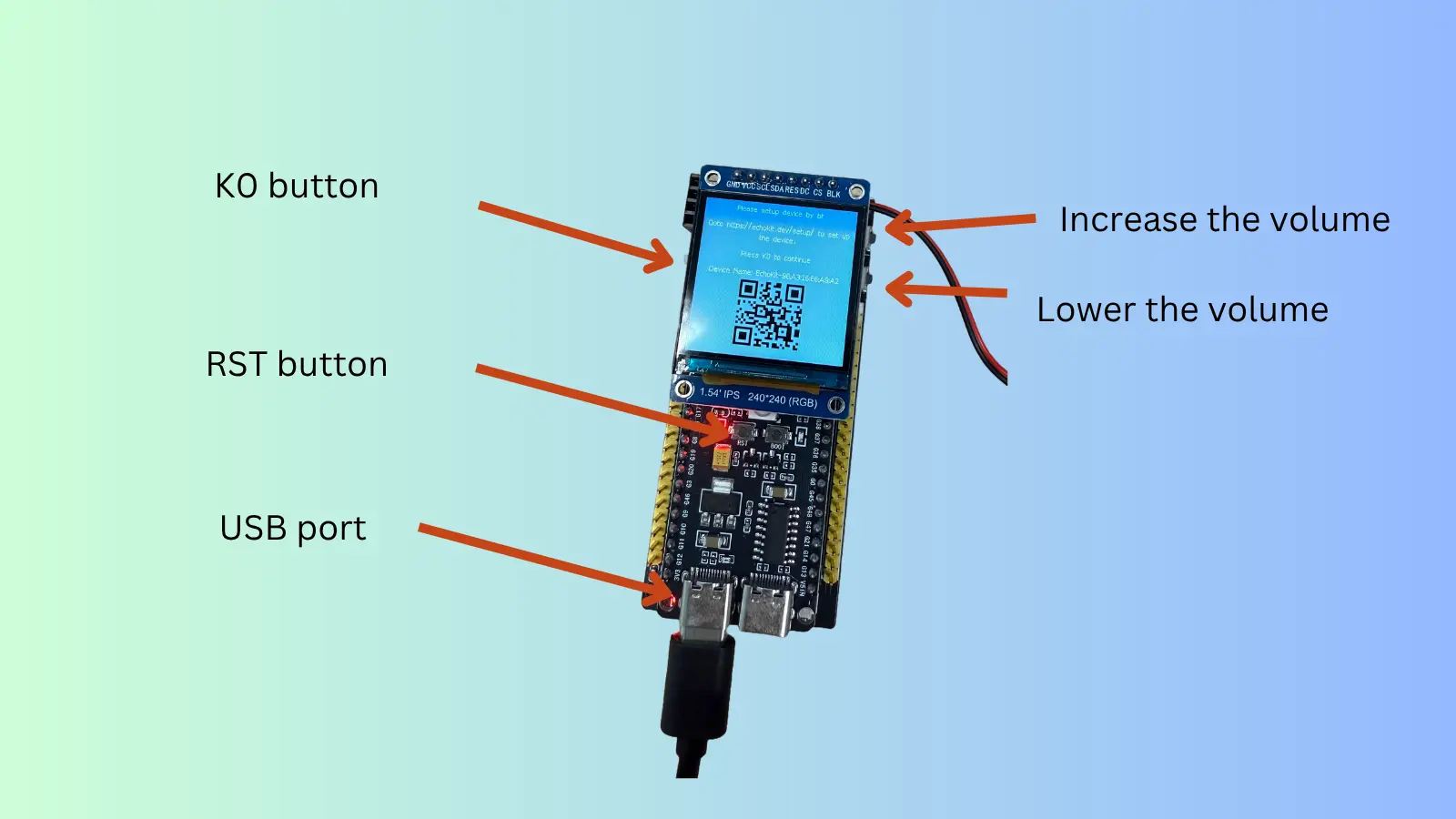
- EchoKit Devkit: A development board setup with an ESP32-S3 and an extension board featuring an LCD and action buttons.
- EchoKit Box: A fully integrated consumer-style enclosure.
- Cube/Cube2: Alternative form factors with specific peripheral mappings.
The hardware interface includes support for physical buttons (RST and K0/Boot), I2C peripherals, and optional NFC modules for expanded functionality.
Development and Deployment
The project uses a modern Rust toolchain tailored for Xtensa architectures. Building the firmware requires the esp toolchain and espflash for deployment. The build system is configured to handle different hardware targets via feature flags, allowing a single codebase to support various iterations of the EchoKit hardware.
# Example: Building for the EchoKit Box variant
cargo build --release --no-default-features --features box
Once flashed, the device typically connects to a dedicated EchoKit server via WebSockets, allowing it to function as a thin client for AI-driven voice services. The firmware handles the local heavy lifting of audio capture, wake-word detection, and display updates, while offloading complex natural language processing to the server.