CYD ANSI-VT100 Serial Terminal
A mini-project that transforms the ESP32-based Cheap Yellow Display (CYD) into a standalone ANSI-VT100 serial terminal. It utilizes the FabGL library to handle terminal emulation and display output, allowing users to monitor serial data from other microcontrollers at 115200 baud without a PC.
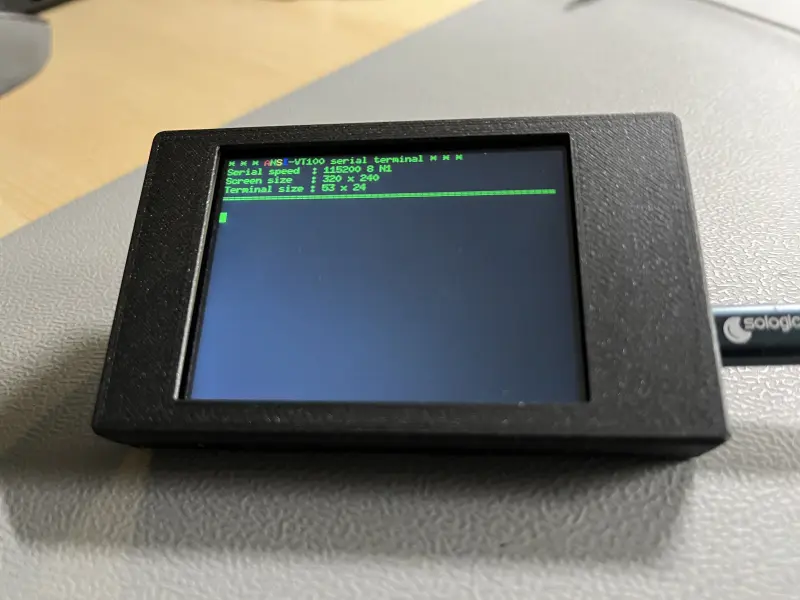
Overview
The CYD Terminal project is a practical utility for embedded developers that turns the popular “Cheap Yellow Display” (ESP32-2432S028) into a portable, standalone ANSI-VT100 serial terminal. This setup is particularly useful for debugging microcontrollers in the field or on a workbench where a full PC setup might be cumbersome. By leveraging the ESP32’s processing power and integrated display, the project creates a dedicated window into serial data streams.
Hardware Requirements
The project is designed specifically for the ESP32-2432S028, often referred to as the Cheap Yellow Display (CYD). This board features an ESP32 module, a 2.8-inch color touchscreen, and various expansion headers.
One critical hardware modification is noted for reliable operation: the two small 100-ohm resistors located near the Rx/Tx JST connector (P1) should be replaced with 0-ohm resistors or small wire bridges. The original resistors can interfere with high-speed serial signal integrity, and bypassing them ensures a stable connection at standard baud rates.
Technical Implementation
The firmware is built using the Arduino framework within the PlatformIO ecosystem. It relies heavily on the FabGL library, a powerful graphics and terminal abstraction layer for the ESP32. FabGL provides the ANSI-VT100 terminal emulation, handling escape codes and text rendering that allow the display to behave like a classic hardware terminal.
The system is configured to operate at 115200 baud with 8N1 parameters (8 data bits, no parity, 1 stop bit). While the ESP32 typically operates at 3.3V, the project notes that the RX pin on this specific board is 5V tolerant, making it easier to interface with a wide variety of 5V microcontrollers like the Arduino Uno or Mega.
Connectivity and Setup
Connecting the terminal to a target device is straightforward using the JST connector P1 provided with most CYD units:
- VIN: Connect to a 5V power supply.
- GND: Common ground between the supply and the target microcontroller.
- RX: Connect to the TX pin of the target microcontroller.
For a professional finish, the project supports a 3D-printable enclosure designed specifically for the Sunton ESP32-2432S028R, which includes the necessary cutouts for the serial connector and power input.
Software Configuration
The project uses a standard platformio.ini configuration targeting the esp32doit-devkit-v1 board. A specific workaround is noted in the configuration for the FabGL library regarding a header conflict in ICMP.cpp, requiring a manual path adjustment to the WiFiGeneric.h file within the ESP32 Arduino framework. This ensures that the networking components of the library do not conflict with the terminal functionality during the build process.