CMSIS-DAP over TCP for ESP32
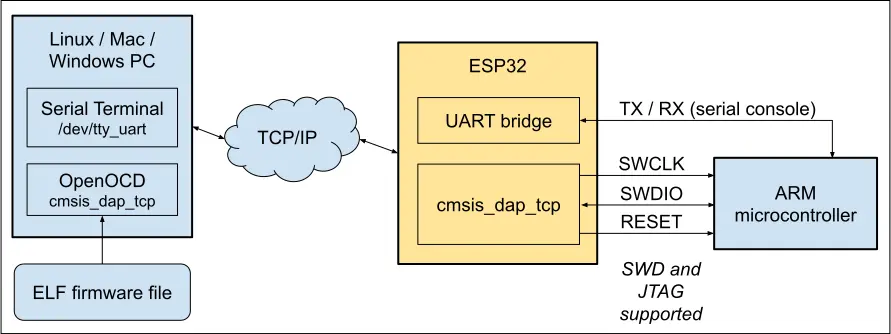
A firmware implementation for ESP32 that enables remote ARM microcontroller debugging and flashing via the CMSIS-DAP protocol over TCP/IP. It supports both JTAG and SWD interfaces, allowing OpenOCD to connect to target hardware over WiFi. The project includes a UART-to-TCP bridge for remote serial console access.
Overview
Debugging and flashing ARM microcontrollers typically requires a local USB connection to a JTAG or SWD programmer. The cmsis_dap_tcp_esp32 project changes this paradigm by implementing the CMSIS-DAP protocol over TCP/IP. By using an ESP32 as a remote programmer, developers can connect OpenOCD to a target board over a WiFi network, enabling remote firmware updates and real-time debugging without physical proximity to the hardware.
This project is particularly useful for hardware-in-the-loop (HIL) testing, remote laboratory setups, or debugging devices installed in hard-to-reach locations. It leverages the high-speed GPIO capabilities of the ESP32 to emulate the timing required for JTAG and SWD protocols while handling network communication via the ESP-IDF’s networking stack.
Key Features
- Dual Protocol Support: Full support for both JTAG (minimum 4 GPIOs) and the two-wire Serial Wire Debug (SWD) interface.
- High Performance: Achieves SRAM read/write speeds up to 200 KB/sec. Flashing a 512 KB image to an STM32F4 can be completed in approximately 13 to 20 seconds depending on the specific ESP32 variant used.
- Integrated UART Bridge: Includes a UART-to-TCP/IP bridge, allowing the target board’s serial console to be accessed remotely via a pseudo-tty on the host machine.
- Broad Hardware Compatibility: Tested with modern ESP32 chips including the ESP32-C6 and ESP32-S3, targeting popular ARM platforms like the STM32 Blue Pill and Nucleo boards.
- Configurable I/O: GPIO assignments for SWCLK, SWDIO, TDI, TDO, and reset signals are fully configurable through the ESP-IDF menuconfig system.
Technical Implementation
The project is built on the ESP-IDF framework and utilizes FreeRTOS for task management. The core CMSIS-DAP logic is derived from the official ARM CMSIS-DAP repository, with a modified DAP_config.h to map protocol actions to ESP32-specific GPIO operations.
Communication with the host PC relies on a specific OpenOCD backend (cmsis_dap_tcp). Instead of looking for a USB device, OpenOCD initiates a TCP connection to the ESP32’s IP address on a designated port (default 4441). The ESP32 then translates these network packets into bit-banged or peripheral-driven JTAG/SWD signals for the target microcontroller.
Performance and Optimization
Performance is highly dependent on the ESP32’s clock speed and WiFi signal quality. The ESP32-S3, running at 240 MHz, generally provides higher throughput compared to the ESP32-C6. To ensure stability on slower or congested networks, the project supports a min_timeout parameter in the OpenOCD configuration to prevent command mismatch errors during high-latency spikes.
Example OpenOCD Configuration
To use the ESP32 as a remote programmer, the OpenOCD configuration file must be set to use the TCP backend:
adapter driver cmsis-dap
cmsis-dap backend tcp
cmsis-dap tcp host 192.168.1.107
cmsis-dap tcp port 4441
transport select swd
Getting Started
Building the firmware requires the ESP-IDF build toolchain. The project provides pre-configured sdkconfig files for common boards like the Xiao ESP32-C6 and ESP32-S3-DevKitC-1. Users can configure their WiFi credentials and GPIO assignments through the idf.py menuconfig interface under the “CMSIS-DAP configuration” menu. Once flashed, the ESP32 will output its IP address via the serial monitor, at which point it is ready to accept connections from a network-enabled OpenOCD instance.