AI Wireless Debugger
An ESP32-S3 multi-protocol wireless hardware debugger that bridges physical debugging interfaces with network services and AI tooling. Built on ESP-IDF with FreeRTOS and lwIP, it supports UART, SPI, I2C, PWM measurement, and CMSIS-DAP SWD debugging alongside an onboard ST7735 LCD and Model Context Protocol (MCP) server integration.
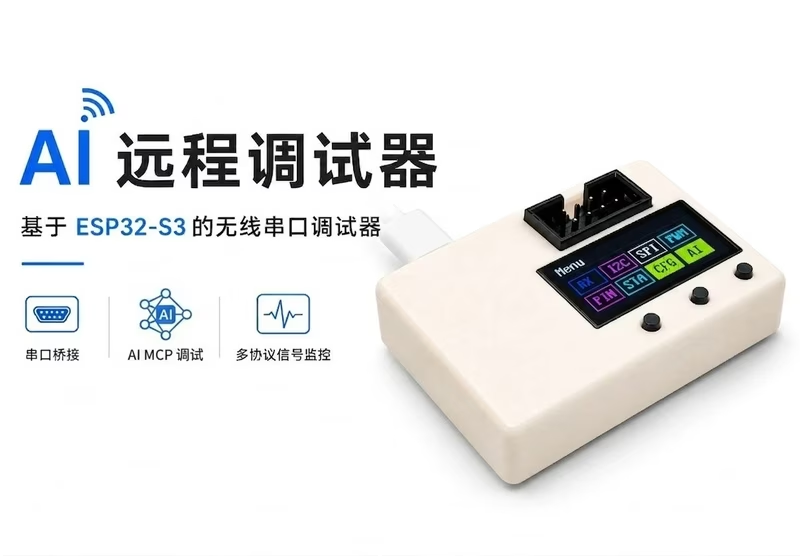
Bridging Hardware Debugging and AI Tooling
Hardware engineers frequently juggle a bench full of specialized tools: a USB-to-UART bridge, a logic analyzer, a hardware programmer, and a digital multimeter or frequency counter. The AI Wireless Debugger streamlines this workflow by implementing a multi-protocol debugging bridge on an ESP32-S3 microcontroller, offering wireless connectivity alongside direct Model Context Protocol (MCP) integration for modern AI assistants.
Rather than tethering target hardware to a development machine with short ribbon cables, the device exposes protocol inspection and control interfaces over Wi-Fi, paired with an on-board ST7735 color LCD and physical navigation buttons for standalone bench monitoring.
Multi-Protocol Hardware Interface
Powered by the dual-core 240 MHz Xtensa LX7 architecture of the ESP32-S3 with 8MB Octal PSRAM and 16MB Flash, the firmware dynamically configures pins to support several core protocols:
- UART Serial Bridge: Supports bidirectional serial communication at configurable baud rates ranging from 9600 up to 921600 baud, exposed over network sockets.
- SPI & I2C Bus Monitoring: Captures transactions and allows active interrogation on synchronous serial buses.
- PWM Signal Analysis: Measures real-time frequency and duty cycles of incoming digital signals.
- CMSIS-DAP SWD Programmer: Provides an ARM Serial Wire Debug (SWD) interface for programming and debugging Cortex-M microcontrollers remotely.
Network Architecture and Standalone UI
The device uses lwIP and FreeRTOS to manage dual-mode networking and real-time protocol engines concurrently:
- Dual Wi-Fi Modes: Operates in STA mode to connect to existing local networks, or switches to SoftAP mode for initial configuration or field use.
- Raw TCP Server: Runs on port 3333 to stream serial data to multiple client connections simultaneously, functioning as a network-accessible COM port.
- HTTP Management Server: Serves status dashboards and configuration pages on port 80 directly from the ESP32-S3.
- Local LCD UI: Driven by the ST7735 display controller, the interface provides live signal telemetry, network status, assigned IP addresses, and menu navigation handled via three physical push buttons.
AI Hardware Debugging via MCP
One of the standout capabilities of the project is its integration with Anthropic’s Model Context Protocol (MCP). By deploying a lightweight Python MCP server alongside AI environments like Claude Desktop, Claude Code, or Cursor, developers can allow LLMs to directly interact with embedded devices in real time.
Through predefined MCP tool calls, an AI agent can inspect connected devices without manual terminal copy-pasting:
# Register the MCP server with Claude Code
claude mcp add wireless-debugger --scope user -- python mcp/mcp_server.py
Once connected, engineers can prompt AI models with high-level diagnostic requests such as querying serial streams for specific boot panic logs, issuing AT commands, reading I2C sensor registers, or diagnosing clock timing issues on the SPI bus. By combining real-time hardware telemetry with intelligent reasoning, the system turns routine hardware troubleshooting into an interactive, automated workflow.