Interrupts in Zephyr
How k_sem_give behaves in an interrupt handler, why it never switches threads there, and how the interrupt exit picks the thread to run.
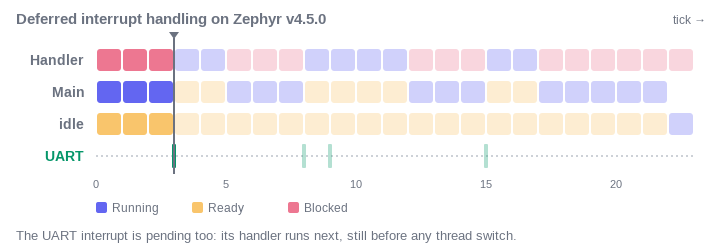
Simulated kernel: Zephyr v4.5.0. This scenario and every other one are in the scheduler playground. The simulator and its data files are not covered by the site's CC BY-SA license; see their license notices.
This walkthrough follows one interrupt through the Zephyr source, from the handler’s give to the thread switch on the way out of the interrupt. The interrupts lesson explains the idea. Set the step level to Line and jump to tick 3.
The application connects its handler when main() runs and keeps it to one line:
void uart_isr(const void *arg)
{
    k_sem_give(&S);
}

int main(void)
{
    IRQ_CONNECT(UART_IRQ, 2, uart_isr, NULL, 0);
    irq_enable(UART_IRQ);
    return 0;
}
On most hardware IRQ_CONNECT() places the handler in the interrupt vector table when the image is
built; on native_sim it registers the handler when main() runs. Unlike FreeRTOS, there is no
separate ISR form of k_sem_give(): the same call is safe in a thread and in an ISR.
The interrupt loop
The simulator follows the native_sim board, where interrupts are delivered by
posix_irq_handler(). On a Cortex-M the code is different (each interrupt has its own vector, and
the exit path is z_arm_int_exit()), but it makes the same decision at the same point.
void posix_irq_handler(void)
{
	uint64_t irq_lock;
	int irq_nbr;
	static int may_swap;

	irq_lock = hw_irq_ctrl_get_current_lock();

	if (irq_lock) {
		/* "spurious" wakes can happen with interrupts locked */
		return;
	}

	irq_nbr = hw_irq_ctrl_get_highest_prio_irq();

	if (irq_nbr == -1) {
		/* This is a phony interrupt during a busy wait, no need for more */
		return;
	}

	if (_kernel.cpus[0].nested == 0) {
		may_swap = 0;
	}

	_kernel.cpus[0].nested++;

	do {
		int last_current_running_prio = hw_irq_ctrl_get_cur_prio();
		int last_running_irq = currently_running_irq;

		hw_irq_ctrl_set_cur_prio(hw_irq_ctrl_get_prio(irq_nbr));
		hw_irq_ctrl_clear_irq(irq_nbr);

		currently_running_irq = irq_nbr;
		vector_to_irq(irq_nbr, &may_swap);
		currently_running_irq = last_running_irq;

		hw_irq_ctrl_set_cur_prio(last_current_running_prio);
	} while ((irq_nbr = hw_irq_ctrl_get_highest_prio_irq()) != -1);

	_kernel.cpus[0].nested--;

	/* Call swap if all the following is true:
	 * 1) may_swap was enabled
	 * 2) We are not nesting irq_handler calls (interrupts)
	 * 3) Next thread to run in the ready queue is not this thread
	 */
	if (may_swap
		&& (hw_irq_ctrl_get_cur_prio() == 256)
		&& (_kernel.ready_q.cache) && (_kernel.ready_q.cache != _current)) {

		(void)z_swap_irqlock(irq_lock);
	}
}boards/native/native_sim/irq_handler.c, lines 67–120 · Zephyr v4.5.0 · Apache-2.0 license
At tick 3 two interrupts are pending: the system timer and the UART. The do … while loop handles
them in order of priority:
vector_to_irq()calls the timer driver’s handler, which announces the tick (sys_clock_announce()): the tick count becomes 3. The only entry due isMain’s time-slice timer; no other thread of priority 13 is ready, soMainsimply gets a new slice.- The UART is still pending, so the loop goes round and calls
uart_isr(). - Each ordinary handler sets
may_swap. After the loop, if this is the outermost interrupt and the scheduler’s cache,_kernel.ready_q.cache, holds a different thread from the one that was interrupted,z_swap_irqlock()switches to it.
That last check is the only place where an interrupt leads to a thread switch. Every handler can change which thread should run; none of them switches.
k_sem_give in a handler
void z_impl_k_sem_give(struct k_sem *sem)
{
	struct k_spinlock *lock = sem_spinlock_get(sem);
	k_spinlock_key_t key = k_spin_lock(lock);
	bool resched;

	SYS_PORT_TRACING_OBJ_FUNC_ENTER(k_sem, give, sem);

	if (z_sched_wake(&sem->wait_q, 0, NULL)) {
		resched = true;
	} else {
		sem->count += (sem->count != sem->limit) ? 1U : 0U;
		resched = sem_handle_poll_events(sem);
	}

	if (unlikely(resched)) {
		z_reschedule(lock, key);
	} else {
		k_spin_unlock(lock, key);
	}

	SYS_PORT_TRACING_OBJ_FUNC_EXIT(k_sem, give, sem);
}kernel/sem.c, lines 116–138 · Zephyr v4.5.0 · Apache-2.0 license
Handler waits in S’s wait queue, so z_sched_wake() takes it out, hands it the semaphore (the
count stays 0, as explained in the semaphores lesson), and makes it ready.
Making a thread ready updates the cache: Handler is more urgent than Main, and Main is
preemptible, so the cache now points at Handler.
Then z_reschedule() is called, as after any give that woke a thread:
static void reschedule(struct k_spinlock *lock, k_spinlock_key_t key)
{
	if (resched(key.key) && need_swap()) {
		z_swap(lock, key);
	} else {
		signal_pending_ipi();
		k_spin_unlock(lock, key);
	}
}kernel/sched.c, lines 403–411 · Zephyr v4.5.0 · Apache-2.0 license
resched() is false inside an ISR (arch_is_in_isr()), so the function only releases the lock.
In a thread, the same call would have switched to Handler on the spot. Here the switch waits for
the end of posix_irq_handler(), which finds the cache changed and swaps. Handler runs during
tick 3.
Nothing to forget
Compare this with FreeRTOS, where the handler must end with portYIELD_FROM_ISR() and forgetting it
delays the woken task by up to a tick (see the FreeRTOS walkthrough).
In Zephyr the interrupt exit always asks the scheduler, so there is no such mistake to make, and the
simulator offers no Yield from ISR switch for Zephyr.
The price is paid elsewhere: the check runs on every interrupt exit, including the many interrupts that wake nobody. It is cheap, a comparison of two pointers, because the cache is kept up to date whenever a thread becomes ready.
A give that finds the semaphore given
Set Handler urgency to 1. Main is now more urgent and keeps the CPU until tick 14, so nobody
waits for S. The interrupt at tick 3 raises the count to 1. The ones at 8 and 9 find it at its
limit of 1, and k_sem_give() leaves it there: those two events are lost. The event log still
shows the gives, because the call itself succeeded; it simply has nowhere to put a second event.