Eclipse ThreadX
v6.5.0.202601_relFeatures
-
Picokernel architecture eliminates unnecessary function call overhead by plugging services directly into the core.
-
Preemption-threshold scheduling reduces context switches and helps guarantee system schedulability.
-
Automatic scaling ensures only the services used by the application are included in the final link-time image.
-
Symmetric Multiprocessing (SMP) support provides dynamic load balancing across multiple processor cores.
-
ThreadX Modules enable dynamic loading of application threads with optional MPU/MMU memory protection.
-
Event chaining allows applications to register notify callbacks for every communication or synchronization object.
-
Sub-microsecond context switching and fast boot times in fewer than 120 cycles for high-performance requirements.
-
Full determinism ensures consistent performance regardless of the number of threads in the ready state.
-
Execution Profile Kit (EPK) provides real-time performance metrics and system event tracing.
-
Separate interrupt stack management reduces the RAM footprint required for individual thread stacks.
-
MISRA-C: 2004 and 2012 compliance for safety-critical and industrial-grade software development.
-
Adaptation layers provide compatibility for legacy APIs including FreeRTOS, POSIX, and OSEK.
-
Advanced memory management includes both fixed-size block pools and variable-size byte pools.
-
Priority-based preemptive scheduling supports up to 1024 priority levels for complex task management.
-
Run-time stack analysis detects and prevents stack overflow conditions during execution.
Eclipse ThreadX is designed with a non-layered picokernel architecture, where services are integrated directly into the core rather than being built in layers. This design minimizes function call overhead and results in a highly efficient, small-footprint kernel (as small as 2KB instruction area). The system is highly modular, utilizing automatic scaling to ensure that only the specific services invoked by the application are included in the final binary image.
The architecture supports both Asymmetric Multiprocessing (AMP) and Symmetric Multiprocessing (SMP). In SMP mode, the kernel performs dynamic load balancing across available cores while allowing all resources, such as queues and semaphores, to be accessed by any thread on any core. For security and reliability, the ThreadX Modules subsystem allows for the dynamic loading of code into separate address spaces, protected by hardware Memory Protection Units (MPU) or Memory Management Units (MMU).
Core Components
- Thread Manager: Handles priority-based preemptive and cooperative scheduling.
- Communication Objects: Includes message queues, counting semaphores, and mutexes with priority inheritance.
- Event Flags: Provides synchronization through logical AND/OR combinations of event bits.
- Memory Pools: Manages both fixed-block and variable-byte memory allocation.
- Timer Management: High-resolution software timers and optimized interrupt processing.
Use Cases
This RTOS is ideal for:
- Industrial Automation: High-reliability control systems requiring MISRA compliance and TÜV safety certifications.
- Consumer Electronics: Resource-constrained devices like printers and wearables that benefit from a 2KB minimal footprint.
- Medical Devices: Safety-critical applications requiring deterministic response times and memory protection.
- IoT Gateways: Multicore systems utilizing SMP for dynamic load balancing and complex networking stacks.
Getting Started
To begin developing with Eclipse ThreadX, it is recommended to use the CMake-based build system which supports various toolchains including the Arm GNU Toolchain, IAR, and AC6. Developers should start by defining system-wide configurations in a tx_user.h file, using the provided tx_user_sample.h as a template. The repository includes a samples/ directory containing demo_threadx.c, which demonstrates basic thread creation and IPC usage. Comprehensive documentation is available in the docs/ folder and the official Eclipse ThreadX Documentation repository.
Related Projects
View All Projects →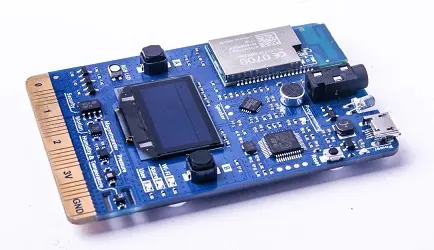
Eclipse ThreadX IoT DevKit Starter Application
A foundational starter application for the MXChip AZ3166 IoT DevKit based on the Eclipse ThreadX RTOS and NetX Duo network stack. It provides a preconfigured environment for the STM32F412RG MCU, enabling WiFi connectivity and peripheral access for embedded IoT development.
JsonX — Lightweight Embedded JSON Serializer
A declarative C mapping layer for the cJSON library specifically optimized for embedded systems. It provides structured serialization and parsing with native support for ThreadX, FreeRTOS, and bare-metal environments using a low-footprint memory model.
Speech2Touch
An embedded voice-to-touch conversion system for the Franke A600 coffee machine. Built on the STM32WB55 MCU using Azure RTOS (ThreadX/USBX) and Picovoice, it translates voice commands into USB HID touch events to automate beverage selection.
STM32CubeN6 MCU Firmware Package
A comprehensive embedded software platform for the STM32N6 series microcontrollers. It provides HAL and LL drivers, CMSIS modules, and a full middleware stack featuring Azure RTOS (ThreadX), USBX, and FileX. The package includes numerous examples and applications for STM32N6 evaluation and Nucleo boards.
Eclipse ThreadX USBX
A high-performance USB host, device, and on-the-go (OTG) stack fully integrated with the Eclipse ThreadX RTOS. It provides a small-footprint solution for deeply embedded applications requiring USB connectivity across various hardware architectures including ARM Cortex-M, Renesas, and NXP microcontrollers.
X-CUBE-AZRTOS-F4 Azure RTOS Software Expansion for STM32Cube
A comprehensive software expansion package for the STM32F4 series that integrates the Microsoft Azure RTOS suite into the STM32Cube ecosystem. It provides a full middleware stack including ThreadX, NetXDuo, FileX, LevelX, and USBX, optimized for STM32 microcontrollers.
X-CUBE-AZRTOS-F7 Azure RTOS Software Expansion for STM32Cube
A comprehensive software expansion package that integrates the Microsoft Azure RTOS suite with the STM32F7 series of microcontrollers. It provides a full middleware stack including ThreadX, NetXDuo, FileX, LevelX, and USBX, along with ready-to-run examples for STM32F7 evaluation boards.
X-CUBE-AZRTOS-G0: Azure RTOS Software Expansion for STM32Cube
A comprehensive software expansion package for the STM32G0 series, integrating Microsoft Azure RTOS into the STM32Cube ecosystem. It provides a full suite of middleware including ThreadX, NetXDuo, FileX, LevelX, and USBX, along with hardware-specific drivers and ready-to-run examples for evaluation boards.