RTIC
v2.3.0Features
-
Hardware-accelerated task scheduling using the system’s interrupt controller.
-
Support for both event-triggered tasks and software-spawned tasks.
-
Message passing mechanism for transferring data to software tasks at spawn time.
-
Integrated timer queue for scheduling tasks with specific delays or periodic execution.
-
Preemptive multitasking based on user-defined task priorities.
-
Data race free memory sharing via fine-grained, priority-based critical sections.
-
Compile-time guarantees for deadlock-free execution using Stack Resource Policy (SRP).
-
Highly efficient memory management where all tasks share a single call stack.
-
Zero-cost abstractions with a minimal software footprint for the scheduler.
-
No hard dependency on a dynamic memory allocator (heapless operation).
-
Full support for the entire ARM Cortex-M microcontroller family.
-
Support for most RISC-V devices with specific backend implementations.
-
Amenability to formal Worst Case Execution Time (WCET) and scheduling analysis.
-
Integration with Rust’s ownership and type system for safety guarantees.
-
Support for QEMU and ESP32 environments for testing and simulation.
Architecture
RTIC is built on the Real-Time For the Masses (RTFM) framework, utilizing a declarative syntax to define tasks and resources. Its architecture is unique in that it lacks a traditional software-based scheduler; instead, it leverages the hardware’s Nested Vectored Interrupt Controller (NVIC) or equivalent to manage task preemption and execution. This hardware-centric approach ensures that context switching occurs with the lowest possible latency, as the hardware itself handles the saving and restoring of registers.
The system operates on the Stack Resource Policy (SRP), which allows all tasks to share a single call stack safely. By assigning static priorities to tasks and using priority ceilings for shared resources, RTIC guarantees at compile-time that deadlocks cannot occur and that data races are impossible. This design makes the system highly predictable and amenable to Worst Case Execution Time (WCET) analysis.
Core Components
- Task Dispatcher: Maps software and hardware tasks to specific interrupt vectors for hardware-accelerated scheduling.
- Resource Manager: Implements priority-based critical sections for safe data sharing between tasks of different priorities.
- Timer Queue: Manages scheduled and periodic tasks using hardware timers to trigger software tasks in the future.
- Message Queue: Facilitates asynchronous data transfer between tasks at the moment they are spawned.
Use Cases
This RTOS is ideal for:
- Industrial Automation: Managing high-speed sensor data and actuator control with strict timing requirements.
- Safety-Critical Systems: Applications requiring formal guarantees against deadlocks and memory corruption at compile time.
- Battery-Powered Devices: Systems needing minimal CPU overhead to maximize sleep cycles and energy efficiency through hardware-driven wakeups.
- Automotive Sensors: Processing CAN bus or LIN bus signals where predictable latency and high reliability are mandatory.
- Medical Instrumentation: Real-time monitoring where deterministic behavior and memory safety are paramount.
- Digital Signal Processing: Handling high-frequency interrupts for audio or radio frequency applications with minimal jitter.
Getting Started
To begin developing with RTIC, developers should first install the Rust toolchain and the appropriate target support for their hardware (e.g., thumbv7m-none-eabi). The primary entry point for documentation is the RTIC Book (https://rtic.rs), which provides a comprehensive guide from basic task spawning to advanced resource management. Projects are typically structured using the #[rtic::app] attribute, which allows developers to define local and shared resources along with task functions that respond to hardware interrupts. For rapid prototyping and testing, the framework supports QEMU and provides an xtask based workflow for running continuous integration checks and formatting locally.
Related Projects
View All Projects →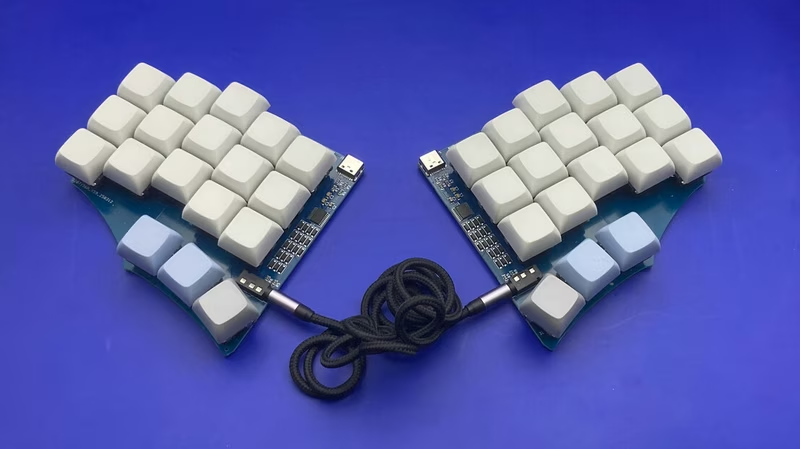
Smart Keymap
A library for building advanced keyboard firmware that uses the Nickel configuration language to define complex keymap behaviors. It supports Rust-based firmware using the RTIC and Embassy frameworks, as well as C-based firmware for WCH RISC-V microcontrollers. The project enables sophisticated features like layers, tap-hold keys, and chords across various hardware platforms including RP2040, STM32F4, and CH32X.
Modular Music CV/Gate Sequencer for STM32
A modular music CV/Gate sequencer built for the STM32F103C8 (Blue Pill) using the Rust programming language and the RTIC framework. It features a custom Cherry MX keypad interface, dual MCP4921 DACs for control voltage output, and WS2812 LED support for visual feedback.
Pico RTIC Template
A Rust-based project template for the Raspberry Pi Pico (RP2040) using the Real-Time Interrupt-driven Concurrency (RTIC) framework. It provides a pre-configured environment with advanced debugging tools and examples for timer-based tasks and GPIO interrupts.
pinetime-rs
A Rust-based firmware for the PineTime smartwatch utilizing the RTIC (Real-Time Interrupt-driven Concurrency) framework. It targets the nRF52832 microcontroller and includes drivers for the ST7789 display and external SPI flash.
Pomia-rs
A Rust-based firmware project for the STM32F103C8T6 microcontroller using the RTIC framework. It demonstrates hardware integration including an ST7735 LCD, BME280 environmental sensor, and PWM-based audio generation.
Rauk - RTIC Analysis Using KLEE
Rauk is a measurement-based Worst-Case Execution Time (WCET) analysis tool for RTIC applications targeting ARM Cortex-M microcontrollers. It utilizes the KLEE symbolic execution engine to automatically generate test vectors that ensure full path coverage of user tasks for hardware-in-the-loop timing measurements.
Retro Nixie Clock
A Rust-based Nixie clock firmware for the STM32F103 'BluePill' microcontroller using the RTIC framework. It drives Nixie valves via a BCD-to-decimal decoder and provides a secondary display on an I2C OLED, utilizing the STM32's internal RTC for timekeeping.
RTIC Blinky for nRF52840
A basic blinky application implemented for the nRF52840 microcontroller using the RTIC (Real-Time Interrupt-driven Concurrency) framework. It demonstrates hardware-driven LED toggling using the nRF52840's timer peripheral on the nRF52840-DK development kit.