Wireguard FPGA
An open-source, FPGA-based implementation of the Wireguard VPN protocol designed for wire-speed data tunneling. It utilizes a hardware-software SoC architecture featuring a RISC-V control plane and an RTL-accelerated data plane targeting Artix-7 FPGA platforms.
Overview
Wireguard FPGA is an ambitious open-source project that brings the modern, secure Wireguard VPN protocol to hardware acceleration. While software implementations of Wireguard are widely available, they often struggle to reach wire-speed performance on standard hardware. Conversely, existing hardware solutions are frequently proprietary and expensive. This project bridges that gap by providing a transparent, FPGA-based System-on-Chip (SoC) designed for high-performance secure networking.
The project implements a complete Wireguard node as an IP router. It is built around a two-layer architecture: a control plane for managing sessions and handshakes, and a data plane for wire-speed cryptography and routing. By leveraging open-source tools and ubiquitous hardware like the Artix-7 FPGA, Wireguard FPGA makes high-speed VPN technology accessible to researchers and developers alike.
Hardware-Software Architecture
The system is partitioned to maximize efficiency. The Control Plane runs on a soft RISC-V CPU. This layer is responsible for the complex logic of the Wireguard protocol, including managing remote peers, executing handshakes, and handling key rotation. The software is written in bare-metal C and utilizes several cryptographic primitives such as Curve25519 for key exchange and BLAKE2s for hashing.
The Data Plane is implemented entirely in RTL (Verilog/SystemVerilog) to ensure maximum throughput. It handles the heavy lifting of the network traffic, including:
- ChaCha20-Poly1305 Encryptor/Decryptor: High-speed symmetric encryption and authentication.
- IP Lookup Engine: Pipelined routing and forwarding table lookups.
- Packet Assembler/Disassembler: Encapsulating and decapsulating tunneled traffic.
- 1G MAC & PHY Controller: Interfacing with physical Ethernet ports.
Technical Implementation and Tooling
One of the most notable aspects of Wireguard FPGA is its reliance on a modern, open-source toolchain. The project integrates several cutting-edge technologies to streamline development:
- PipelineC: An HLS-like tool used to move cryptography blocks from C to hardware gates.
- PeakRDL: Used for generating Control and Status Registers (CSR) and their associated software abstraction layers (HAL).
- VProc: A virtual processor co-simulation element that allows for high-speed simulation of the RISC-V software alongside the HDL logic.
- OpenXC7: An open-source toolchain for Xilinx Series 7 FPGAs, ensuring the project remains free from proprietary tool lock-in.
Simulation and Validation
To manage the complexity of a hardware-software SoC, the project employs a sophisticated simulation environment. The test bench supports both full HDL simulation (using RTL cores like PicoRV32 or Ibex) and co-simulation using the VProc virtual processor. This flexibility allows developers to verify software logic against hardware models with significantly faster iteration times than traditional RTL simulation.
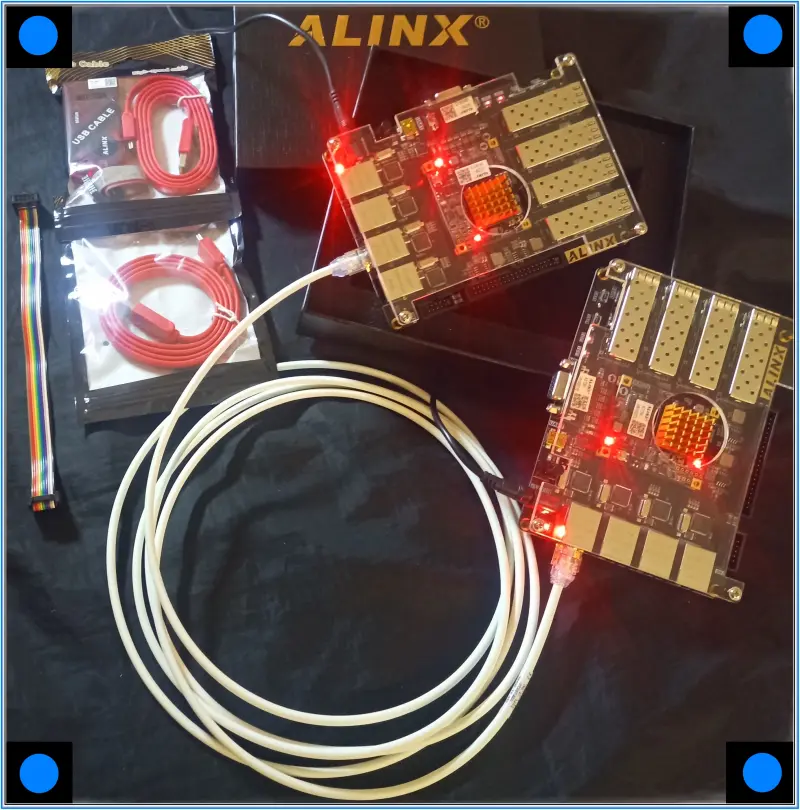
For real-world validation, the project targets the Alinx AX7201 development board, which features four 1000Base-T ports. This setup allows for at-speed testing of VPN tunnels between multiple nodes, demonstrating the system’s capability as a functional, self-sufficient network appliance.
Project Status and Future Goals
Currently in its first phase, the project serves as a robust proof-of-concept. The development team has successfully achieved board bring-up, implemented the basic Wireguard datapath, and integrated the RISC-V control plane. Future phases aim to increase the number of supported channels, optimize timing closure using open-source tools, and provide user-friendly management interfaces. By maintaining a well-documented and open repository, Wireguard FPGA invites the community to contribute to the future of open-source secure networking hardware.