Swift Examples for STM32C011
A collection of example projects demonstrating the use of Embedded Swift on the STM32C011 microcontroller. It targets the STM32C0116-DK development kit, showcasing hardware interaction through direct register access and the swift-mmio library for tasks like LED blinking, ADC joystick input, and USART communication.
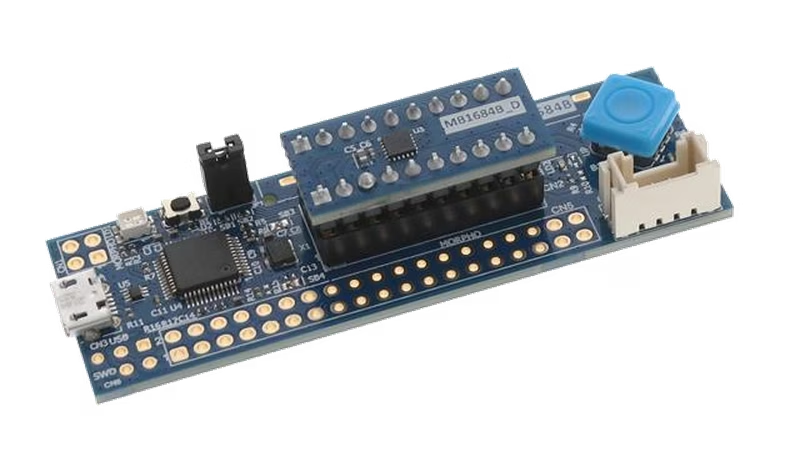
The evolution of Swift has brought it to the world of microcontrollers through the “Embedded Swift” feature introduced in Swift 6.0. This repository provides a practical look at how to leverage this modern, safety-focused language on the STM32C011, a cost-effective ARM Cortex-M0+ microcontroller. Specifically designed for the STM32C0116-DK development kit, these examples demonstrate that Swift can operate efficiently in resource-constrained environments with as little as 6 KiB of SRAM and 32 KiB of flash.
Direct Hardware Interaction
One of the most interesting aspects of this project is how it handles hardware peripherals without a traditional operating system or a heavy abstraction layer. The examples are split into two categories: a simple demo and MMIO-based demos. The simple blink demo shows how Swift can interact with hardware using no dependencies other than the Swift toolchain itself, while the MMIO demos utilize the swift-mmio library. This library allows for type-safe register access, generated from SVD (System View Description) files, ensuring that hardware interactions are both performant and less prone to common memory-mapping errors.
Exploring the Examples
The repository includes several distinct projects that cover common embedded tasks:
- Blink: The classic “Hello World” of hardware, available in both a dependency-free version and a version using MMIO for register definitions.
- Joystick: This demo utilizes the 5-way joystick on the STM32C0116-DK. It reads the joystick’s position via ADC (Analog-to-Digital Converter) and adjusts the LED blinking rate accordingly, demonstrating real-time analog input processing.
- USART: A communication demo that enables printing to and receiving characters from USART2. It even flashes an LED to indicate serial activity, providing a foundation for building interactive command-line interfaces on embedded devices.
Technical Foundation
Under the hood, the build process is managed by Makefiles that orchestrate the Swift compiler, the ARM GNU Toolchain, and Clang. It uses a custom linker script (STM32C011F6.ld) and targets the arm-none-eabi architecture. To keep the binary size minimal, the project links against newlib-nano and nosys, ensuring the resulting firmware fits comfortably within the STM32C011’s flash memory.
For developers looking to dive in, the project supports multiple environments. While it can be built natively on macOS and various Linux distributions (including WSL2), it also includes a VS Code Dev Container configuration. This pre-configured environment ensures that all necessary tools—like the specific Swift 6.1 toolchain and stlink utilities—are ready to use immediately, lowering the barrier to entry for Swift developers curious about the embedded space.
Integrating with the STM32 Ecosystem
These examples rely on the swift-stm32c011 library for common functionality. This library is particularly noteworthy because it uses the SVD2Swift tool to generate register definitions directly from a patched SVD file for the STM32C011. This approach highlights a modern workflow for embedded development: using automated tools to create safe, high-level interfaces for low-level hardware registers, all while maintaining the performance characteristics required for Cortex-M0+ devices.