STM32 Pocket Game/Dev Console
An open-source handheld console based on the STM32F042 microcontroller, featuring a 2.4-inch SPI TFT display and programmable inputs. It is designed for portability with 2xAAA batteries and serves as a versatile platform for gaming or data acquisition projects.
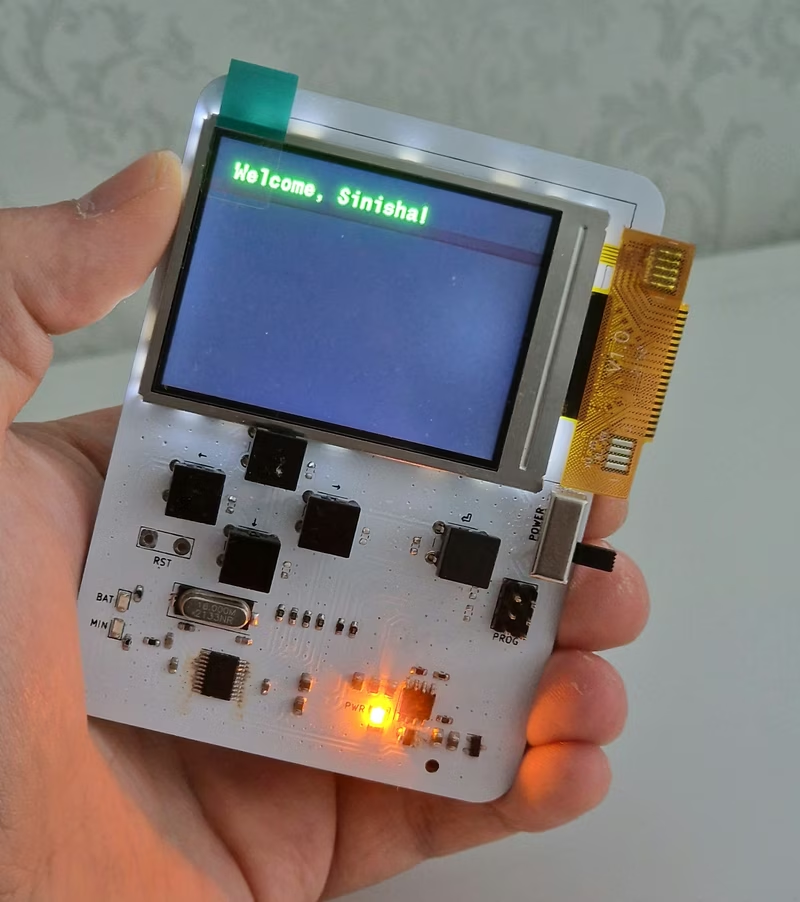
The STM32 Pocket Game/Dev Console is a compact, handheld platform designed for developers and hobbyists looking to explore embedded systems through gaming or portable utility applications. Built around the STM32F042 microcontroller, this device packs essential user interface components into a 97x70mm footprint, making it an ideal candidate for custom firmware experimentation and portable project development.
Hardware Overview
The console’s hardware is centered on a 2.4-inch SPI TFT display with a resolution of 320x240 pixels, providing a crisp output for games or data visualization. For user interaction, the board includes five programmable buttons and two status LEDs. One of the more thoughtful design features is the integrated battery voltage monitoring; by using the STM32’s analog-to-digital converter (ADC), the device can track the remaining life of its two AAA batteries, allowing developers to implement low-power alerts or shutdown routines.
Originally, the board utilized a TagConnect interface for programming, which is excellent for production but can be a barrier for hobbyists. The design was subsequently updated to feature a standard 2.54mm pitch connector, significantly enhancing programming flexibility. This change ensures that the board is compatible with a wide range of common SWD programmers, including the ST-Link, J-Link, and affordable DAPLINK adapters.
Technical Architecture
From a software perspective, the project is built on the STM32 Hardware Abstraction Layer (HAL) and the CMSIS standard. This choice provides a robust foundation for managing hardware peripherals like SPI for the display and ADC for battery sensing. The firmware build system is managed via a standard Makefile and the arm-none-eabi GCC toolchain, making it accessible to developers who prefer a command-line workflow over heavy IDEs.
The project utilizes the STM32Cube F0 firmware package, which simplifies the configuration of the STM32F042’s internal clocks and peripheral routing. Because it uses standard C libraries and a common toolchain, it is relatively straightforward to port existing C-based game engines or sensor libraries to the platform.
Customization and Development
The STM32 Pocket Console is positioned as an evolving platform. While the core hardware is stable, the project remains open for software contributions and testing. Its compact size and straightforward peripheral set make it highly adaptable. Developers can use it as a dedicated handheld game console, a portable terminal for interacting with other hardware via serial, or a mobile data logger.
For those interested in manufacturing their own units, the project includes complete Gerber files. The board was designed with manufacturing in mind, fitting within standard low-cost PCB production tiers while maintaining high quality. Whether you are looking to build a custom game or a portable dev tool, the STM32 Pocket Console offers a well-documented and accessible starting point.