SolArk Live Data Interceptor
An ESP8266-based serial sniffer designed to intercept and parse real-time power metrics from SolArk solar inverters. It bypasses cloud latency by extracting data directly from the inverter's internal communication bus for high-granularity local automation.
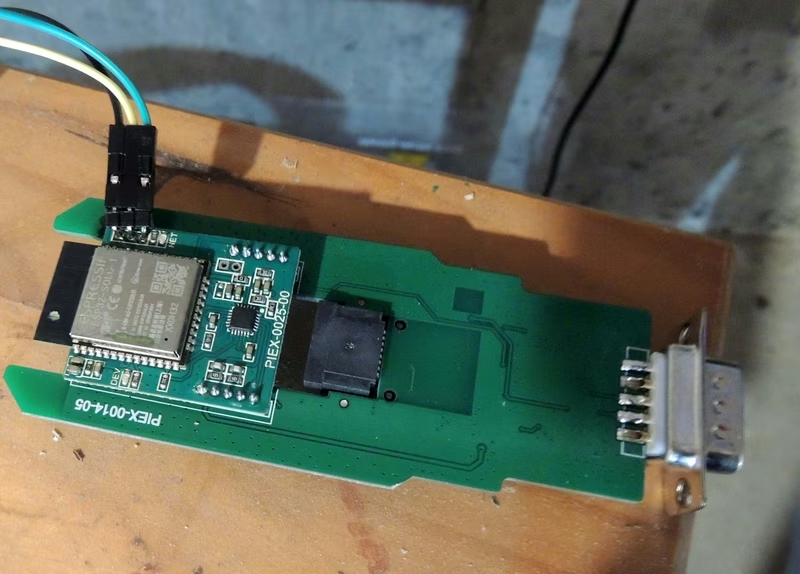
Monitoring solar energy systems often involves a trade-off between convenience and data granularity. While manufacturers like SolArk provide cloud-based monitoring, these platforms frequently suffer from update delays and coarse resolution. The SolArk Live Data Interceptor project addresses this by tapping directly into the serial communication stream between the inverter and its official WiFi dongle.
By intercepting the internal protocol, this project enables real-time data access with much finer granularity than the official cloud portal. This capability is essential for responsive home automation, such as adjusting EV charging speeds based on instantaneous solar production or managing battery discharge states with high precision.
Hardware Integration
The hardware setup involves connecting a microcontroller, specifically an ESP8266 (such as a D1 Mini), to the internal serial header found inside the SolArk WiFi dongle shell. The physical implementation requires some finesse; the pin header on the dongle uses a non-standard 0.2 mm spacing, which is tighter than the ubiquitous 0.1-inch (2.54 mm) pitch found on most hobbyist electronics. A clever physical hack involves bending the pins of a standard header inward to friction-fit the holes, allowing for a reliable connection without permanent soldering.
Since the communication uses 3.3V logic levels, it is directly compatible with the ESP8266. The TX and RX lines from the dongle-inverter link are routed to the microcontroller’s digital pins (e.g., D7 and D8), allowing the device to “sniff” the packets without disrupting the dongle’s normal operation of reporting to the manufacturer’s servers.
Protocol and Data Parsing
The communication between the inverter and the dongle consists of a constant stream of ASCII-encoded hexadecimal strings. Through reverse-engineering and comparison with known cloud reports, the project identifies specific substrings that correspond to critical system metrics. To extract usable numbers, the software converts these hex values into bytes or two-byte words, often employing 2’s complement math to handle signed values like battery charging versus discharging.
Key data points extracted include:
- Grid Power: Real-time consumption from or export to the utility.
- Battery Metrics: State of charge (percentage) and battery power flow.
- Load Power: Total household consumption.
- Solar Production: Individual power output for multiple PV strings.
Software Implementation
The Arduino sketch leverages the ESP8266’s WiFi capabilities to serve the parsed data locally. Because the ESP8266 has limited hardware serial resources, the project utilizes a web-based interface for both data delivery and debugging. The sketch serves a lightweight web page containing a delimited list of values, which can be easily polled by other local services.
This data is typically consumed by external systems for long-term logging or sophisticated energy management. For example, users can pipe the data into a MySQL database to generate detailed graphs that far exceed the resolution provided by standard manufacturer tools. This allows for sub-second response times when managing high-load appliances like circulator pumps or EV chargers.
Protocol Evolution and Compatibility
It is important to note that this method relies on an undocumented internal protocol. As of late 2025, SolArk introduced firmware updates that significantly restructured the internal serial data format, including changes to packet encapsulation and handling. Because these internal interfaces are not officially supported for third-party access, the project highlights the challenges of maintaining local integrations in the face of proprietary firmware updates. For those on compatible firmware, it remains a powerful tool for unlocking the full potential of their solar hardware.