Multi-Modal AI Assistant on Raspberry Pi 5
A fully offline, edge AI assistant for the Raspberry Pi 5 integrating local LLM (Gemma 3), YOLOv8 object detection, and RAG-based memory. It features a hardware interface with an OLED display, physical buttons for control, and voice interaction via Vosk STT and espeak TTS.
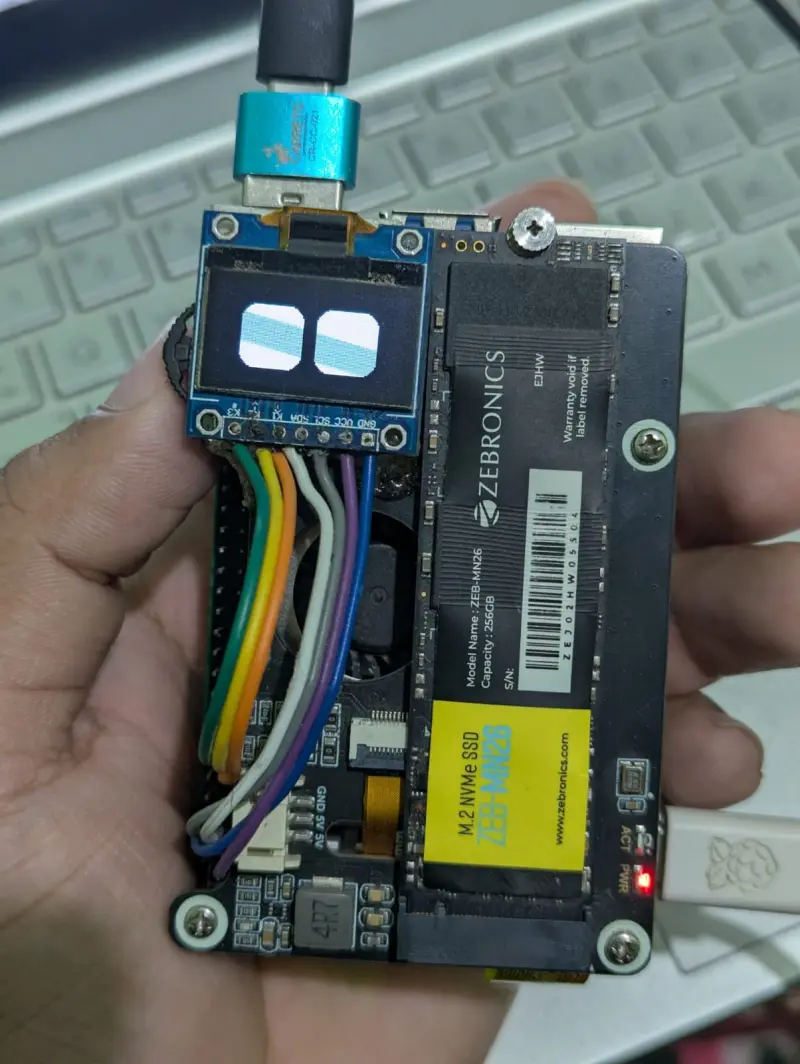
The Multi-Modal AI Assistant is a sophisticated edge computing project that transforms the Raspberry Pi 5 into a fully autonomous, offline intelligent agent. By integrating local Large Language Models (LLMs), computer vision, and voice processing, the system provides a private and responsive AI experience without relying on external cloud APIs or internet connectivity.
The system is built around a hardware-centric design, utilizing the Raspberry Pi 5’s increased processing power to handle demanding AI workloads. Interaction is handled through a physical interface consisting of an SSD1306 OLED display and three GPIO-connected push buttons, allowing for a tactile user experience that bypasses the need for a traditional terminal or keyboard.
Multi-Threaded Architecture
To maintain responsiveness, the assistant employs a multi-threaded architecture. A dedicated button listener thread polls GPIO pins at 10ms intervals, ensuring low-latency event detection. Simultaneously, an animation thread manages the OLED display, rendering “idle eyes” to give the assistant a personality. The main thread acts as the controller, orchestrating events between the various AI subsystems.
Intelligent Modalities
The assistant operates in three primary modes, each mapped to a physical button:
- LLM Conversation (K1): Utilizing a quantized Gemma 3 4B model via
llama-cpp-python, the assistant engages in natural language dialogue. It uses Vosk for offline speech-to-text and espeak for text-to-speech. Interaction is handled via push-to-talk logic. - Object Detection (K2): The system leverages YOLOv8 Nano to identify objects in the environment. When triggered, it captures a frame from the Pi Camera, runs inference, and announces the detected object through the speaker and OLED.
- Image Capture (K3): A utility mode for saving timestamped JPEG images to local storage, providing visual confirmation on the display.
Retrieval-Augmented Generation (RAG)
One of the standout features is the implementation of local RAG. Using ChromaDB and the all-MiniLM-L6-v2 sentence transformer, the assistant maintains a persistent memory of past conversations and a local knowledge base. When a user asks a question, the system retrieves relevant context to augment the LLM prompt, significantly reducing hallucinations and providing a more personalized experience. This memory is persisted locally, ensuring that the assistant “remembers” previous interactions even after a reboot.
Performance on the Edge
Optimized for the 4GB Raspberry Pi 5, the system balances model quantization and memory usage. The Gemma 3 4B model is run using 4-bit quantization (IQ4_XS), allowing it to fit within the Pi’s RAM while maintaining a generation rate of 5-10 tokens per second. This makes the Raspberry Pi 5 a viable platform for sophisticated, multi-modal AI applications that were previously reserved for desktop-class hardware.
Technical Implementation
The project is written in Python and leverages several key libraries for its operation:
# Example of the event-driven controller logic
def handle_event(self, event):
    if event.type == ButtonEvent.K1_HOLD:
        self.recorder.start_recording()
    elif event.type == ButtonEvent.K1_RELEASE:
        audio_path = self.recorder.stop_recording()
        text = self.stt.transcribe(audio_path)
        response = self.llm.generate(text)
        self.tts.speak(response)
By combining specialized hardware interfaces with modern AI frameworks, this project demonstrates the potential for private, secure, and capable AI assistants that operate entirely on local hardware.