Mobile Mecanum 4WD Robot
A comprehensive robotics project featuring a 4WD mobile platform equipped with omnidirectional Mecanum wheels. It utilizes a dual-controller architecture with a Raspberry Pi running ROS1/ROS2 and an Arduino Mega for low-level motor control and sensor interfacing. The system implements PID control for precise movement and supports joystick operation via a ROS-based communication bridge.
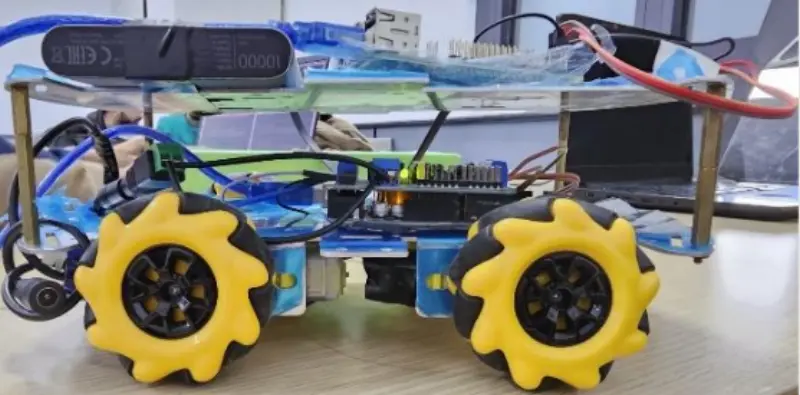
Overview
The Mobile Mecanum 4WD Robot is an advanced robotics platform designed for research, education, and industrial automation. By utilizing four omnidirectional Mecanum wheels, the robot achieves seamless movement in any direction without changing its orientation. This project integrates high-level processing with low-level hardware control, bridging the gap between ROS1 and ROS2 environments to provide a robust and flexible development platform.
Hardware Architecture
The robot’s physical layer is built upon a versatile component stack designed for reliability and performance:
- Processing Units: A Raspberry Pi 3 Model B+ handles high-level logic and ROS communication, while an Arduino Mega manages real-time motor control and sensor data acquisition.
- Sensing: An MPU6050 Inertial Measurement Unit (IMU) provides gyroscopic and accelerometer data for internal state estimation and orientation tracking.
- Actuation: Four DC motors driven by a specialized motor shield provide the torque necessary for the Mecanum drive system.
- Power: The system is powered by a combination of a dedicated battery for the motors and a power bank for the logic controllers.
Software and Control Systems
The software architecture is a hybrid system that leverages the strengths of both ROS1 (Noetic) and ROS2 (Foxy). A critical component of this project is the implementation of the ros1_bridge, which allows nodes from different ROS versions to communicate seamlessly. This enables the use of legacy ROS1 packages alongside modern ROS2 features.
Motion Control and Kinematics
At the heart of the robot’s movement is a sophisticated control loop. The system employs a PID (Proportional-Integral-Derivative) controller to regulate angular velocities and ensure precise trajectory following. The kinematic model translates desired velocity commands (linear x, linear y, and angular z) into individual wheel speeds, accounting for the unique geometry of the Mecanum drive.
Teleoperation and Simulation
For user interaction, the project supports joystick control, providing an intuitive interface for manual navigation. Beyond physical hardware, the project includes support for Gazebo and RVIZ, allowing developers to simulate the robot’s behavior in a virtual environment before deploying code to the actual chassis. This simulation-first approach is vital for testing PID tuning and sensor fusion algorithms without risking hardware damage.
Technical Implementation
The project is divided into several functional nodes:
- Kinematic Node: Handles the mathematical transformations for omnidirectional motion.
- IMU Node: Processes raw data from the MPU6050 to provide Euler angles and orientation.
- PID Node: Manages the closed-loop feedback system to maintain speed accuracy.
- Bridge Node: Facilitates communication between the Raspberry Pi (ROS2) and the Arduino (ROS1/Serial).
By combining these elements, the Mobile Mecanum 4WD Robot serves as a powerful example of modern embedded systems integration, showcasing how different hardware and software ecosystems can be unified into a single, cohesive robotic platform.